
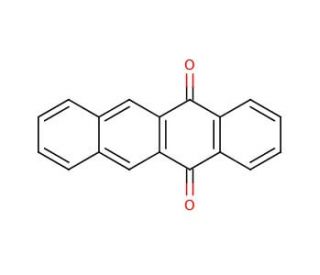

Molecular structure of 5,12-Naphthacenequinone, CAS Number: 1090-13-7
5,12-Naphthacenequinone (CAS 1090-13-7)
See product citations (1)
CAS Number:
1090-13-7
Purity:
≥96%
Molecular Weight:
258.27
Molecular Formula:
C18H10O2
For Research Use Only. Not Intended for Diagnostic or Therapeutic Use.
* Refer to Certificate of Analysis for lot specific data.
QUICK LINKS
Ordering Information
Product Citations
Description
Technical Information
Safety Information
SDS & Certificate of Analysis
5,12-Naphthacenequinone is a naturally occurring quinone compound present in various plants, animals, and fungi. Its polycyclic aromatic hydrocarbon structure and distinctive properties make it a pivotal molecule in numerous scientific research endeavors. This versatile compound finds diverse applications in scientific research, serving as a redox-active molecule, antioxidant, anti-inflammatory agent, anticancer agent, and photoreactive agent.
5,12-Naphthacenequinone (CAS 1090-13-7) References
- Electronic structure of the lowest excited triplet state of 5,12-naphthacenequinone. | Shimokage, T., et al. 2002. Spectrochim Acta A Mol Biomol Spectrosc. 58: 1201-8. PMID: 11993468
- Photochemical properties of the triplet pi,pi* state, anion and ketyl radicals of 5,12-naphthacenequinone in solution studied by laser flash photolysis: electron transfer and phenolic H-atom transfer. | Yamaji, M., et al. 2002. Photochem Photobiol Sci. 1: 869-76. PMID: 12659526
- Ozonolysis of polycylic aromatics. V. Naphthacene and 5,12-naphthacenequinone. | MORICONI, EJ., et al. 1959. Arch Biochem Biophys. 83: 283-90. PMID: 13662016
- Metabolic enzyme induction by HepG2 cells exposed to oxygenated and nonoxygenated polycyclic aromatic hydrocarbons. | Misaki, K., et al. 2007. Chem Res Toxicol. 20: 277-83. PMID: 17253728
- Aryl hydrocarbon receptor ligand activity of polycyclic aromatic ketones and polycyclic aromatic quinones. | Misaki, K., et al. 2007. Environ Toxicol Chem. 26: 1370-9. PMID: 17665676
- Effects of quinone derivatives, such as 1,4-naphthoquinone, on DNA polymerase inhibition and anti-inflammatory action. | Kobayashi, K., et al. 2011. Med Chem. 7: 37-44. PMID: 21235518
- Phenol transformation photosensitised by quinoid compounds. | Maurino, V., et al. 2011. Phys Chem Chem Phys. 13: 11213-21. PMID: 21573289
- Inhibition of repair-related DNA polymerases by vitamin Ks, their related quinone derivatives and associated inflammatory activity (Review). | Mizushina, Y., et al. 2013. Int J Oncol. 42: 793-802. PMID: 23338798
- Oxy-PAHs: occurrence in the environment and potential genotoxic/mutagenic risk assessment for human health. | Clergé, A., et al. 2019. Crit Rev Toxicol. 49: 302-328. PMID: 31512557
- Tetracenomycin F1 monooxygenase: oxidation of a naphthacenone to a naphthacenequinone in the biosynthesis of tetracenomycin C in Streptomyces glaucescens. | Shen, B. and Hutchinson, CR. 1993. Biochemistry. 32: 6656-63. PMID: 8329392
Ordering Information
| Product Name | Catalog # | UNIT | Price | Qty | FAVORITES | |
5,12-Naphthacenequinone, 2.5 g | sc-223709 | 2.5 g | $111.00 |