
Subscrever / Inscrever-se Conta
Corrinho de compra (0)
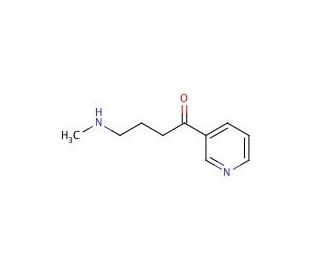

Estrutura molecular do 4-(Methylamino)-1-(3-pyridyl)-1-butanone Dihydrochloride, Número CAS: 66093-90-1
4-(Methylamino)-1-(3-pyridyl)-1-butanone Dihydrochloride (CAS 66093-90-1)
Nomes alternativos:
Pseudooxynicotine
Aplicacao:
4-(Methylamino)-1-(3-pyridyl)-1-butanone Dihydrochloride é um metabolito amino-cetónico da nicotina
Numero VAT:
66093-90-1
Peso Molecular:
251.15
Separar por Funcao:
C10H16Cl2N2O
Informação complementar:
Este produto está classificado como um Bem Perigoso para transporte e pode estar sujeito a custos de envio adicionais.
Para uso em exclusivo em pesquisa. Não se destina a uso em diagnostico e tratamento.
* Refere-se a Certificado de Análise para data especifica de lotes (incluindo-se o conteúdo de agua).
LINKS RÁPIDOS
Informacoes sobre ordens
Descricao
Informações Técnicas
Informações de Segurança
SDS & Certificado de Análise
O dicloridrato de 4-(metilamino)-1-(3-piridil)-1-butanona, normalmente chamado de dicloridrato de MPAB, é um membro sintético da classe química dos compostos de piridínio. O dicloridrato de MPAB está sendo investigado por sua função como fixador na criação de compostos orgânicos e como participante de reações químicas. Ele também está sendo explorado para inclusão em ensaios bioquímicos. O composto funciona como um agonista da família de receptores acoplados à proteína G (GPCR), onde se especula que ele inicie uma série de eventos bioquímicos por meio da ligação protéica a esses receptores, ativando assim vias celulares específicas.
4-(Methylamino)-1-(3-pyridyl)-1-butanone Dihydrochloride (CAS 66093-90-1) Referencias
- Metabolitos de carcinogéneos urinários humanos: biomarcadores para a investigação do tabaco e do cancro. | Hecht, SS. 2002. Carcinogenesis. 23: 907-22. PMID: 12082012
- Inibição da oxidação da (S)-nicotina no microssoma hepático humano pelo (-)-mentol e seus análogos. | MacDougall, JM., et al. 2003. Chem Res Toxicol. 16: 988-93. PMID: 12924926
- Lesão por stress nitrosativo induzida por compostos relacionados com o tabaco na bolsa da bochecha do hamster. | Barley, RD., et al. 2004. J Dent Res. 83: 903-8. PMID: 15557395
- Ativação metabólica catalisada pelo citocromo P450 2A de nitrosaminas carcinogénicas estruturalmente semelhantes: enantiómeros da N'-nitrosonornicotina, N-nitrosopiperidina e N-nitrosopirrolidina. | Wong, HL., et al. 2005. Chem Res Toxicol. 18: 61-9. PMID: 15651850
- Múltiplos papéis da nicotina na proliferação celular e na inibição da apoptose: implicações na carcinogénese pulmonar. | Catassi, A., et al. 2008. Mutat Res. 659: 221-31. PMID: 18495523
- As nitrosaminas do tabaco como responsáveis por doenças: revisão dos mecanismos. | Yalcin, E. and de la Monte, S. 2016. J Physiol Biochem. 72: 107-20. PMID: 26767836
- Um método para metabolómica comparativa na urina utilizando espetrometria de massa de alta resolução. | Ramakrishnan, P., et al. 2016. J Chromatogr A. 1443: 83-92. PMID: 27012786
- O destino metabólico da nicotina do néctar em abelhas operárias. | du Rand, EE., et al. 2017. J Insect Physiol. 98: 14-22. PMID: 27840286
- Uma metodologia exaustiva para a separação quiral de 40 alcalóides do tabaco e dos seus metabolitos carcinogénicos E/Z-(R,S)-nitrosamina específicos do tabaco. | Hellinghausen, G., et al. 2018. Talanta. 181: 132-141. PMID: 29426492
- Bioquímica do metabolismo da nicotina e sua relevância para o cancro do pulmão. | Murphy, SE. 2021. J Biol Chem. 296: 100722. PMID: 33932402
- Um estudo sobre a carcinogénese do tabaco. LI. Potências relativas de N-nitrosaminas específicas do tabaco como indutoras de tumores pulmonares em ratinhos A/J. | Hoffmann, D., et al. 1993. Cancer Lett. 71: 25-30. PMID: 8364894
- O rooibos (Aspalathus linearis), o honeybush (Cyclopia intermedia) e o cancer bush (Sutherlandia frutescens subsp. microphylla) protegem contra a mutagénese específica do tabaco in vitro | Gelderblom, W. C., Joubert, E., Gamieldien, K., Sissing, L., Malherbe, C. J., & Maritz, G. 2017. South African Journal of Botany. 110: 194-200.
- Um método LC-MS/MS rápido para a determinação simultânea da nicotina e dos seus principais derivados, incluindo os isómeros de hidroxilação | Shen, Y., Zhang, N., Prinyawiwatkul, W., & Xu, Z. 2021. International Journal of Mass Spectrometry. 468: 116642.
Informacoes sobre ordens
| Nome do Produto | Numero de Catalogo | UNID | Preco | Qde | FAVORITOS | |
4-(Methylamino)-1-(3-pyridyl)-1-butanone Dihydrochloride, 250 mg | sc-209851 | 250 mg | $428.00 |