
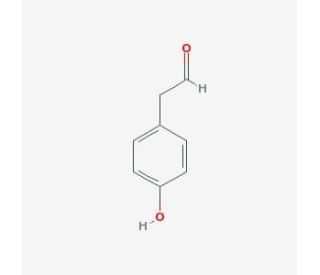

4-Hydroxyphenylacetaldehyde (CAS 7339-87-9)
See product citations (1)
QUICK LINKS
4-Hydroxyphenylacetaldehyde (4-HPA) emerges as a key intermediate in the metabolic breakdown of the amino acid phenylalanine and the dopamine, underscoring its pivotal role in neurochemical and physiological processes. The compound is formed through the oxidative deamination of dopamine, facilitated by monoamine oxidase (MAO) enzymes, and its subsequent metabolic pathways are for the detoxification and elimination of excess neurotransmitters from the body. The compound′s reactivity and potential to form adducts with proteins and nucleic acids make it a focal point in studies investigating the molecular underpinnings of cellular damage. By understanding the dynamics of 4-HPA formation and clearance, researchers can gain insights into the delicate balance of neurotransmitter levels, the impact of oxidative stress on neural cells.
4-Hydroxyphenylacetaldehyde (CAS 7339-87-9) References
- Modification of type III VLDL, their remnants, and VLDL from ApoE-knockout mice by p-hydroxyphenylacetaldehyde, a product of myeloperoxidase activity, causes marked cholesteryl ester accumulation in macrophages. | Whitman, SC., et al. 1999. Arterioscler Thromb Vasc Biol. 19: 1238-49. PMID: 10323775
- p-hydroxyphenylacetaldehyde, an aldehyde generated by myeloperoxidase, modifies phospholipid amino groups of low density lipoprotein in human atherosclerotic intima. | Heller, JI., et al. 2000. J Biol Chem. 275: 9957-62. PMID: 10744670
- Elevated levels of protein-bound p-hydroxyphenylacetaldehyde, an amino-acid-derived aldehyde generated by myeloperoxidase, are present in human fatty streaks, intermediate lesions and advanced atherosclerotic lesions. | Hazen, SL., et al. 2000. Biochem J. 352 Pt 3: 693-9. PMID: 11104675
- p-Hydroxyphenylacetaldehyde, the major product of tyrosine oxidation by the activated myeloperoxidase system can act as an antioxidant in LDL. | Exner, M., et al. 2001. FEBS Lett. 490: 28-31. PMID: 11172805
- Structural basis of enzymatic (S)-norcoclaurine biosynthesis. | Ilari, A., et al. 2009. J Biol Chem. 284: 897-904. PMID: 19004827
- Biochemical evaluation of a parsley tyrosine decarboxylase results in a novel 4-hydroxyphenylacetaldehyde synthase enzyme. | Torrens-Spence, MP., et al. 2012. Biochem Biophys Res Commun. 418: 211-6. PMID: 22266321
- Production of aromatic compounds by metabolically engineered Escherichia coli with an expanded shikimate pathway. | Koma, D., et al. 2012. Appl Environ Microbiol. 78: 6203-16. PMID: 22752168
- Asymmetric synthesis of tetrahydroisoquinolines by enzymatic Pictet-Spengler reaction. | Nishihachijo, M., et al. 2014. Biosci Biotechnol Biochem. 78: 701-7. PMID: 25036970
- Complete Pathway Elucidation and Heterologous Reconstitution of Rhodiola Salidroside Biosynthesis. | Torrens-Spence, MP., et al. 2018. Mol Plant. 11: 205-217. PMID: 29277428
- Preparation and properties of p-hydroxyphenylacetaldehyde and 3-methoxy-4-hydroxyphenylacetaldehyde. | Robbins, JH. 1966. Arch Biochem Biophys. 114: 576-84. PMID: 5957713
- p-Hydroxyphenylacetaldehyde is the major product of L-tyrosine oxidation by activated human phagocytes. A chloride-dependent mechanism for the conversion of free amino acids into reactive aldehydes by myeloperoxidase. | Hazen, SL., et al. 1996. J Biol Chem. 271: 1861-7. PMID: 8567631
- p-Hydroxyphenylacetaldehyde, the major product of L-tyrosine oxidation by the myeloperoxidase-H2O2-chloride system of phagocytes, covalently modifies epsilon-amino groups of protein lysine residues. | Hazen, SL., et al. 1997. J Biol Chem. 272: 16990-8. PMID: 9202012
- Synthesis, isolation, and characterization of the adduct formed in the reaction of p-hydroxyphenylacetaldehyde with the amino headgroup of phosphatidylethanolamine and phosphatidylserine. | Hazen, SL., et al. 1999. Chem Res Toxicol. 12: 19-27. PMID: 9894014
Ordering Information
| Product Name | Catalog # | UNIT | Price | Qty | FAVORITES | |
4-Hydroxyphenylacetaldehyde, 10 mg | sc-214245 | 10 mg | $280.00 | |||
4-Hydroxyphenylacetaldehyde, 25 mg | sc-214245A | 25 mg | $620.00 | |||
4-Hydroxyphenylacetaldehyde, 100 mg | sc-214245B | 100 mg | $1345.00 | |||
4-Hydroxyphenylacetaldehyde, 250 mg | sc-214245C | 250 mg | $2905.00 |