
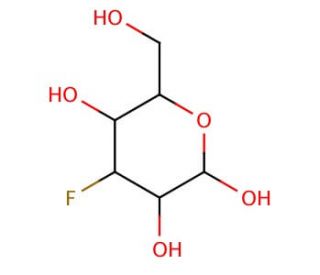

3-Deoxy-3-fluoro-D-mannose 的分子结构, CAS编号: 87764-46-3
3-Deoxy-3-fluoro-D-mannose (CAS 87764-46-3)
备用名:
3-Deoxy-3-fluoro-D-mannose
应用:
3-Deoxy-3-fluoro-D-mannose 被代谢并结合到 75220Saccharomyces cerevisiae95064 的细胞壁中。
CAS号码:
87764-46-3
分子量:
182.15
分子式:
C6H11FO5
仅供科研使用。不可用于诊断或治疗。
* 参考分析证明 大量特定数据 (包括水 含量).
快捷链接
订购信息
描述
技术信息
安全信息
安全技术说明书和分析证明书
3-Deoxy-3-fluoro-D-mannose 是一种合成糖类似物,因其独特的性质和潜在的应用而在生化和药物研究领域备受关注。这种化合物的主要作用机制之一是在细胞代谢过程中将其纳入糖蛋白和糖脂等糖类共轭物中。这种糖基化模式的改变会影响各种细胞过程,包括细胞粘附、信号传递和识别。在研究环境中,3-脱氧-3-氟-D-甘露糖已被用作探究特定糖残基在生物系统中作用的工具,特别是在侧重于碳水化合物与蛋白质相互作用以及糖基转移酶功能的研究中。此外,这种化合物还被研究用于开发针对细菌细胞壁生物合成的新型抗菌剂。此外,3-脱氧-3-氟-D-甘露糖衍生物有望成为正电子发射断层扫描(PET)等成像技术的分子探针,从而实现生物体内糖基化过程的可视化和跟踪。总之,3-脱氧-3-氟-D-甘露糖是糖生物学研究中的一个宝贵工具,它能让人们深入了解碳水化合物在各种生物途径中的作用,并为开发诊断工具提供机会。
3-Deoxy-3-fluoro-D-mannose (CAS 87764-46-3) 参考文献
- D-perosamine 的 3-脱氧-3-氟衍生物的合成探索。 | Poirot, E., et al. 2001. Carbohydr Res. 334: 195-205. PMID: 11513826
- 首次合成 2-脱氧-2-氟-D-葡萄糖(2-脱氧-2-[18F]氟-D-葡萄糖的未标记前身)的历史。 | Pacák, J. and Cerný, M. 2002. Mol Imaging Biol. 4: 352-4. PMID: 14537109
- 合成和纯化 2-脱氧-2-[18F]氟-D-葡萄糖和 2-脱氧-2-[18F]氟-D-甘露糖:利用 1H 和 19F-NMR 光谱鉴定产品。 | Oberdorfer, F., et al. 1986. Int J Rad Appl Instrum A. 37: 695-701. PMID: 3021670
- L6 大鼠肌母细胞中的己糖转运。I. 限速步骤, 动力学特性以及两个系统的证据。 | D'Amore, T. and Lo, TC. 1986. J Cell Physiol. 127: 95-105. PMID: 3958060
- 酿酒酵母 S288C 对 3-脱氧-3-氟-D-甘露糖和 4-脱氧-4-氟-D-甘露糖的代谢。 | Grier, TJ. and Rasmussen, JR. 1983. Biochem J. 209: 677-85. PMID: 6347179
- 制备 3-脱氧-3-氟-D-甘露糖和相应的己糖醇 | Černý, Miloslav, et al. 1983. Collection of Czechoslovak chemical communications. 48: 2693.
订购信息
| 产品名称 | 产品编号 | 规格 | 价格 | 数量 | 收藏夹 | |
3-Deoxy-3-fluoro-D-mannose, 5 mg | sc-220860 | 5 mg | $380.00 |