
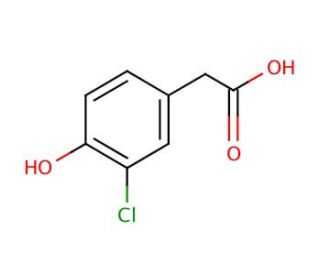

Molecular structure of 3-Chloro-4-hydroxyphenylacetic acid, CAS Number: 33697-81-3
3-Chloro-4-hydroxyphenylacetic acid (CAS 33697-81-3)
CAS Number:
33697-81-3
Molecular Weight:
186.59
Molecular Formula:
C8H7ClO3
For Research Use Only. Not Intended for Diagnostic or Therapeutic Use.
* Refer to Certificate of Analysis for lot specific data.
QUICK LINKS
Ordering Information
Description
Technical Information
Safety Information
SDS & Certificate of Analysis
3-Chloro-4-hydroxyphenylacetic acid, known as an auxin influx inhibitor, serves as a prominent chlorinated metabolite of chlorotyrosine. This hydroxy monocarboxylic acid, (3-chloro-4-hydroxyphenyl)acetic acid, is a derivative of acetic acid wherein one of the methyl hydrogens is substituted by a 3-chloro-4-hydroxyphenyl group. It plays a significant role as a mammalian metabolite and falls under the category of hydroxy monocarboxylic acids, phenols, and monochlorobenzenes. Its origin can be traced back to acetic acid.
3-Chloro-4-hydroxyphenylacetic acid (CAS 33697-81-3) References
- Random transposition by Tn916 in Desulfitobacterium dehalogenans allows for isolation and characterization of halorespiration-deficient mutants. | Smidt, H., et al. 1999. J Bacteriol. 181: 6882-8. PMID: 10559152
- Novel auxin transport inhibitors phenocopy the auxin influx carrier mutation aux1. | Parry, G., et al. 2001. Plant J. 25: 399-406. PMID: 11260496
- Characterization of CprK1, a CRP/FNR-type transcriptional regulator of halorespiration from Desulfitobacterium hafniense. | Gábor, K., et al. 2006. J Bacteriol. 188: 2604-13. PMID: 16547048
- Auxin response, but not its polar transport, plays a role in hydrotropism of Arabidopsis roots. | Kaneyasu, T., et al. 2007. J Exp Bot. 58: 1143-50. PMID: 17244629
- Synthesis and spectroscopic characterisation of a combinatorial library based on the fungal natural product 3-chloro-4-hydroxyphenylacetamide. | Davis, RA., et al. 2007. Magn Reson Chem. 45: 442-5. PMID: 17372964
- Auxin influx inhibitors 1-NOA, 2-NOA, and CHPAA interfere with membrane dynamics in tobacco cells. | Lanková, M., et al. 2010. J Exp Bot. 61: 3589-98. PMID: 20595238
- Design and Synthesis of a Screening Library Using the Natural Product Scaffold 3-Chloro-4-hydroxyphenylacetic Acid. | Kumar, R., et al. 2015. J Nat Prod. 78: 914-8. PMID: 25803573
- Auxin protects Arabidopsis thaliana cell suspension cultures from programmed cell death induced by the cellulose biosynthesis inhibitors thaxtomin A and isoxaben. | Awwad, F., et al. 2019. BMC Plant Biol. 19: 512. PMID: 31752698
- Exploring the Biomarkers of Sepsis-Associated Encephalopathy (SAE): Metabolomics Evidence from Gas Chromatography-Mass Spectrometry. | Zhu, J., et al. 2019. Biomed Res Int. 2019: 2612849. PMID: 31781604
- Chemical Biology in Auxin Research. | Hayashi, KI. 2021. Cold Spring Harb Perspect Biol. 13: PMID: 33431581
- Inducible and tunable gene expression systems for Pseudomonas putida KT2440. | Sathesh-Prabu, C., et al. 2021. Sci Rep. 11: 18079. PMID: 34508142
- Standardization of regulatory nodes for engineering heterologous gene expression: a feasibility study. | Nikel, PI., et al. 2022. Microb Biotechnol. 15: 2250-2265. PMID: 35478326
- Eremophilane-Type Sesquiterpenes from a Marine-Derived Fungus Penicillium Copticola with Antitumor and Neuroprotective Activities. | Zhang, J., et al. 2022. Mar Drugs. 20: PMID: 36421990
- Proteome adaptations of the organohalide-respiring Desulfitobacterium hafniense strain DCB-2 to various energy metabolisms. | Willemin, MS., et al. 2023. Front Microbiol. 14: 1058127. PMID: 36733918
Ordering Information
| Product Name | Catalog # | UNIT | Price | Qty | FAVORITES | |
3-Chloro-4-hydroxyphenylacetic acid, 25 g | sc-254457 | 25 g | $79.00 |