
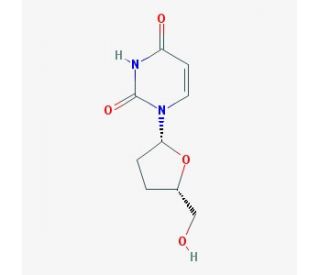

2′,3′-Dideoxyuridine (CAS 5983-09-5)
QUICK LINKS
2′,3′-Dideoxyuridine is a nucleoside analog where the hydroxyl groups at the 2′ and 3′ positions of the sugar moiety are absent, replaced with hydrogen atoms. This structural modification renders it a chain terminator for DNA synthesis, making it a valuable tool in the field of molecular biology and biochemistry. The key mechanism of action of 2′,3′-Dideoxyuridine involves its incorporation into DNA strands during the replication process. Because it lacks the necessary 3′ hydroxyl group, which is essential for forming the phosphodiester bond with the next incoming nucleotide, its incorporation results in the termination of DNA chain elongation. This property is particularly useful for studying viral replication mechanisms where DNA synthesis is a crucial step. In scientific research, 2′,3′-Dideoxyuridine has been utilized extensively to explore the fidelity and mechanisms of DNA polymerases. By studying how different DNA polymerases incorporate or bypass this nucleoside analog, researchers can gain insights into the enzyme′s substrate specificity and mechanism of action. This has implications for understanding replication fidelity and the molecular basis of mutations. Furthermore, 2′,3′-Dideoxyuridine is employed in studies aimed at investigating the cellular and viral DNA replication pathways. It helps in delineating how cells and viruses cope with the presence of unnatural nucleosides in their DNA, which can shed light on the cellular mechanisms for detecting and repairing damaged DNA.
2′,3′-Dideoxyuridine (CAS 5983-09-5) References
- Membrane-permeable dideoxyuridine 5'-monophosphate analogue inhibits human immunodeficiency virus infection. | Sastry, JK., et al. 1992. Mol Pharmacol. 41: 441-5. PMID: 1372082
- Synthesis and biological evaluation of some 5-nitro- and 5-amino derivatives of 2'-deoxycytidine, 2',3'-dideoxyuridine, and 2',3'-dideoxycytidine. | Colacino, E., et al. 2003. Nucleosides Nucleotides Nucleic Acids. 22: 2013-26. PMID: 14680024
- Potent DNA chain termination activity and selective inhibition of human immunodeficiency virus reverse transcriptase by 2',3'-dideoxyuridine-5'-triphosphate. | Hao, Z., et al. 1990. Mol Pharmacol. 37: 157-63. PMID: 1689452
- Design, synthesis, and anti-HIV activity of 2',3'-didehydro-2',3'-dideoxyuridine (d4U), 2',3'-dideoxyuridine (ddU) phosphoramidate 'ProTide' derivatives. | Mehellou, Y., et al. 2007. Bioorg Med Chem Lett. 17: 3666-9. PMID: 17485204
- An investigation into the anti-HIV activity of 2',3'-didehydro-2',3'-dideoxyuridine (d4U) and 2',3'-dideoxyuridine (ddU) phosphoramidate 'ProTide' derivatives. | Mehellou, Y., et al. 2009. Org Biomol Chem. 7: 2548-53. PMID: 19503928
- Production of 2',3'-dideoxyadenosine and 2',3'-dideoxyinosine from 2',3'-dideoxyuridine and the corresponding purine bases by resting cells of Escherichia coli AJ 2595. | Shirae, H., et al. 1989. Appl Environ Microbiol. 55: 419-24. PMID: 2497709
- Anti-retrovirus activity of 3'-fluoro- and 3'-azido-substituted pyrimidine 2',3'-dideoxynucleoside analogues. | Balzarini, J., et al. 1988. Biochem Pharmacol. 37: 2847-56. PMID: 2840080
- The disposition and metabolism of 2',3'-dideoxycytidine, an in vitro inhibitor of human T-lymphotrophic virus type III infectivity, in mice and monkeys. | Kelley, JA., et al. 1987. Drug Metab Dispos. 15: 595-601. PMID: 2891473
- Data set on the synthesis and properties of 2',3'-dideoxyuridine triphosphate conjugated to SiO2 nanoparticles. | Vasilyeva, SV., et al. 2018. Data Brief. 21: 540-547. PMID: 30370324
- Glycosyl-oxycarbonylaminosulfonyl-2',3'-dideoxynucleoside derivatives as lipophilic nucleotide mimics. Synthesis and anti-HIV activity. | Pérez-Pérez, MJ., et al. 1993. Bioorg Med Chem. 1: 279-84. PMID: 8081859
Ordering Information
| Product Name | Catalog # | UNIT | Price | Qty | FAVORITES | |
2′,3′-Dideoxyuridine, 100 mg | sc-256376 | 100 mg | $209.00 |