
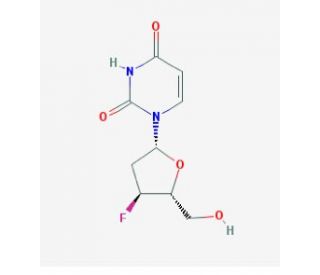

2′,3′-Dideoxy-3′-fluorouridine (CAS 41107-56-6)
QUICK LINKS
2′,3′-Dideoxy-3′-fluorouridine, a synthetic nucleoside analogue, has gained attention in scientific research due to its unique mechanisms of action and potential applications in various fields. This chemical interferes with nucleic acid synthesis by acting as a chain terminator during RNA transcription. Specifically, it replaces the 3′-hydroxyl group of the ribose sugar with a fluorine atom, preventing the addition of subsequent nucleotides and halting RNA elongation. This mechanism makes it particularly valuable in molecular biology and virology research, where it is used to study RNA-dependent processes such as viral replication and transcription. Researchers have utilized 2′,3′-dideoxy-3′-fluorouridine to investigate the replication mechanisms of RNA viruses, including HIV and hepatitis C virus (HCV), providing insights into the development of antiviral therapies targeting viral RNA synthesis. Additionally, this compound has been employed in structural biology to study RNA-protein interactions and RNA folding kinetics, elucidating the molecular basis of RNA function and regulation. Furthermore, its potential as an agent for viral infections has prompted investigations into novel drug delivery systems and pharmacokinetic profiles to enhance its efficacy and bioavailability. Overall, 2′,3′-dideoxy-3′-fluorouridine′s unique mechanism of action and diverse research applications highlight its significance as a valuable tool for understanding RNA biology, viral pathogenesis, and drug development.
2′,3′-Dideoxy-3′-fluorouridine (CAS 41107-56-6) References
- Inhibition of hepatitis B virus production by modified 2',3'-dideoxy-thymidine and 2',3'-dideoxy-5-methylcytidine derivatives. In vitro and in vivo studies. | Matthes, E., et al. 1992. Biochem Pharmacol. 43: 1571-7. PMID: 1314607
- Use of a standardized cell culture assay to assess activities of nucleoside analogs against hepatitis B virus replication. | Korba, BE. and Gerin, JL. 1992. Antiviral Res. 19: 55-70. PMID: 1444322
- Inhibition of Mycobacterium tuberculosis, Mycobacterium bovis, and Mycobacterium avium by novel dideoxy nucleosides. | Rai, D., et al. 2007. J Med Chem. 50: 4766-74. PMID: 17696514
- Synthesis and anti-HIV evaluation of 2',3'-dideoxyribo-5-chloropyrimidine analogues: reduced toxicity of 5-chlorinated 2',3'-dideoxynucleosides. | Van Aerschot, A., et al. 1990. J Med Chem. 33: 1833-9. PMID: 2342078
- Inhibition of HIV-replication by 3'-fluoro-modified nucleosides with low cytotoxicity. | Matthes, E., et al. 1989. Biochem Biophys Res Commun. 165: 488-95. PMID: 2480126
- 5-Halogeno-3'-fluoro-2',3'-dideoxyuridines as inhibitors of human immunodeficiency virus (HIV): potent and selective anti-HIV activity of 3'-fluoro-2',3'-dideoxy-5-chlorouridine. | Balzarini, J., et al. 1989. Mol Pharmacol. 35: 571-7. PMID: 2725468
- 3'-Fluoro-2',3'-dideoxy-5-chlorouridine: most selective anti-HIV-1 agent among a series of new 2'- and 3'-fluorinated 2',3'-dideoxynucleoside analogues. | Van Aerschot, A., et al. 1989. J Med Chem. 32: 1743-9. PMID: 2754700
- Anti-retrovirus activity of 3'-fluoro- and 3'-azido-substituted pyrimidine 2',3'-dideoxynucleoside analogues. | Balzarini, J., et al. 1988. Biochem Pharmacol. 37: 2847-56. PMID: 2840080
- Estimation of the lipophilicity of anti-HIV nucleoside analogues by determination of the partition coefficient and retention time on a Lichrospher 60 RP-8 HPLC column. | Balzarini, J., et al. 1989. Biochem Biophys Res Commun. 158: 413-22. PMID: 2916990
- 5-Chloro-substituted derivatives of 2', 3'-didehydro-2',3'-dideoxyuridine, 3'-fluoro-2',3'-dideoxyuridine and 3'-azido-2',3'-dideoxyuridine as anti-HIV agents. | Balzarini, J., et al. 1989. Biochem Pharmacol. 38: 869-74. PMID: 2930588
Ordering Information
| Product Name | Catalog # | UNIT | Price | Qty | FAVORITES | |
2′,3′-Dideoxy-3′-fluorouridine, 25 mg | sc-256375 | 25 mg | $235.00 |