
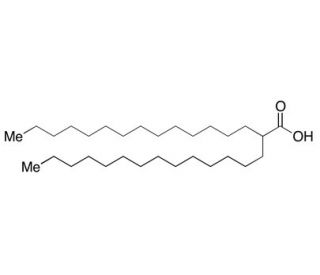

2-Tetradecylhexadecanoic Acid (CAS 66880-77-1)
QUICK LINKS
2-Tetradecylhexadecanoic acid, also known as Palmitic acid is a saturated fatty acid abundantly present in plants, animals, and microorganisms. It serves as a constituent of various lipids and plays a significant role in cell membrane composition. Moreover, 2-Tetradecylhexadecanoic acid acts as a vital intermediate in the synthesis of other fatty acids and finds utility as a surfactant in certain industrial processes. The scientific and medical domains extensively employ 2-Tetradecylhexadecanoic acid for synthesizing pharmaceuticals. Within scientific research, 2-Tetradecylhexadecanoic acid boasts a diverse array of applications. It has been utilized to investigate the structure and functionality of cell membranes, as well as explore the intricate mechanisms governing gene expression. Additionally, it is employed to examine the impact of fatty acids on organ and tissue development and function. Moreover, 2-Tetradecylhexadecanoic acid has facilitated studies concerning protein-lipid interactions and the influence of fatty acids on cellular metabolism. 2-Tetradecylhexadecanoic acid exerts various effects on the body mentioned above. It exhibits specific binding to cell surface receptors, thereby activating or inhibiting the activity of specific genes. Furthermore, 2-Tetradecylhexadecanoic acid can induce changes in cell membrane structure, leading to alterations in membrane permeability and the activity of membrane-bound proteins. Lastly, it impacts cellular metabolism by influencing energy production, nutrient uptake, and metabolite synthesis.
2-Tetradecylhexadecanoic Acid (CAS 66880-77-1) References
- Self-recognition of N-linked glycans with multivalent GlcNAc, determined as ceramide mimetic conjugate. | Yoon, SJ., et al. 2007. Glycobiology. 17: 1007-14. PMID: 17609198
- Investigation of the protonation state of novel cationic lipids designed for gene transfection. | Antipina, MN., et al. 2007. J Phys Chem B. 111: 13845-50. PMID: 18020325
- Physical-chemical properties and transfection activity of cationic lipid/DNA complexes. | Antipina, MN., et al. 2009. Chemphyschem. 10: 2471-9. PMID: 19731278
- Langmuir monolayers as models to study processes at membrane surfaces. | Stefaniu, C., et al. 2014. Adv Colloid Interface Sci. 208: 197-213. PMID: 24612663
- Tris(2-aminoethyl)amine-based α-branched fatty acid amides - Synthesis of lipids and comparative study of transfection efficiency of their lipid formulations. | Erdmann, N., et al. 2015. Eur J Pharm Biopharm. 96: 349-62. PMID: 26325061
- Nonpyrogenic Molecular Adjuvants Based on norAbu-Muramyldipeptide and norAbu-Glucosaminyl Muramyldipeptide: Synthesis, Molecular Mechanisms of Action, and Biological Activities in Vitro and in Vivo. | Effenberg, R., et al. 2017. J Med Chem. 60: 7745-7763. PMID: 28829599
- Hyaluronic Acid Surface Modified Liposomes Prepared via Orthogonal Aminoxy Coupling: Synthesis of Nontoxic Aminoxylipids Based on Symmetrically α-Branched Fatty Acids, Preparation of Liposomes by Microfluidic Mixing, and Targeting to Cancer Cells Expressing CD44. | Bartheldyová, E., et al. 2018. Bioconjug Chem. 29: 2343-2356. PMID: 29898364
- N-Oxy lipid-based click chemistry for orthogonal coupling of mannan onto nanoliposomes prepared by microfluidic mixing: Synthesis of lipids, characterisation of mannan-coated nanoliposomes and in vitro stimulation of dendritic cells. | Bartheldyová, E., et al. 2019. Carbohydr Polym. 207: 521-532. PMID: 30600036
- TREM2 is a receptor for non-glycosylated mycolic acids of mycobacteria that limits anti-mycobacterial macrophage activation. | Iizasa, E., et al. 2021. Nat Commun. 12: 2299. PMID: 33863908
- Studies on selection blockers. 5. Design, synthesis, and biological profile of sialyl Lewis x mimetics based on modified serine-glutamic acid dipeptides. | Tsukida, T., et al. 1997. J Med Chem. 40: 3534-41. PMID: 9357520
- Studies on selectin blockers. 6. Discovery of homologous fucose sugar unit necessary for E-selectin binding. | Hiramatsu, Y., et al. 1998. J Med Chem. 41: 2302-7. PMID: 9632363
- Studies on selectin blockers. 7. Structure-activity relationships of sialyl Lewis X mimetics based on modified Ser-Glu dipeptides. | Tsukida, T., et al. 1998. J Med Chem. 41: 4279-87. PMID: 9784103
Ordering Information
| Product Name | Catalog # | UNIT | Price | Qty | FAVORITES | |
2-Tetradecylhexadecanoic Acid, 1 g | sc-472561 | 1 g | $775.00 |