
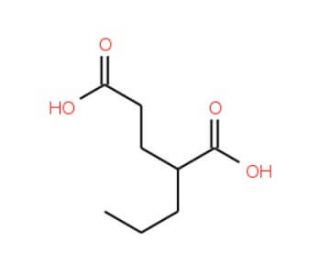

2-Propylglutaric Acid (CAS 32806-62-5)
ENLACES RÁPIDOS
2-Propylglutaric acid (2PGA) es un ácido carboxílico comúnmente utilizado en la investigación científica debido a sus aplicaciones versátiles. Sirve como un compuesto vital en el metabolismo de organismos específicos y ha generado interés por su potencial en la investigación biomédica. Como un ácido natural no tóxico que puede ser fácilmente sintetizado, 2PGA es útil en numerosos experimentos de laboratorio, con una exploración continua de su potencial en la investigación biomédica. En la investigación científica, 2-Propylglutaric acid ha sido ampliamente empleado en diversos campos como la bioquímica, fisiología y farmacología. Sus aplicaciones incluyen investigar el metabolismo de varios organismos, incluyendo humanos, y explorar los efectos de los medicamentos en el cuerpo. Además, se ha utilizado para estudiar los impactos bioquímicos y fisiológicos de compuestos como medicamentos y hormonas. Adicionalmente, 2-Propylglutaric acid ha sido instrumental en el estudio de los efectos de los contaminantes ambientales en el cuerpo. Significativamente, 2-Propylglutaric acid juega un papel crucial en el metabolismo de organismos específicos. Participa en la síntesis de ácidos grasos y otros compuestos, así como en la descomposición de proteínas y carbohidratos. Además, 2-Propylglutaric acid contribuye a la producción de ATP, la moneda de energía de las células. También juega un papel en la síntesis de ciertas hormonas, incluyendo el cortisol.
2-Propylglutaric Acid (CAS 32806-62-5) Referencias
- Disposición del ácido valproico en la oveja materna, fetal y recién nacida. II: metabolismo y eliminación renal. | Kumar, S., et al. 2000. Drug Metab Dispos. 28: 857-64. PMID: 10859160
- Efecto del ácido valproico sobre los niveles hepáticos y plasmáticos de 15-F2t-isoprostano en ratas. | Tong, V., et al. 2003. Free Radic Biol Med. 34: 1435-46. PMID: 12757854
- Efectos in vitro del valproato y sus metabolitos sobre las oxidaciones mitocondriales. Relevancia del secuestro de CoA en las inhibiciones observadas. | Ponchaut, S., et al. 1992. Biochem Pharmacol. 43: 2435-42. PMID: 1610408
- Influencia de la administración crónica de valproato sobre la ultraestructura y el contenido enzimático de los peroxisomas de hígado y riñón de rata. Oxidación del valproato por los peroxisomas hepáticos. | Ponchaut, S., et al. 1991. Biochem Pharmacol. 41: 1419-28. PMID: 2018550
- Perfil metabolómico cerebral de la abeja melífera oriental (Apis cerana) infestada por el ácaro Varroa destructor. | Wu, JL., et al. 2017. PLoS One. 12: e0175573. PMID: 28403242
- Determinación del ácido valproico y sus metabolitos mediante cromatografía de gases-espectrometría de masas con monitorización de iones seleccionados. | Tatsuhara, T., et al. 1987. J Chromatogr. 399: 183-95. PMID: 3116023
- Ensayo de cromatografía de gases capilar para el ácido valproico y su metabolito 2-desaturado en cerebro y plasma. | Semmes, RL. and Shen, DD. 1988. J Chromatogr. 432: 185-97. PMID: 3146579
- Determinación de ácido valproico y sus seis metabolitos en suero humano mediante LC-MS/MS y aplicación a la interacción con carbapenems en pacientes epilépticos. | Yang, X., et al. 2023. Biomed Chromatogr. 37: e5572. PMID: 36520520
- Inhibición de la gluconeogénesis por valproato sódico y sus metabolitos en hepatocitos aislados de rata. | Rogiers, V., et al. 1985. Xenobiotica. 15: 759-65. PMID: 3934853
- Identificación de metabolitos del ácido valproico en suero y orina humanos utilizando ácido valproico hexadeuterado y análisis de espectrometría de masas por cromatografía de gases. | Acheampong, A., et al. 1983. Biomed Mass Spectrom. 10: 586-95. PMID: 6419788
- Cinco metabolitos doblemente insaturados del ácido valproico en orina y plasma de pacientes en tratamiento con ácido valproico. | Kochen, W., et al. 1984. J Clin Chem Clin Biochem. 22: 309-17. PMID: 6429268
- Ácido valproico y varios metabolitos: determinación cuantitativa en suero, orina, leche materna y tejidos mediante cromatografía de gases-espectrometría de masas con monitorización de iones seleccionados. | Nau, H., et al. 1981. J Chromatogr. 226: 69-78. PMID: 6798056
- El valproato sódico regula a la baja el sustrato de la cinasa C rica en alanina miristoilada (MARCKS) en células inmortalizadas del hipocampo: una propiedad de los estabilizadores del estado de ánimo mediados por la proteína cinasa C. | Watson, DG., et al. 1998. J Pharmacol Exp Ther. 285: 307-16. PMID: 9536026
Información sobre pedidos
| Nombre del producto | Número de catálogo | UNIDAD | Precio | CANTIDAD | Favoritos | |
2-Propylglutaric Acid, 2.5 mg | sc-206485 | 2.5 mg | $296.00 | |||
2-Propylglutaric Acid, 5 mg | sc-206485A | 5 mg | $510.00 | |||
2-Propylglutaric Acid, 10 mg | sc-206485B | 10 mg | $920.00 |