
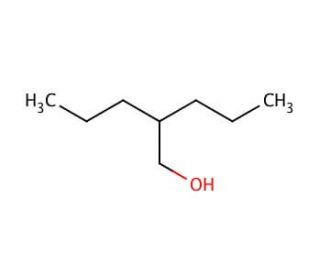

Molecular structure of 2-Propyl-1-pentanol, CAS Number: 58175-57-8
2-Propyl-1-pentanol (CAS 58175-57-8)
Alternate Names:
2-Propylpentan-1-ol
Application:
2-Propyl-1-pentanol is a potential synthesis reagent
CAS Number:
58175-57-8
Molecular Weight:
130.23
Molecular Formula:
C8H18O
For Research Use Only. Not Intended for Diagnostic or Therapeutic Use.
* Refer to Certificate of Analysis for lot specific data.
QUICK LINKS
Ordering Information
Description
Technical Information
Safety Information
SDS & Certificate of Analysis
2-Propyl-1-pentanol, also known as isohexyl alcohol or 2-propylpentan-1-ol, is a chemical compound with the molecular formula C8H18O. It is an alcohol that consists of a propyl group attached to a pentyl (or amyl) group. It is a colorless liquid with a strong odor. 2-Propyl-1-pentanol is used primarily as a solvent in various industries, including paints, coatings, and cleaning products. 2-Propyl-1-pentanol, can be used as an intermediate in the synthesis of other organic compounds.
2-Propyl-1-pentanol (CAS 58175-57-8) References
- Metabolic conversion of 2-propylpentanal acetals to valproic acid in vitro. Model prodrugs of carboxylic acid agents. | Vicchio, D. and Callery, PS. 1989. Drug Metab Dispos. 17: 513-7. PMID: 2573494
- A disposable breath sensing tube with on-tube single-nanowire sensor array for on-site detection of exhaled breath biomarkers. | Wu, CH., et al. 2016. Lab Chip. 16: 4395-4405. PMID: 27738678
- Effect of Exogenous Abscisic Acid and Methyl Jasmonate on Anthocyanin Composition, Fatty Acids, and Volatile Compounds of Cabernet Sauvignon (Vitis vinifera L.) Grape Berries. | Ju, YL., et al. 2016. Molecules. 21: PMID: 27754331
- Combination of probiotic yeast and lactic acid bacteria as starter culture to produce maize-based beverages. | Menezes, AGT., et al. 2018. Food Res Int. 111: 187-197. PMID: 30007675
- Multi-Statistical Approach for the Study of Volatile Compounds of Industrial Spoiled Manzanilla Spanish-Style Table Olive Fermentations. | Garrido-Fernández, A., et al. 2021. Foods. 10: PMID: 34073901
- The role of tetradecane in the identification of host plants by the mirid bugs Apolygus lucorum and Adelphocoris suturalis and potential application in pest management. | Yin, H., et al. 2022. Front Physiol. 13: 1061817. PMID: 36561212
- Synthesis of GABA-valproic acid derivatives and evaluation of their anticonvulsant and antioxidant activity. | Rekatas, GV., et al. 1996. Arch Pharm (Weinheim). 329: 393-8. PMID: 8915099
- Research on the pharmacochemistry of some GABA and valproic acid derivatives | Rekatas, G. V., Tani, E. K., Demopoulos, V. J., & Kourounakis, P. N. 2000. Drug development research. 51(3): 143-148.
- Hydrogen-bond networks in linear, branched and tertiary alcohols | Stephenson, S. K., Offeman, R. D., Robertson, G. H., & Orts, W. J. 2007. Chemical engineering science. 62(11): 3019-3031.
- Phase equilibria of alcohols in supercritical fluids Part II. The effect of side branching on C8 alcohols in supercritical carbon dioxide | Schwarz, C. E., Fourie, F., & Knoetze, J. H. 2009. The Journal of Supercritical Fluids,. 51(2): 128-135.
- Read-across of 90-day rat oral repeated-dose toxicity: A case study for selected 2-alkyl-1-alkanols | Schultz, T. W., Przybylak, K. R., Richarz, A. N., Mellor, C. L., Bradbury, S. P., & Cronin, M. T. 2017. Computational Toxicology. 2: 28-38.
- Comparison of volatile components in 11 Chinese yam (Dioscorea spp.) varieties | Chen, J. N., Gao, Q., Liu, C. J., Li, D. J., Liu, C. Q., & Xue, Y. L. 2020. Food Bioscience. 34: 100531.
- Effects of different pH conditions on interfacial composition and protein-lipid co-oxidation of whey protein isolate-stabilised O/W emulsions | Chen, J., Li, X., Cao, C., Kong, B., Wang, H., Zhang, H., & Liu, Q. 2022. Food Hydrocolloids. 131: 107752.
Ordering Information
| Product Name | Catalog # | UNIT | Price | Qty | FAVORITES | |
2-Propyl-1-pentanol, 1 g | sc-230650 | 1 g | $59.00 | |||
2-Propyl-1-pentanol, 10 g | sc-230650A | 10 g | $251.00 |