
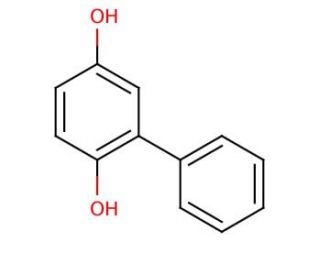

2-Phenylhydroquinone (CAS 1079-21-6)
QUICK LINKS
2-Phenylhydroquinone is a derivative of hydroquinone distinguished by the addition of a phenyl group at the second position, enhancing its chemical reactivity and stability compared to its parent compound. This aromatic hydroquinone variant is primarily utilized in the field of organic synthesis, where its properties are exploited in the creation of complex organic molecules such as dyes, antioxidants, and other phenol-derived compounds. The presence of the phenyl group significantly stabilizes radical intermediates, facilitating controlled synthetic pathways and improving reaction yields. 2-Phenylhydroquinone is also of interest in materials science, particularly in the development of polymers and photoresists, due to its ability to undergo redox reactions and act as a photosensitizer. This application is critical in processes involving UV light-induced polymerization, where 2-Phenylhydroquinone can initiate and propagate chain reactions leading to novel polymeric materials with specific properties. Its role in research extends to studying electron transfer mechanisms, which are pivotal in understanding and developing new materials for electronic and photonic applications. Overall, 2-Phenylhydroquinone serves as a versatile and valuable chemical tool in advancing synthetic chemistry and materials science research.
2-Phenylhydroquinone (CAS 1079-21-6) References
- Comparison of the applicability domain of a quantitative structure-activity relationship for estrogenicity with a large chemical inventory. | Netzeva, TI., et al. 2006. Environ Toxicol Chem. 25: 1223-30. PMID: 16704052
- Review of the existing maximum residue levels for 2-phenylphenol according to Article 12 of Regulation (EC) No 396/2005. | ,. 2017. EFSA J. 15: e04696. PMID: 32625404
- Preparation and Properties of Novel Crosslinked Polyphosphazene-Aromatic Ethers Organic-Inorganic Hybrid Microspheres. | Wang, Y., et al. 2022. Polymers (Basel). 14: PMID: 35745985
- Miniaturized flexible micro-tube plasma ionization source for the effective ionization of non-easily ionizable pesticides in food with liquid chromatography/mass spectrometry. | García-Martínez, J., et al. 2024. Talanta. 274: 126011. PMID: 38574537
- Comparative metabolism of ortho-phenylphenol in mouse, rat and man. | Bartels, MJ., et al. 1998. Xenobiotica. 28: 579-94. PMID: 9667081
- A study of coating properties of novel poly(amino-quinone)s prepared from 2-methylbenzoquinone and 2-phenylbenzoquinone† | T. Ashok Reddy, S. Erhan. 1994. Journal of Applied Polymer Science. 51: 1591-1595.
- Quinone-amine polymers. XII. Synthesis and characterization of novel polymers from 2-phenylbenzoquinone and aliphatic diamines | T. Ashok Reddy, S. Erhan. 1994. Journal of Polymer Science Part A: Polymer Chemistry. 32: 557-565.
- LCP aromatic polyesters by esterolysis melt polymerization | Woon-Seop Choi, Anne Buyle Padias, H. K. Hall Jr. 2000. 38: 3586-3595.
- A Rapid and Efficient Synthesis of Quinone Derivatives: Ru(II)- or Ir(I)-Catalyzed Hydrogen Peroxide Oxidation of Phenols and Methoxyarenes | Seiji Iwasa, Ahmad Fakhruddin, Herman Setyo Widagdo, Hisao Nishiyama. 2005. Advanced Synthesis & Catalysis. 347: 517-520.
- PTSA–catalyzed functionalization of hydroquinones with benzhydryl alcohols in water | Pallavi Singh, Udai Pratap Singh, Rama Krishna Peddinti. 2017. Tetrahedron Letters. 58: 2813-2817.
Ordering Information
| Product Name | Catalog # | UNIT | Price | Qty | FAVORITES | |
2-Phenylhydroquinone, 25 g | sc-223457 | 25 g | $41.00 | |||
2-Phenylhydroquinone, 100 g | sc-223457A | 100 g | $106.00 |