
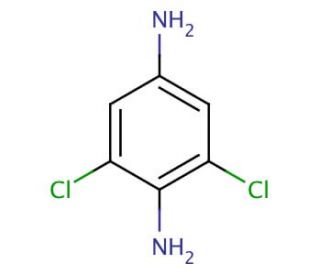

2,6-Dichloro-p-phenylenediamine (CAS 609-20-1)
LINK RAPIDI
La 2,6-dicloro-p-fenilendiammina (DCPD) è un composto amminico aromatico classificato nel gruppo delle ammine aromatiche. Questo solido incolore ha un odore caratteristico e presenta insolubilità in acqua. Nell'ambito della ricerca scientifica, la 2,6-dicloro-p-fenilendiammina svolge un ruolo fondamentale in diverse applicazioni. Funziona come reagente nella sintesi organica e funge da catalizzatore nella sintesi dei polimeri e nella produzione di altri composti organici. Inoltre, la 2,6-dicloro-p-fenilendiammina contribuisce alla creazione di coloranti, polimeri e altri prodotti industriali. Le proprietà catalitiche della 2,6-dicloro-p-fenilendiammina si evidenziano nella sintesi di polimeri e altri composti organici. Si ritiene che la reazione tra la 2,6-dicloro-p-fenilendiammina e i monomeri porti alla formazione di prodotti polimerici. Questa reazione comporta la generazione di un intermedio attivato, che successivamente subisce ulteriori reazioni per ottenere il polimero desiderato.
2,6-Dichloro-p-phenylenediamine (CAS 609-20-1) Referenze
- Cancerogenicità chimica: è possibile prevederla in base alla conoscenza della mutagenicità e della dermatite allergica da contatto? | Rosenkranz, HS. and Karol, MH. 1999. Mutat Res. 431: 81-91. PMID: 10656488
- Biotest di cancerogenesi della 2,6-dicloro-p-fenilendiammina (n. CAS 609-20-1) in ratti F344 e topi B6C3F1 (studio sui mangimi). | ,. 1982. Natl Toxicol Program Tech Rep Ser. 219: 1-121. PMID: 12778217
- Trasformazione microbica di derivati dell'anilina: biotrasformazione e detossificazione regioselettiva della 2-fenilendiammina da parte di Bacillus cereus ceppo PDa-1. | Takenaka, S., et al. 2006. J Biosci Bioeng. 102: 21-7. PMID: 16952832
- Prestazioni di 133 composti nell'endpoint dell'induzione di profagi lambda del saggio Microscreen e confronto con i saggi di mutagenicità di S. typhimurium e di cancerogenicità nei roditori. | Rossman, TG., et al. 1991. Mutat Res. 260: 349-67. PMID: 1831244
- Differenze significative nella base strutturale dell'induzione di scambi di cromatidi fratelli e aberrazioni cromosomiche in cellule ovariche di criceto cinese. | Rosenkranz, HS., et al. 1990. Environ Mol Mutagen. 16: 149-77. PMID: 2209572
- Epatociti pancreatici associati alla somministrazione cronica di 2,6-dicloro-p-fenilendiammina in ratti Fischer 344. | McDonald, MM. and Boorman, GA. 1989. Toxicol Pathol. 17: 1-6. PMID: 2665028
- Trasformazione riduttiva di composti nitroaromatici da parte di nanoparticelle di Pd su carbonio drogato con azoto (Pd@NC) biosintetizzate con Pantoea sp. IMH. | Liu, W., et al. 2019. J Hazard Mater. 366: 338-345. PMID: 30530026
- Esplorare le relazioni tra le potenze mutagene e cancerogene. | Piegorsch, WW. and Hoel, DG. 1988. Mutat Res. 196: 161-75. PMID: 3419441
- Potenziamento chimico della trasformazione del virus SA7 in cellule embrionali di criceto: valutazione mediante test interlaboratorio di diverse sostanze chimiche. | Hatch, GG., et al. 1986. Environ Mutagen. 8: 515-31. PMID: 3732194
- 2,6-dicloro-p-fenilendiammina: disposizione comparativa in ratti e topi maschi e femmine. | Ioannou, YM. and Matthews, HB. 1985. J Toxicol Environ Health. 16: 285-97. PMID: 4078934
- Confronto dei risultati dei test di aberrazione cromosomica e di micronucleo del midollo osseo di topo. | Shelby, MD. and Witt, KL. 1995. Environ Mol Mutagen. 25: 302-13. PMID: 7607185
- Valutazione della predittività del test di trasformazione cellulare dell'embrione di criceto siriano per la determinazione del potenziale cancerogeno nei roditori di composti amminici aromatici/nitroaromatici a singolo anello. | Kerckaert, GA., et al. 1998. Toxicol Sci. 41: 189-97. PMID: 9520355
- Cancerogeni specifici per i topi: una valutazione del pericolo e del significato per la convalida di biotest di cancerogenicità a breve termine in topi transgenici. | Battershill, JM. and Fielder, RJ. 1998. Hum Exp Toxicol. 17: 193-205. PMID: 9617631
Informazioni ordini
| Nome del prodotto | Codice del prodotto | UNITÀ | Prezzo | Quantità | Preferiti | |
2,6-Dichloro-p-phenylenediamine, 10 g | sc-231171 | 10 g | $180.00 |