
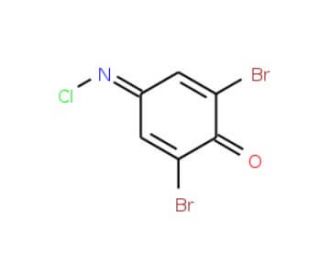

2,6-Dibromoquinone-4-chloroimide (CAS 537-45-1)
QUICK LINKS
2,6-Dibromoquinone-4-chloroimide is a reagent for the determination of phenols. The compound, 2,6-Dibromo-4-(chloroimino)cyclohexa-2,5-dienone, plays a significant role in scientific research, particularly in organic synthesis. It facilitates the synthesis of various compounds and also acts as a reagent in biochemical and physiological studies. Its versatile nature enables it to aid in the detection of proteins, nucleic acids, and other biomolecules. Due to its high reactivity, 2,6-Dibromo-4-(chloroimino)cyclohexa-2,5-dienone readily forms covalent bonds with a wide range of molecules. This property allows it to react with proteins, nucleic acids, and other biomolecules, leading to the formation of covalent bonds.
2,6-Dibromoquinone-4-chloroimide (CAS 537-45-1) References
- THE BACTERIAL DEGRADATION OF CATECHOL. | DAGLEY, S. and GIBSON, DT. 1965. Biochem J. 95: 466-74. PMID: 14340096
- Response of enzyme activities and microbial communities to soil amendment with sugar alcohols. | Yu, H., et al. 2016. Microbiologyopen. 5: 604-15. PMID: 27005019
- Novel Organophosphate Ligand O-(2-Fluoroethyl)-O-(p-Nitrophenyl)Methylphosphonate: Synthesis, Hydrolytic Stability and Analysis of the Inhibition and Reactivation of Cholinesterases. | Chao, CK., et al. 2016. Chem Res Toxicol. 29: 1810-1817. PMID: 27551891
- An improved radiosynthesis of O-(2-[18 F]fluoroethyl)-O-(p-nitrophenyl)methylphosphonate: A first-in-class cholinesterase PET tracer. | Neumann, KD., et al. 2017. J Labelled Comp Radiopharm. 60: 337-342. PMID: 28406525
- Combined use of a microbial restoration substrate and avirulent Ralstonia solanacearum for the control of tomato bacterial wilt. | Zheng, X., et al. 2019. Sci Rep. 9: 20091. PMID: 31882824
- Increasing the Efficacy of Seproxetine as an Antidepressant Using Charge-Transfer Complexes. | Alsanie, WF., et al. 2022. Molecules. 27: PMID: 35630766
- Attempting to Increase the Effectiveness of the Antidepressant Trazodone Hydrochloride Drug Using π-Acceptors. | Alsanie, WF., et al. 2022. Int J Environ Res Public Health. 19: PMID: 36141553
- Multispectral and Molecular Docking Studies Reveal Potential Effectiveness of Antidepressant Fluoxetine by Forming π-Acceptor Complexes. | Gaber, A., et al. 2022. Molecules. 27: PMID: 36144618
- Evaluation of exposure to phenol: absorption of phenol vapour in the lungs and through the skin and excretion of phenol in urine. | Piotrowski, JK. 1971. Br J Ind Med. 28: 172-8. PMID: 5572685
- Catabolism of phenylpropionic acid and its 3-hydroxy derivative by Escherichia coli. | Burlingame, R. and Chapman, PJ. 1983. J Bacteriol. 155: 113-21. PMID: 6345502
- Catabolism of pseudocumene and 3-ethyltoluene by Pseudomonas putida (arvilla) mt-2: evidence for new functions of the TOL (pWWO) plasmid. | Kunz, DA. and Chapman, PJ. 1981. J Bacteriol. 146: 179-91. PMID: 7216999
- Bacterial degradation of 3,4,5-trimethoxyphenylacetic and 3-ketoglutaric acids. | Donnelly, MI., et al. 1981. J Bacteriol. 147: 477-81. PMID: 7263613
- Production of methanol from aromatic acids by Pseudomonas putida. | Donnelly, MI. and Dagley, S. 1980. J Bacteriol. 142: 916-24. PMID: 7380811
Ordering Information
| Product Name | Catalog # | UNIT | Price | Qty | FAVORITES | |
2,6-Dibromoquinone-4-chloroimide, 5 g | sc-358745 | 5 g | $206.00 |