
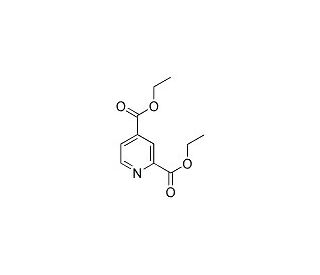

2,4-Diethylpyridine dicarboxylate (CAS 41438-38-4)
QUICK LINKS
2,4-Diethylpyridine dicarboxylate is a specialized compound that has the interest of researchers due to its pyridine core and carboxylate functional groups. In the realm of coordination chemistry, it acts as a ligand that can chelate to transition metals, forming coordination complexes that are studied for their catalytic properties and their potential use in fine chemical synthesis. The diethyl groups on the pyridine ring can influence the steric and electronic environment of the complex, which is for understanding and designing catalysts with specific reactivities. Additionally, this compound is involved in studies focusing on organic electronics, where its ability to donate electrons can be harnessed in the development of conductive materials. In the field of supramolecular chemistry, the dicarboxylate groups provide an opportunity to engage in hydrogen bonding and other non-covalent interactions, which are essential for constructing larger molecular assemblies.
2,4-Diethylpyridine dicarboxylate (CAS 41438-38-4) References
- Prolyl 4-hydroxylase is required for viability and morphogenesis in Caenorhabditis elegans. | Friedman, L., et al. 2000. Proc Natl Acad Sci U S A. 97: 4736-41. PMID: 10781079
- Targeting of HIF-alpha to the von Hippel-Lindau ubiquitylation complex by O2-regulated prolyl hydroxylation. | Jaakkola, P., et al. 2001. Science. 292: 468-72. PMID: 11292861
- HIFalpha targeted for VHL-mediated destruction by proline hydroxylation: implications for O2 sensing. | Ivan, M., et al. 2001. Science. 292: 464-8. PMID: 11292862
- A conserved family of prolyl-4-hydroxylases that modify HIF. | Bruick, RK. and McKnight, SL. 2001. Science. 294: 1337-40. PMID: 11598268
- Autophagy in cancer associated fibroblasts promotes tumor cell survival: Role of hypoxia, HIF1 induction and NFκB activation in the tumor stromal microenvironment. | Martinez-Outschoorn, UE., et al. 2010. Cell Cycle. 9: 3515-33. PMID: 20855962
- α-Ketoglutarate-related inhibitors of HIF prolyl hydroxylases are substrates of renal organic anion transporters 1 (OAT1) and 4 (OAT4). | Hagos, Y., et al. 2012. Pflugers Arch. 464: 367-74. PMID: 22875277
- Effects of prolyl 4-hydroxylase inhibitor on bladder function, bladder hypertrophy and collagen subtypes in a rat model with partial bladder outlet obstruction. | Chung, JM., et al. 2012. Urology. 80: 1390.e7-12. PMID: 22990063
- Renal organic anion transporters in drug-drug interactions and diseases. | Huo, X. and Liu, K. 2018. Eur J Pharm Sci. 112: 8-19. PMID: 29109021
Ordering Information
| Product Name | Catalog # | UNIT | Price | Qty | FAVORITES | |
2,4-Diethylpyridine dicarboxylate, 10 mg | sc-202405 | 10 mg | $21.00 | |||
2,4-Diethylpyridine dicarboxylate, 25 mg | sc-202405A | 25 mg | $68.00 |