
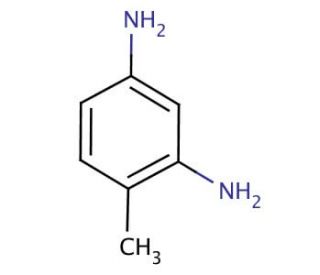

Molecular structure of 2,4-Diaminotoluene, CAS Number: 95-80-7
2,4-Diaminotoluene (CAS 95-80-7)
Alternate Names:
4-Methyl-1,3-phenylenediamine
CAS Number:
95-80-7
Molecular Weight:
122.17
Molecular Formula:
C7H10N2
Supplemental Information:
This is as a Dangerous Good for transport and may be subject to additional shipping charges.
For Research Use Only. Not Intended for Diagnostic or Therapeutic Use.
* Refer to Certificate of Analysis for lot specific data.
QUICK LINKS
Ordering Information
Description
Technical Information
Safety Information
SDS & Certificate of Analysis
2,4-Diaminotoluene (2,4-DAT) is a widely utilized chemical compound in organic synthesis, finding extensive applications in scientific research. This aromatic amine contains two amino groups bound to the same aromatic ring. Its significance lies in being a precursor for various compound syntheses. As for the mechanism of action, while not fully comprehended, it is believed that 2,4-Diaminotoluene functions as a nucleophile, readily donating electrons to other molecules. This electron donation leads to the formation of covalent bonds with the recipient molecules, culminating in the creation of novel compounds.
2,4-Diaminotoluene (CAS 95-80-7) References
- Bioassay of 2,4-diaminotoluene for possible carcinogenicity. | ,. 1979. Natl Cancer Inst Carcinog Tech Rep Ser. 162: 1-139. PMID: 12799700
- 2,4-Diaminotoluene (2,4-DAT)-induced DNA damage, DNA repair and micronucleus formation in the human hepatoma cell line HepG2. | Séverin, I., et al. 2005. Toxicology. 213: 138-46. PMID: 15996806
- Integration of in vivo genotoxicity and short-term carcinogenicity assays using F344 gpt delta transgenic rats: in vivo mutagenicity of 2,4-diaminotoluene and 2,6-diaminotoluene structural isomers. | Toyoda-Hokaiwado, N., et al. 2010. Toxicol Sci. 114: 71-8. PMID: 20026473
- Bioremediation of 2,4-dinitrotoluene (2,4-DNT) in immobilized micro-organism biological filter. | Wang, ZY., et al. 2011. J Appl Microbiol. 110: 1476-84. PMID: 21395949
- Biotransformation of 2,4-dinitrotoluene by obligate marine Shewanella marisflavi EP1 under anaerobic conditions. | Huang, J., et al. 2015. Bioresour Technol. 180: 200-6. PMID: 25603529
- [Determination of 2,4-diaminotoluene in Mianpi composite packaging film bags by ion-exchange solid-phase extraction-gas chromatography-mass spectrometry]. | Lu, Z., et al. 2019. Se Pu. 37: 1053-1058. PMID: 31642283
- An optimized method for RNA extraction from the polyurethane oligomer degrading strain Pseudomonas capeferrum TDA1 growing on aromatic substrates such as phenol and 2,4-diaminotoluene. | Cárdenas Espinosa, MJ., et al. 2021. PLoS One. 16: e0260002. PMID: 34780548
- Extracellular degradation of a polyurethane oligomer involving outer membrane vesicles and further insights on the degradation of 2,4-diaminotoluene in Pseudomonas capeferrum TDA1. | Puiggené, Ò., et al. 2022. Sci Rep. 12: 2666. PMID: 35177693
- High-performance liquid chromatography of 2,6- and 2,4-diaminotoluene, and its application to the determination of 2,4-diaminotoluene in urine and plasma. | Unger, PD. and Friedman, MA. 1979. J Chromatogr. 174: 379-84. PMID: 546895
- Differential in vivo mutagenicity of the carcinogen/non-carcinogen pair 2,4- and 2,6-diaminotoluene. | Hayward, JJ., et al. 1995. Carcinogenesis. 16: 2429-33. PMID: 7586147
- Genotoxic and non-genotoxic activities of 2,4- and 2,6-diaminotoluene, as evaluated in Fischer-344 rat liver. | Taningher, M., et al. 1995. Toxicology. 99: 1-10. PMID: 7761993
- Immunotoxicity of 2,4-diaminotoluene in female B6C3F1 mice. | Burns, LA., et al. 1994. Drug Chem Toxicol. 17: 401-36. PMID: 7988388
- Metabolic and genotoxic interactions of 2-aminofluorene and 2,4-diaminotoluene. | Pan, YH. and Reed, GA. 1997. Toxicol Lett. 91: 73-82. PMID: 9096289
Ordering Information
| Product Name | Catalog # | UNIT | Price | Qty | FAVORITES | |
2,4-Diaminotoluene, 1 g | sc-256319 | 1 g | $32.00 |