
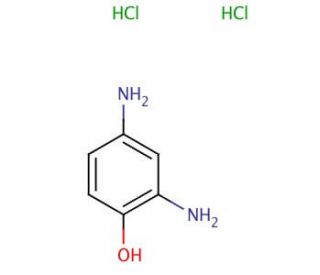

2,4-Diaminophenol dihydrochloride 의 분자 구조, CAS 번호: 137-09-7
2,4-Diaminophenol dihydrochloride (CAS 137-09-7)
대체 이름:
Amidol; 4-Hydroxy-m-phenylenediamine dihydrochloride
CAS 등록번호:
137-09-7
순도:
≥97%
분자량:
197.06
분자식:
C6H8N2O•2HCl
추가 정보:
운송용 위험물로 분류되어 추가 배송료가 부과될 수 있습니다.
연구용으로만 사용가능합니다. 진단이나 치료용으로 사용불가합니다.
* Refer to Certificate of Analysis for lot specific data.
빠른 링크
주문정보
설명
기술정보
안전정보
SDS 및 분석 증명서
2,4-다이아미노페놀 디히드로클로라이드는 물에 쉽게 녹아 과학 연구에서 광범위하게 응용되는 다용도 화합물이다. 이의 유용성은 유기 합성에서 킬레이트제, 환원제, 완충제 및 시약을 포함한 다양한 역할에 걸쳐 있다. 2,4-다이아미노페놀 디히드로클로라이드는 환원제 역할을 하여 금속 이온의 원소 형태로의 전환을 용이하게 한다. 이는 생화학적 분석에서 완충제 역할을 하며 pH 안정성을 보장하고 유기 합성에서 시약의 역할을 한다. 나아가 효소, 단백질 및 기타 생체 분자를 고정시킬 수 있어 이들의 연구 및 조작이 가능하다. 2,4-다이아미노페놀 디히드로클로라이드의 작용 메커니즘은 킬레이트제로서의 기능을 포함한다.
2,4-Diaminophenol dihydrochloride (CAS 137-09-7) 참고자료
- F344/N 쥐 및 B6C3F1 마우스에서 2,4-다이아미노페놀 염산염(CAS 번호 137-09-7)의 독성 및 발암 연구에 대한 NTP 기술 보고서(가비지 연구). | ,. 1992. Natl Toxicol Program Tech Rep Ser. 401: 1-232. PMID: 12621517
- 에스트로겐 수용체는 기저 전뇌의 콜린성 뉴런에서 저친화성 신경 성장 인자 수용체와 공동 분포합니다. | Toran-Allerand, CD., et al. 1992. Proc Natl Acad Sci U S A. 89: 4668-72. PMID: 1316615
- 고도 불포화 인지질은 감마-하이드록시알케날의 산화 및 분열을 촉진합니다: 산화적으로 절단된 에테르 인지질의 형성 및 반응. | Chen, X., et al. 2008. J Lipid Res. 49: 832-46. PMID: 18165704
- L5178Y tk+/tk- 마우스 림프종 세포 순방향 돌연변이 분석의 코딩된 화학물질에 대한 반응. I: 9가지 화합물에 대한 결과. | McGregor, DB., et al. 1987. Environ Mutagen. 9: 143-60. PMID: 3102223
- 폴리이미드 백본과 폴리(ε-카프로락톤) 측쇄를 가진 분자 브러쉬는 ATRP, ROP 및 CuAAC의 조합에 의해 만들어집니다. | Kashina, AV., et al. 2021. Polymers (Basel). 13: PMID: 34641128
- 녹색 및 적색 발광 형광 실리콘 나노입자: 합성, 메커니즘 및 산성 포스파타제 감지. | Han, Y., et al. 2022. ACS Appl Bio Mater. 5: 295-304. PMID: 35014839
- 염색약 성분과 염색약 노출로 인한 잠재적 건강 위험. | He, L., et al. 2022. Chem Res Toxicol. 35: 901-915. PMID: 35666914
- 중국 칭하이 고원의 야크(보스 그루니엔스) 우유에 함유된 칼슘, 인, 마그네슘의 분포. | Franceschi, P., et al. 2023. Foods. 12: PMID: 37048234
- 초파리에서의 화학적 돌연변이 유발 테스트. II. 국가 독성학 프로그램에서 테스트한 20개의 코드화 화합물 결과. | Zimmering, S., et al. 1985. Environ Mutagen. 7: 87-100. PMID: 3917911
- 식이 제한과 암. | Hart, RW. and Turturro, A. 1997. Environ Health Perspect. 105 Suppl 4: 989-92. PMID: 9255593
주문정보
| 제품명 | 카탈로그 번호 | 단위 | 가격 | 수량 | 관심품목 | |
2,4-Diaminophenol dihydrochloride, 25 g | sc-238313 | 25 g | $98.00 |