
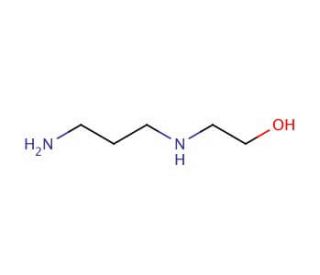

2-(3-Aminopropylamino)ethanol (CAS 4461-39-6)
LINKS RÁPIDOS
O 2-(3-Aminopropilamino)etanol, um composto orgânico pertencente à família das aminas, serve como um bloco de construção versátil para vários compostos químicos. Esse líquido incolor, com um leve odor, tem utilidade primária como reagente em diversos experimentos de laboratório. Suas aplicações em pesquisas científicas são multifacetadas, abrangendo a síntese de diferentes compostos químicos e estudos extensivos sobre seu mecanismo de ação. A importância do 2-(3-Aminopropilamino)etanol na pesquisa científica se estende a vários domínios. Ele serve como um reagente crucial na síntese de polímeros, contribuindo para a produção de produtos farmacêuticos, peptídeos, proteínas, corantes orgânicos e pigmentos. Além disso, esse composto tem desempenhado um papel fundamental no estudo da cinética enzimática e na elucidação do mecanismo de ação de medicamentos específicos. Embora o mecanismo preciso de ação do 2-(3-Aminopropilamino)etanol permaneça indefinido, acredita-se que ele envolva a formação de uma ligação de hidrogênio entre essa molécula e a molécula alvo. Essa ligação de hidrogênio facilita a interação entre o 2-(3-Aminopropilamino)etanol e a molécula alvo, afetando, em última análise, a estrutura e a função da molécula alvo.
2-(3-Aminopropylamino)ethanol (CAS 4461-39-6) Referencias
- Análise estrutura-atividade da potenciação por aminotióis do efeito danificador dos cromossomas da bleomicina em linfócitos humanos G0. | Hoffmann, GR., et al. 2001. Environ Mol Mutagen. 37: 117-27. PMID: 11246218
- Verificação da exposição a organofosforados: Método genérico de espetrometria de massa para a deteção de aductos de butirilcolinesterase humana. | Noort, D., et al. 2006. Anal Chem. 78: 6640-4. PMID: 16970345
- Supressão a longo prazo da neovascularização ocular através da injeção intraocular de partículas poliméricas biodegradáveis contendo um péptido derivado da serpina. | Shmueli, RB., et al. 2013. Biomaterials. 34: 7544-51. PMID: 23849876
- A estrutura diferencial do polímero afina o mecanismo de absorção celular e as vias de transfecção de poliplexos de poli(β-aminoéster) em células de cancro da mama humano. | Kim, J., et al. 2014. Bioconjug Chem. 25: 43-51. PMID: 24320687
- Montagem microfluídica contínua de nanopartículas biodegradáveis de poli(beta-aminoéster)/DNA para uma melhor entrega de genes. | Wilson, DR., et al. 2017. J Biomed Mater Res A. 105: 1813-1825. PMID: 28177587
- Nanopartículas poliméricas como vectores de entrega de ADN específicos do cancro para o carcinoma hepatocelular humano. | Zamboni, CG., et al. 2017. J Control Release. 263: 18-28. PMID: 28351668
- Quadpolímeros de éster-amina diferentemente ramificados com propriedades anfifílicas e sensíveis ao pH para uma entrega eficiente de DNA de plasmídeo. | Wilson, DR., et al. 2019. Mol Pharm. 16: 655-668. PMID: 30615464
- Avaliação de alto rendimento de nanopartículas poliméricas para expressão de genes dirigidos a tecidos utilizando ADN plasmídico com código de barras. | Kim, J., et al. 2021. J Control Release. 337: 105-116. PMID: 34097924
- As nanopartículas de poli(beta-aminoéster) permitem a secreção de TRAIL específica do tumor e um efeito espetador para tratar o cancro do fígado. | Vaughan, HJ., et al. 2021. Mol Ther Oncolytics. 21: 377-388. PMID: 34189258
- Nanoterapêuticas direccionadas para E7 em lesões cervicais afectadas pelo HPV através da utilização de CRISPR/Cas9 e poli (beta-amino-éster). | Xiong, J., et al. 2021. Int J Nanomedicine. 16: 7609-7622. PMID: 34819726
- Nova reação de eliminação de um grupo hidroxietilo num complexo de manganês. Formação de um complexo binuclear de manganês(II) com um ligando macrocíclico do tipo Robson | Mikuriya, M., Nakadera, K., & Tokii, T. 1992. Inorganica chimica acta. 194(2): 129-131.
- Imobilização de aminotióis em poli(oxietileno H-fosfonato)s e poli(oxietileno fosfato)s - Uma abordagem aos agentes protectores poliméricos para radioterapia do cancro | Troev, K., Tsatcheva, I., Koseva, N., Georgieva, R., & Gitsov, I. 2007. Journal of Polymer Science Part A: Polymer Chemistry. 45(7): 1349-1363.
- Condensação Aldeído-Amina Mediada por Iões Halogenados Conduzindo a Complexos Ligandos de CdII de Base de Schiff e de Base Não de Schiff Ciclizada: Uma Investigação Experimental e Teórica Combinada | Purkait, S., Chakraborty, P., Bauzá, A., Frontera, A., Massera, C., & Das, D. 2016. ChemistrySelect. 1(15): 4539-4549.
Informacoes sobre ordens
| Nome do Produto | Numero de Catalogo | UNID | Preco | Qde | FAVORITOS | |
2-(3-Aminopropylamino)ethanol, 5 g | sc-251663 | 5 g | $109.00 |