
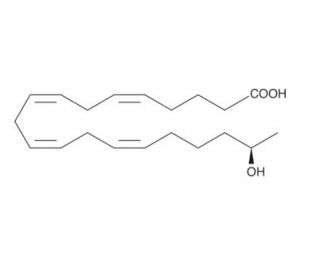

19(R)-HETE (CAS 115461-39-7)
Direktverknüpfungen
19(R)-HETE mit der CAS-Nummer 115461-39-7 ist ein spezifisches Isomer von Hydroxyeicosatetraensäure (HETE), einem Metaboliten der Arachidonsäure, der hauptsächlich durch die Wirkung von Cytochrom-P450-Enzymen auf diese essenzielle Fettsäure entsteht. Als Mitglied der HETE-Familie spielt 19(R)-HETE eine wichtige Rolle bei der Modulation verschiedener biologischer Prozesse, einschließlich derer, die mit der Regulierung des Gefäßtonus und der zellulären Signalwege zusammenhängen. Diese Verbindung ist insbesondere für ihre Beteiligung am komplizierten Gleichgewicht der vasoaktiven Mediatoren bekannt, die zur Regulierung des Blutflusses und des Gefäßwiderstands beitragen. In der Forschung wurde 19(R)-HETE ausgiebig genutzt, um seine Auswirkungen auf intrazelluläre Signalmechanismen und seine Interaktionen mit spezifischen Rezeptoren und Ionenkanälen in vaskulären Endothel- und glatten Muskelzellen zu untersuchen. Indem sie verstehen, wie 19(R)-HETE diese zellulären Prozesse beeinflusst, können die Forscher umfassendere physiologische Konzepte aufklären und zum grundlegenden Wissen in Bereichen wie Biochemie und Gefäßbiologie beitragen.
19(R)-HETE (CAS 115461-39-7) Literaturhinweise
- 20-HETE-Agonisten und -Antagonisten im Nierenkreislauf. | Alonso-Galicia, M., et al. 1999. Am J Physiol. 277: F790-6. PMID: 10564244
- Verminderte Konzentrationen von Cytochrom P450 2E1-abgeleiteten Eicosanoiden sensibilisieren die Nierenarterien bei spontan hypertensiven Ratten für konstriktive Agonisten. | Zhang, F., et al. 2005. Hypertension. 45: 103-8. PMID: 15569854
- 20-Hydroxyeicosatetraensäure verursacht endotheliale Dysfunktion durch eNOS-Entkopplung. | Cheng, J., et al. 2008. Am J Physiol Heart Circ Physiol. 294: H1018-26. PMID: 18156192
- Das S-Enantiomer der 19-Hydroxyeicosatetraensäure schützt bevorzugt vor Angiotensin II-induzierter Herzhypertrophie. | Shoieb, SM. and El-Kadi, AOS. 2018. Drug Metab Dispos. 46: 1157-1168. PMID: 29880629
- Geschlechts- und enantiospezifische Unterschiede in der Bildungsrate von Hydroxyeicosatetraensäuren in Rattenorganen. | Gerges, SH., et al. 2023. Can J Physiol Pharmacol. 101: 425-436. PMID: 37220651
- Plasma-Oxylipin-Profil von Milchkühen nach der Geburt, eingeteilt in verschiedene systemische Entzündungsgrade in der ersten Woche nach dem Absetzen. | Grantz, JM., et al. 2024. JDS Commun. 5: 155-160. PMID: 38482129
- 20-Hydroxyeicosatetraensäure ist ein endogener Vasokonstriktor der renalen Arcuata-Arterien von Hunden. | Ma, YH., et al. 1993. Circ Res. 72: 126-36. PMID: 8417836
- Bildung von 19(S)-, 19(R)- und 18(R)-Hydroxyeicosatetraensäuren durch alkoholinduziertes Cytochrom P450 2E1. | Laethem, RM., et al. 1993. J Biol Chem. 268: 12912-8. PMID: 8509425
- 20-Hydroxyeicosatetraensäure wird in Reaktion auf EGF gebildet und ist ein Mitogen im proximalen Tubulus der Ratte. | Lin, F., et al. 1995. Am J Physiol. 269: F806-16. PMID: 8594874
- Cytochrom P-450-abhängige HETEs: Profil der biologischen Aktivität und Stimulation durch vasoaktive Peptide. | Carroll, MA., et al. 1996. Am J Physiol. 271: R863-9. PMID: 8897975
Bestellinformation
| Produkt | Katalog # | EINHEIT | Preis | ANZAHL | Favoriten | |
19(R)-HETE, 25 µg | sc-204615 | 25 µg | $133.00 | |||
19(R)-HETE, 50 µg | sc-204615A | 50 µg | $255.00 |