
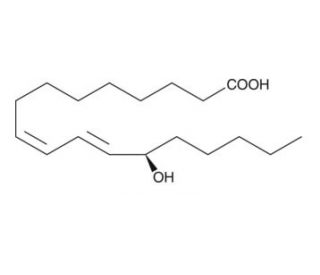

13(R)-HODE (CAS 10219-69-9)
QUICK LINKS
13(R)-HODE, with the CAS number 10219-69-9, represents the R-enantiomer of 13-hydroxyoctadecadienoic acid, a metabolite produced predominantly through the enzymatic oxidation of linoleic acid by 15-lipoxygenases. This specific enantiomer is of great interest in biochemical research due to its unique properties and roles in cellular mechanisms. As a signaling molecule, 13(R)-HODE is involved in the regulation of a host of cellular processes, including the modulation of inflammatory responses and the stabilization of cellular structures through its interaction with lipid membranes. It plays a critical role in understanding the mechanisms of lipid signaling that influence cell behavior, particularly in the context of oxidative stress and inflammation. In experimental research, 13(R)-HODE is utilized to explore its effects on various signaling pathways, including those related to apoptosis, cell differentiation, and immune cell regulation. Its ability to bind and activate specific receptors, such as peroxisome proliferator-activated receptors (PPARs), makes it an important tool for studying lipid-mediated regulatory mechanisms. Through such studies, 13(R)-HODE helps explain the complex interactions between lipid metabolism products and cellular signaling pathways, enhancing our understanding of the biochemical pathways that underpin cellular responses to environmental stimuli and internal metabolic changes.
13(R)-HODE (CAS 10219-69-9) References
- Stereospecificity of the hydroxyeicosatetraenoic and hydroxyoctadecadienoic acids produced by cultured bovine endothelial cells. | Baer, AN., et al. 1991. Biochim Biophys Acta. 1085: 45-52. PMID: 1892877
- Immunohistochemical detection of 13(R)-hydroxyoctadecadienoic acid in atherosclerotic plaques of human carotid arteries using a novel specific antibody. | Shibata, N., et al. 2009. Acta Histochem Cytochem. 42: 197-203. PMID: 20126573
- Oxidized lipids and lysophosphatidylcholine induce the chemotaxis and intracellular calcium influx in natural killer cells. | Rolin, J., et al. 2013. Immunobiology. 218: 875-83. PMID: 23200035
- Differential cell growth/apoptosis behavior of 13-hydroxyoctadecadienoic acid enantiomers in a colorectal cancer cell line. | Cabral, M., et al. 2014. Am J Physiol Gastrointest Liver Physiol. 307: G664-71. PMID: 25035111
- Oxidized lipids and lysophosphatidylcholine induce the chemotaxis, up-regulate the expression of CCR9 and CXCR4 and abrogate the release of IL-6 in human monocytes. | Rolin, J., et al. 2014. Toxins (Basel). 6: 2840-56. PMID: 25251539
- Further studies on the anti-thromboxane A2 activity of monohydroxylated fatty acids. | Lagarde, M., et al. 1989. Biochem Pharmacol. 38: 1863-4. PMID: 2735941
- Metabolomics implicate eicosanoids in severe functional mitral regurgitation. | Hofbauer, TM., et al. 2023. ESC Heart Fail. 10: 311-321. PMID: 36217578
- Characterization of microalgal toxicants in the sediments from an industrial area: Application of advanced effect-directed analysis with multiple endpoint bioassays. | An, SA., et al. 2023. Environ Int. 173: 107833. PMID: 36841187
- A comprehensive review of the botany, ethnopharmacology, phytochemistry, pharmacology, quality control and other applications of Ligustici Rhizoma et Radix. | Liu, Y., et al. 2024. J Ethnopharmacol. 323: 117687. PMID: 38163554
- Liangxue-Qushi-Zhiyang Decoction Ameliorates DNCB-Induced Atopic Dermatitis in Mice through the MAPK Signaling Pathway Based on Network Pharmacology. | Zhang, L., et al. 2024. ACS Omega. 9: 17931-17944. PMID: 38680355
- Metabolomics and electronic tongue reveal the effects of different storage years on metabolites and taste quality of Oolong Tea | Sun, L., Zhang, S., Li, Q., Yuan, E., Chen, R., Yan, F.,.. & Sun, S. 2023. Food Control. 152: 109847.
Ordering Information
| Product Name | Catalog # | UNIT | Price | Qty | FAVORITES | |
13(R)-HODE, 25 µg | sc-205004 | 25 µg | $77.00 | |||
13(R)-HODE, 50 µg | sc-205004A | 50 µg | $146.00 |