
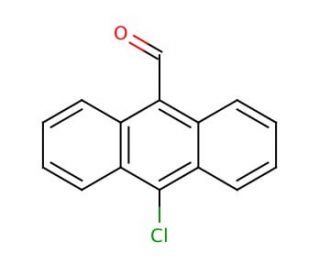

10-Chloro-9-anthraldehyde 的分子结构, CAS编号: 10527-16-9
10-Chloro-9-anthraldehyde (CAS 10527-16-9)
CAS号码:
10527-16-9
纯度:
≥95%
分子量:
240.68
分子式:
C15H9ClO
仅供科研使用。不可用于诊断或治疗。
* 参考分析证明 大量特定数据 (包括水 含量).
快捷链接
订购信息
描述
技术信息
安全信息
安全技术说明书和分析证明书
10-氯-9-蒽醛,也被称为10-Cl-9-Ald,是一种归类为醛的人工化合物。它呈现为无色结晶固体,分子量为240.68 g/mol。该化合物具有多种性质,在有机合成领域是一种有价值的试剂。其潜在应用扩展到多个领域,包括医学、材料科学和生物化学。在材料科学中,10-氯-9-蒽醛可用于合成聚合物和其他材料。同样,在生物化学领域,它有助于合成酶和其他生物分子。虽然10-氯-9-蒽醛的确切作用机制尚不清楚,但已知它能与多种化合物发生反应,从而创造出可用于各种应用的新型化合物。
10-Chloro-9-anthraldehyde (CAS 10527-16-9) 参考文献
- 抗疟氨基醇 II:蒽氨基乙醇和蒽氨基丙醇(1-和 9-取代)。 | Traxler, JT., et al. 1975. J Pharm Sci. 64: 1943-9. PMID: 1107515
- 用于固相微萃取的创新性溶胶-凝胶涂层。开发用于测定水中痕量多环芳烃的纤维。 | Bianchi, F., et al. 2008. J Chromatogr A. 1196-1197: 15-22. PMID: 18258246
- 基于光诱导电子转移的新型杂交探针的设计与合成。 | Yokoyama, C., et al. 2017. Bioorg Med Chem. 25: 3574-3582. PMID: 28522268
- 与妥布霉素共轭的两性赖氨酸可协同传统抗生素对抗野生型和耐多药铜绿假单胞菌。 | Lyu, Y., et al. 2017. Biopolymers.. PMID: 29205266
- 一种低氧激活的抗菌原药。 | Yeoh, YQ., et al. 2020. Bioorg Med Chem Lett. 30: 127140. PMID: 32247730
- 一些 3,5-二氨基异三嗪衍生物的抗疟活性。 | Rees, RW., et al. 1972. J Med Chem. 15: 859-61. PMID: 5044307
- 卤代蒽醛的合成及其向抗疟氨基醇的转化。 | Traxler, JT., et al. 1972. J Med Chem. 15: 861-3. PMID: 5044308
- 具有中枢兴奋剂活性的 3-色胺盐酸盐。 | Lockhart, IM. and Foard, SA. 1972. J Med Chem. 15: 863-5. PMID: 5044309
- 某些芳香醛中醛基松弛的立体效应 | Lakshmi, A., Walker, S., Weir, N. A., & Calderwood, J. H. 1978. The Journal of Physical Chemistry. 82(9): 1091-1095.
- 分子内 Diels-Alder 加成。1.蒽和吖啶的加成反应 | Ciganek, E. 1980. The Journal of Organic Chemistry. 45(8): 1497-1505.
- 离子对在电子供体-受体复合物光化学中的作用。芳烃-四氰基乙烯体系的皮秒光谱研究 | Hilinski, E. F., Masnovi, J. M., Kochi, J. K., & Rentzepis, P. M. 1984. Journal of the American Chemical Society. 106(26): 8071-8077.
- 在催化过程中利用流动化学:选择性合成双(吲哚基)甲烷的新途径 | Mohapatra, S. S., Wilson, Z. E., Roy, S., & Ley, S. V. 2017. Tetrahedron. 73(14): 1812-1819.
- 多芳香族硫代氨基甲酸及其铜络合物的 DNA 和 BSA 相互作用研究及抗白血病评估 | Pelosi, G., Pinelli, S., & Bisceglie, F. 2022. Compounds. 2(2): 144-162.
订购信息
| 产品名称 | 产品编号 | 规格 | 价格 | 数量 | 收藏夹 | |
10-Chloro-9-anthraldehyde, 1 g | sc-223140 | 1 g | $119.00 |