
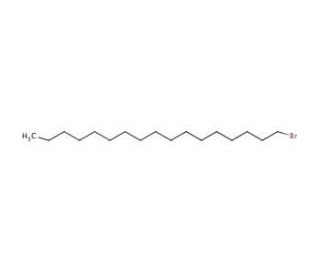

1-bromoheptadecane (CAS 3508-00-7)
QUICK LINKS
1-bromoheptadecane, with the CAS number 3508-00-7, is a long-chain alkyl bromide characterized by a seventeen-carbon hydrocarbon chain terminated with a bromine atom. This structure categorizes it among the higher alkyl halides, which are known for their reactivity and utility in various chemical synthesis processes. In research, 1-bromoheptadecane is primarily used as an alkylating agent in the synthesis of other complex molecules, particularly in the preparation of various esters, polymers, and longer chained organic compounds. Its utility stems from the bromine atom, which acts as a good leaving group in nucleophilic substitution reactions, thereby facilitating the introduction of the heptadecyl group into target molecules. This chemical′s properties make it ideal for studying phase behavior in mixed systems, the formation of self-assembled monolayers, and the behavior of organic compounds at interfaces. Additionally, 1-bromoheptadecane is utilized in experiments designed to explore the kinetics and mechanisms of its reactions with other nucleophiles, helping to explain underlying principles in organic chemistry. Through these applications, 1-bromoheptadecane contributes significantly to advancing the knowledge of chemical properties and reactivities of long-chain alkyl halides in non-biomedical research contexts.
1-bromoheptadecane (CAS 3508-00-7) References
- Evidence for contact sex recognition pheromone of the Asian longhorned beetle, Anoplophora glabripennis (Coleoptera: Cerambycidae). | Zhang, A., et al. 2003. Naturwissenschaften. 90: 410-3. PMID: 14504784
- A comparison of reactivity schemes for the prediction skin sensitization potential. | Patlewicz, G., et al. 2008. Chem Res Toxicol. 21: 521-41. PMID: 18189364
- Molecular self-assembly at bare semiconductor surfaces: characterization of a homologous series of n-alkanethiolate monolayers on GaAs(001). | McGuiness, CL., et al. 2007. ACS Nano. 1: 30-49. PMID: 19203128
- Hierarchical chemosensory regulation of male-male social interactions in Drosophila. | Wang, L., et al. 2011. Nat Neurosci. 14: 757-62. PMID: 21516101
- Sex-specific trail pheromone mediates complex mate finding behavior in Anoplophora glabripennis. | Hoover, K., et al. 2014. J Chem Ecol. 40: 169-80. PMID: 24510414
- Catalytic Access to Alkyl Bromides, Chlorides and Iodides via Visible Light-Promoted Decarboxylative Halogenation. | Candish, L., et al. 2016. Chemistry. 22: 9971-4. PMID: 27191347
- HExpPredict: In Vivo Exposure Prediction of Human Blood Exposome Using a Random Forest Model and Its Application in Chemical Risk Prioritization. | Zhao, F., et al. 2023. Environ Health Perspect. 131: 37009. PMID: 36913238
- Microbiological oxidation of long-chain aliphatic compounds. 3. 1-halogenoalkenes, 1-cyanohexadecane, and 1-alkoxyalkanes. | Jones, DF. and Howe, R. 1968. J Chem Soc Perkin 1. 22: 2816-21. PMID: 5749355
- Regiospecific attack of nitrogen and sulfur nucleophiles on quinones derived from poison oak/ivy catechols (urushiols) and analogues as models for urushiol-protein conjugate formation. | Liberato, DJ., et al. 1981. J Med Chem. 24: 28-33. PMID: 7205871
- In vitro release of cytarabine from swellable matrices of CnEmCn triblock copolymers. | Ameri, M., et al. 1998. J Control Release. 56: 1-6. PMID: 9801424
Ordering Information
| Product Name | Catalog # | UNIT | Price | Qty | FAVORITES | |
1-bromoheptadecane, 1 g | sc-208642 | 1 g | $300.00 |