
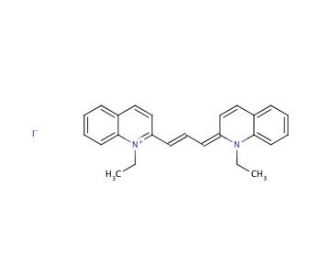

1,1′-Diethyl-2,2′-carbocyanine iodide (CAS 605-91-4)
QUICK LINKS
1,1′-Diethyl-2,2′-carbocyanine iodide, also known as Pinacyanol iodide, is a fluorescent cationic cyanine dye. The molecule contains two nitrogen atoms interacting through a conjugated pi system with one nitrogen bearing a formal positive charge, setting up a "push-pull" alkene system that poises the dye for strong interaction with light - a property of the cyanines that has been exploited for use in laser spectroscopy, formulation of photographic emulsions, and numerous other applications. The interaction between surfactants and dyes is assessable through resulting changes in absorption and emission of the light-active compound, and this principle has permitted the use of the closely related Pinacyanol chloride in determining physical and chemical information of cationic surfactants, micelles, and vesicles. The dimer of 1,1′-Diethyl-2,2′-carbocyanine iodide also absorbs and this dimerization can be monitered by changes in the observed absorption wavelength of a sample.
1,1′-Diethyl-2,2′-carbocyanine iodide (CAS 605-91-4) References
- A comparative study of the photosensitizing characteristics of some cyanine dyes. | Delaey, E., et al. 2000. J Photochem Photobiol B. 55: 27-36. PMID: 10877064
- Location of Pinacyanol in Micellar Solutions of N-Alkyl Trimethylammonium Bromide Surfactants. | Sabaté, R., et al. 2001. J Colloid Interface Sci. 233: 205-210. PMID: 11121267
- Cyanines during the 1990s: A Review. | Mishra, A., et al. 2000. Chem Rev. 100: 1973-2012. PMID: 11749281
- Molecular structural requirements, dye specificity, and application of anionic peptide amphiphiles that induce intense fluorescence in cationic dyes. | Hachisako, H., et al. 2009. Org Biomol Chem. 7: 2327-37. PMID: 19462042
- Passive mode locking of a continuous-wave energy-transfer dye laser operating in the near infrared around 750 nm. | French, PM., et al. 1987. Opt Lett. 12: 684-6. PMID: 19741839
- Photophysics of cyanine dyes on surfaces. A new emission from aggregates of 2, 2′-cyanines adsorbed onto microcrystalline cellulose | VieiraáFerreira, L. F. 1996. Journal of the Chemical Society, Faraday Transactions. 92(7): 1217-1225.
- AM1 semiempirical calculated potential energy surfaces for the isomerization of symmetrical carbocyanines | Park, J. 2000. Dyes and pigments. 46(3): 155-161.
- Adsorption of thiacyanine dyes on silver halide nanoparticles: Study of the adsorption site | Jeunieau, L., Alin, V., & Nagy, J. B. 2000. Langmuir. 16(2): 597-606.
- Determination of the structure of 1,1′-diethyl-2,2′-carbocyanine iodide using NMR spectra and GIAO-HF/DFT calculations | Kim, S. M., & Kim, D. H. 2008. Dyes and Pigments,. 79(1): 1-6.
- Ratiometric fluorescence detection of hydroxyl radical using cyanine-based binary nanoGUMBOS | Cong, M., Siraj, N., Bhattarai, N., Kolic, P. E., McCarter, K. S., Chhotaray, P. K., & Warner, I. M. 2018. Sensors and Actuators B: Chemical. 257: 993-1000.
Ordering Information
| Product Name | Catalog # | UNIT | Price | Qty | FAVORITES | |
1,1′-Diethyl-2,2′-carbocyanine iodide, 250 mg | sc-206215 | 250 mg | $84.00 | |||
1,1′-Diethyl-2,2′-carbocyanine iodide, 1 g | sc-206215A | 1 g | $228.00 |