
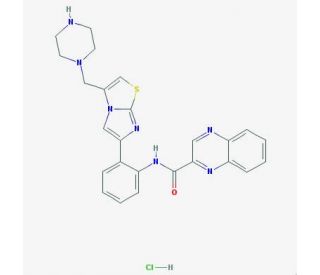

SRT1720 (CAS 1001645-58-4)
Produktreferenzen ansehen (13)
Direktverknüpfungen
SRT1720 ist ein Aktivator von Sirtuin-1 (SIRT1), einer NAD-abhängigen Deacetylase (EC50 = 0,16 μM), der hochselektiv für SIRT1 im Vergleich zu SIRT2 oder SIRT3 ist. Er bindet an den Enzym-Peptid-Substrat-Komplex von SIRT1 am allosterischen Zentrum des aminoterminalen Ende der katalytischen Domäne und senkt die Michaelis-Konstante für acetylierte Substrate. Das humane SIRT1 ist das Homolog von Silent Information Regulator 2 (Sir2) in Hefe und kann die Aktivität des Tumorsuppressors p53 regulieren und die Apoptose hemmen. Studien in Hefe legen nahe, dass Sirtuine an epigenetischem Gen-Silencing und der Deacetylierung von Proteinen, die den Zellzyklus regulieren, beteiligt sein könnten. Es kann die Lebensdauer in Hefe und C. elegans auf eine Weise verlängern, die der kalorischen Restriktion ähnelt.
SRT1720 (CAS 1001645-58-4) Literaturhinweise
- Kleine Molekülaktivatoren von SIRT1 als Therapeutika für die Behandlung von Typ-2-Diabetes. | Milne, JC., et al. 2007. Nature. 450: 712-6. PMID: 18046409
- Präklinische Bewertung des neuartigen SIRT1-Modulators SRT1720 in Zellen des multiplen Myeloms. | Chauhan, D., et al. 2011. Br J Haematol. 155: 588-98. PMID: 21950728
- SRT1720, ein SIRT1-Aktivator, fördert die Migration von Tumorzellen und die Lungenmetastasierung von Brustkrebs bei Mäusen. | Suzuki, K., et al. 2012. Oncol Rep. 27: 1726-32. PMID: 22470132
- Sirtuin-Aktivatoren und -Inhibitoren. | Villalba, JM. and Alcaín, FJ. 2012. Biofactors. 38: 349-59. PMID: 22730114
- Die Histon-Deacetylase SIRT1 trägt bei jungen Mäusen zur Resistenz gegen eine durch Ischämie/Reperfusion verursachte akute Nierenverletzung bei. | Fan, H., et al. 2013. Kidney Int. 83: 404-13. PMID: 23302720
- Strukturen von menschlichen Sirtuin-3-Komplexen mit ADP-Ribose und mit Carba-NAD+ und SRT1720: Bindungsdetails und Hemmungsmechanismus. | Nguyen, GT., et al. 2013. Acta Crystallogr D Biol Crystallogr. 69: 1423-32. PMID: 23897466
- SIRT1 reguliert die durch Amyloid-Beta ausgelöste Entzündung negativ über den NF-κB-Signalweg. | Cao, L., et al. 2013. Braz J Med Biol Res. 46: 659-69. PMID: 24036938
- Der SIRT1-Aktivator SRT1720 verlängert die Lebensspanne und verbessert die Gesundheit von Mäusen, die mit einer Standarddiät gefüttert werden. | Mitchell, SJ., et al. 2014. Cell Rep. 6: 836-43. PMID: 24582957
- SRT1720 induziert den lysosomal-abhängigen Zelltod von Brustkrebszellen. | Lahusen, TJ. and Deng, CX. 2015. Mol Cancer Ther. 14: 183-92. PMID: 25411356
- Die Vorbehandlung mit SRT1720 fördert die mitochondriale Biogenese gealterter menschlicher mesenchymaler Stammzellen und verbessert deren Transplantation in postinfarktierten Herzen nichtmenschlicher Primaten. | Zeng, Z., et al. 2021. Stem Cells Dev. 30: 386-398. PMID: 33567991
- SRT1720 verbessert die Reifung und Qualität von Eizellen bei älteren Mäusen. | Liu, MJ., et al. 2021. Anim Sci J. 92: e13608. PMID: 34405491
- SRT1720 hemmt das Wachstum von Blasenkrebs in Organoiden und Mausmodellen durch die SIRT1-HIF-Achse. | Tan, P., et al. 2021. Oncogene. 40: 6081-6092. PMID: 34471236
- Scherstress-induzierte zelluläre Seneszenz beeinträchtigt die Leberregeneration durch die Notch-Sirtuin 1-P21/P16-Achse. | Duan, JL., et al. 2022. Hepatology. 75: 584-599. PMID: 34687050
- SRT1720 induziert den SIRT1-unabhängigen Zelltod bei adulter T-Zell-Leukämie/Lymphom. | Kozako, T., et al. 2022. FEBS J. 289: 3477-3488. PMID: 35029032
Bestellinformation
| Produkt | Katalog # | EINHEIT | Preis | ANZAHL | Favoriten | |
SRT1720, 5 mg | sc-364624 | 5 mg | $197.00 | |||
SRT1720, 10 mg | sc-364624A | 10 mg | $364.00 |