
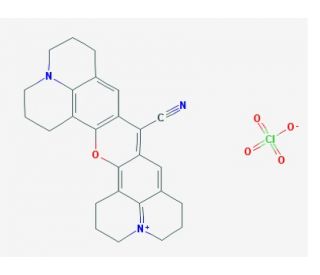


Rhodamine 800 の分子構造、CAS番号: 101027-54-7
Rhodamine 800 (CAS 101027-54-7)
参考文献をチェックします (1)
別名:
6-(3-methylbut-2-enyl)-1H-indole-2,3-dione
アプリケーション:
Rhodamine 800は、フローサイトメトリーに使用されるレーザー色素です
CAS 番号:
101027-54-7
分子量:
495.95
分子式:
C26H26ClN3O5
試験・研究用以外には使用しないでください。 臨床及び体外診断には使用できません。
* Refer to Certificate of Analysis for lot specific data.
クイックリンク
注文情報
参考文献
説明
技術サポート情報
安全情報
SDSと分析証明書
ローダミン800は蛍光色素で、研究および分析用途に広く使用されている。青紫色領域の光を吸収し、可視スペクトルの赤橙色領域の光を放出する。研究者は一般的に、細胞内のタンパク質の検出、分子の動きの追跡、分子間相互作用の研究など、さまざまな目的で蛍光色素を使用している。蛍光顕微鏡やイメージングでは、ローダミン800によって生きた細胞内の細胞小器官や分子を可視化することができる。フローサイトメトリーでは、DNAレベルの測定やタンパク質やその他の分子の定量に威力を発揮する。さらに、分析化学の分野では、サンプル中の低分子を検出・定量できるローダミン800の利点が生かされている。ローダミン800はローダミン系に属し、2分子のローダミンBがニトロエチレン基で結合したものである。明るい赤橙色の蛍光を示すため、生化学研究においてタンパク質、核酸、その他の分子の標識に最適である。ローダミン800の蛍光は、タンパク質の検出、タンパク質間相互作用のモニタリング、タンパク質のフォールディングやアセンブリーの研究に利用されている。ローダミン800の利点は、蛍光性が高いことであり、様々な実験やイメージングシステムに適している。分子の検出と定量が可能で、フローサイトメトリーで細胞の特性を解析するのに使用される。さらに、標識化によってタンパク質間相互作用の研究が容易になる。研究者たちは、ローダミン800の合成や誘導体、バイオセンシングへの応用、硫化水素、金属イオン、活性酸素種、細胞内pH、DNA、脂質ラフトを検出するプローブとしての役割など、さまざまな関連研究を通じてローダミン800を探求してきた。
Rhodamine 800 (CAS 101027-54-7) 参考文献
- 全血および血漿中のローダミン800の蛍光特性。 | Abugo, OO., et al. 2000. Anal Biochem. 279: 142-50. PMID: 10706783
- 水中におけるローダミン800二量体の生成と解離:定常状態および超高速分光法による研究。 | Sekiguchi, K., et al. 2006. J Phys Chem A. 110: 2601-6. PMID: 16494368
- ミトコンドリア膜電位感受性色素ローダミン800とラットミトコンドリア, 細胞および灌流心臓との相互作用。 | Jilkina, O., et al. 2006. J Biomed Opt. 11: 014009. PMID: 16526886
- 透明SiO2 GLAD薄膜に吸着したローダミン6Gと800J-ヘテロ会合体の増強アクセプター発光(HEAL)。 | Sánchez-Valencia, JR., et al. 2011. Phys Chem Chem Phys. 13: 7071-82. PMID: 21394368
- 可視ダイオードレーザー誘起蛍光を用いた逆相液体クロマトグラフィー検出へのローダミン800の応用。 | Rahavendran, SV. and Karnes, HT. 1996. Anal Chem. 68: 3763-8. PMID: 21619248
- ローダミン800とp-スルホナトカリックス[8]アレーンの錯体を用いた水溶液中のアセチルコリンの近赤外蛍光検出。 | Jin, T. 2010. Sensors (Basel). 10: 2438-49. PMID: 22294934
- 高輝度蛍光体コア-シリカシェルナノ粒子の生物系への取り込み。 | Zane, A., et al. 2015. Int J Nanomedicine. 10: 1547-67. PMID: 25759579
- 腫瘍におけるP-糖タンパク質活性のマーカーとしての近赤外色素の評価。 | Semenenko, I., et al. 2016. Front Pharmacol. 7: 426. PMID: 27895581
- カリウムイオンの化学的検出のためのハイドロゲルからナノスフェアへのローダミン色素の移動。 | Yang, W., et al. 2019. Analyst. 144: 5617-5623. PMID: 31432884
- 分子性色素の広帯域可視二次元分光。 | Mewes, L., et al. 2021. J Chem Phys. 155: 034201. PMID: 34293898
- 水溶液中におけるローダミン800の励起:理論的検討 | Kostjukov, VV. 2022. J Mol Model. 28: 52. PMID: 35112197
- 高感度ミトコンドリア温度計2.0と褐色脂肪細胞の熱発生能の利用可能性。 | Meng, XY., et al. 2022. Front Physiol. 13: 977431. PMID: 36091398
- 高感度で高効率な人工光集光システムのための両親媒性制御多色発光超分子自己集合体。 | Chen, XM., et al. 2022. Small. 18: e2204360. PMID: 36135778
- 近赤外領域における細胞および組織の通電プローブとしてのローダミン800:ラット単離肝ミトコンドリアおよび肝細胞を用いた研究。 | Sakanoue, J., et al. 1997. J Biochem. 121: 29-37. PMID: 9058188
注文情報
| 製品名 | カタログ # | 単位 | 価格 | 数量 | お気に入り | |
Rhodamine 800, 250 mg | sc-212776 | 250 mg | $166.00 |