
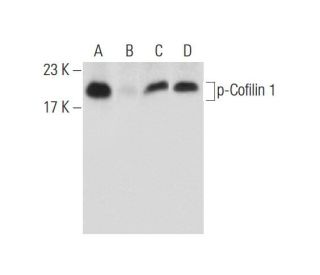


フェニルアルシンオキシド:sc-3521。K-562(A)、ラムダホスファターゼ(sc-200312)処理したK-562(B)、フェニルアルシンオキシド処理したK-562(C)、およびフェニルアルシンオキシドとラムダホスファターゼ処理したK-562(D)におけるコフィリン1のリン酸化のウェスタンブロット分析。試験抗体:p-コフィリン1(H-2):sc-271923。レーンDにおけるフェニルアルシンオキシドによるラムダホスファターゼの阻害に注目。
Phenylarsine oxide (CAS 637-03-6)
인용논문 보기 (4)
대체 이름:
PAO; Arzene; Oxophenylarsine
적용:
Phenylarsine oxide 는 막 투과성 PTPase 억제제입니다.
CAS 등록번호:
637-03-6
분자량:
168.02
분자식:
C6H5AsO
추가 정보:
운송용 위험물로 분류되어 추가 배송료가 부과될 수 있습니다.
연구용으로만 사용가능합니다. 진단이나 치료용으로 사용불가합니다.
* 참조분석증명서대량의 측정 데이터(함수량포함).
빠른 링크
주문정보
논문정보
설명
기술정보
안전정보
SDS 및 분석 증명서
페닐라신 옥사이드는 티로신 키나제에 영향을 미치지 않는 막 투과성 단백질-티로신 포스파타제(PTPase) 억제제이다. 이는 세포 표면 수용체의 내재화를 억제한다. 페닐라신 옥사이드는 티로신 인산화 사건 및 티로신 인산화를 억제 또는 차단하는 기전 연구에 매우 유용하다. 한 보고는 TNF 의존성 NFkappaB 활성화 연구를 위해 페닐라신 옥사이드와 TNF를 인간 골수세포(ML-1a)에 적용하였다. 페닐라신 옥사이드는 인슐린 저항성 인간 골격근에서 2-디옥시글루코스 수송을 자극하고 Lck(림프구 특이 단백질 티로신 키나제)를 활성화시키는 것으로 보고되었다. 페닐라신 옥사이드는 또한 카스파제 및 핵 사멸 사건의 억제제이므로 세포자멸 연구에 유용하다.
Phenylarsine oxide (CAS 637-03-6) 참고자료
- 페닐아르신 옥사이드(PAO)는 미토콘드리아 경로를 활성화하여 As2O3보다 급성 전골수성 백혈병 및 As2O3 내성 APL 세포주에서 세포 사멸을 더 강력하게 유도합니다. | Sahara, N., et al. 2004. Leuk Lymphoma. 45: 987-95. PMID: 15291359
- 글루타레독신 2의 짧은 간섭 RNA 매개 침묵은 독소루비신과 페닐아르신 옥사이드에 대한 HeLa 세포의 민감도를 증가시킵니다. | Lillig, CH., et al. 2004. Proc Natl Acad Sci U S A. 101: 13227-32. PMID: 15328416
- 페닐라신 옥사이드는 시냅스 소포 산성 풀을 소멸시킬 수 있습니다. | Tarasenko, AS., et al. 2005. Neurochem Int. 46: 541-50. PMID: 15843048
- 페닐알라신 산화물과 인슐린 자극 당 수송의 메커니즘. | Douen, AG. and Jones, MN. 1990. Biofactors. 2: 153-61. PMID: 2165780
- 과도 수용체 전위 바닐로이드 1형 채널 기능의 산화 환원 조절제로서의 페닐아르신 산화물. | Carlin, KP., et al. 2015. J Neurosci Res. 93: 309-20. PMID: 25250537
- 페닐아르신 산화물은 비소 저항성 돌연변이 PML 단백질 용해도 변화를 유도할 수 있습니다. | Jiang, YH., et al. 2017. Int J Mol Sci. 18: PMID: 28125064
- 페닐알라신 옥사이드(PAO)는 ROS 매개 미토콘드리아 및 ER 스트레스 의존적 신호 경로를 통해 HepG2 세포에서 세포 사멸을 유도합니다. | Huang, P., et al. 2017. Metallomics. 9: 1756-1764. PMID: 28831476
- 페닐아르신 산화물은 급성 골수성 백혈병의 PLZF-RARα 변이 융합 단백질의 분해를 유도할 수 있습니다. | Hussain, L., et al. 2019. Chem Res Toxicol. 32: 548-550. PMID: 30869512
- 페닐아르신 옥사이드에 의한 인간 호중구에서 효소 서브유닛의 막 전위와 먼 거리에서 NADPH 산화효소의 완전하고 가역적인 억제. | Le Cabec, V. and Maridonneau-Parini, I. 1995. J Biol Chem. 270: 2067-73. PMID: 7530716
- 단백질 티로신 포스파타제 억제제는 종양 괴사인자 의존성 핵 전사 인자 NF-카파 B의 활성화를 차단합니다. | Singh, S. and Aggarwal, BB. 1995. J Biol Chem. 270: 10631-9. PMID: 7738000
- 오카다산, 바나데이트 및 페닐아르신 산화물은 인슐린 저항성 인간 골격근에서 2- 데옥시 포도당 수송을 자극합니다. | Carey, JO., et al. 1995. Diabetes. 44: 682-8. PMID: 7789633
- 포스포티로신 포스파타제 억제제인 페닐알라신 옥사이드에 의한 p56lck 단백질 티로신 키나아제의 과인산화 및 활성화 유도. | Oetken, C., et al. 1994. Mol Immunol. 31: 1295-302. PMID: 7997241
- 페닐아르신 옥사이드(PAO)는 항원 수용체에 의한 칼슘 반응과 특정 단백질 그룹의 티로신 인산화를 차단합니다. | Rozsnyay, Z., et al. 1993. Immunol Lett. 37: 197-205. PMID: 8258460
- 쥐 호염기성 백혈병(RBL-2H3) 세포에서 페닐알라신 산화물(PAO)에 의한 포스포리파제 D의 활성화: 칼슘과 단백질 키나아제 C의 관여 가능성. | Kumada, T., et al. 1996. Immunobiology. 195: 347-59. PMID: 8877408
- 페닐아르신 옥사이드에 의한 ICE 관련 프로테아제(카스파제) 및 핵 아포토시스 억제. | Takahashi, A., et al. 1997. Exp Cell Res. 231: 123-31. PMID: 9056419
의 억제제:
α-defensin 6, 3-Hydroxybutyrate Dehydrogenase, 4921523A10Rik, 4930432O21Rik, 5730403M16Rik, 9130014G24Rik, 9230107M04Rik, AGAP1, AGXT2, AKR1CL2, Anamorsin, apoL7c, apoL7e, Arylsulfatase D, Arylsulfatase E, Arylsulfatase F, Arylsulfatase K, AU017455, AY026312, BLVRA, CaBP8, Calumenin, Caspase, CBR4, Cdc25A, Cdc50B, Chemical Peptide Caspase, CYB5D1, dsg1β, DUSP20, ECHDC1, EG665927, epsin, Ero1-Lα, Exocyst complex component (EXOC), FAM173A, Fap-1, FucU, GOLPH4, Gtlf3a, GUF1, HscB, Kell, Keratin 71, KRTAP12-2, KRTAP2-2, KRTAP4-8, Lipocalin-10, LPPR3, LRRC14B, LRRC68, LYPLA1, Mcsp, MIPP, Morc2b, MORN2, MYPT1, NAALADL1, NAG-2, NECAP 2, Nkx-6, OCRL, OCRL1, OR52E5, OST-PTP, OXNAD1, PADI3, PAP-2c, PDI1 ER Nuclear Envelope Marker, PDIR, PHI-1, PHLPPL, phosphatasefamily surface anchored protein, Phosphogluco-mutase, PI 4-kinase II β, PIPK I α, PITP, PP2A-β, PP2A-δ, PP2B-Aβ, PPIAL4C, PPIAL4G, Protein tyrosine phosphatase receptor (PTPR), PTP-H1, PTP-MEG2, PTPδ, PTPλ, PTPψ, PTPρ, PTPDC1, PTPN20, PTPN20A, PTPN20B, PTPy, PYROXD1, Rab 3 GAP p150, Rab 40AL, Rab 41, Rabenosyn-5, RP23-110D11.1, SDHAF1, SDHAF2, SDHC, Sec23IP, Sec24, Sec4, Selenoprotein M, SH-PTP1, SPACA5, TBG, TMPPE, Transaldolase, TXNDC1, Type I 4-phoshatase α, Type I 4-phoshatase β, Type II 4-phoshatase, Type II 4-phoshatase β, TYW3, V1RI9, VHX, Vmn2r50, VWCE, XylT-I, ZDHHC9, ZFP1, ZFP773, ZIP3, ZNF202, ZNF256, ZNF589, ZNF598.의 활성화자:
2010005H15Rik, ALG6, ARL15, B430203M17Rik, Bestatin, cathepsin 3, CD45RC, Cdc14b Phosphatase, Centaurin β5, Clathrin LCB, CYP, DEP-1, DEPDC6, DUSP22, DUSP24, DUSP26, DUSP28, Dynamin II, FKBP52, GLTPD2, Maspardin, MBLAC2, NXF3, ORP-11, OS4, PIG-C, Pin1l, PP2A-Bα, PTEN, PTP 1β, Pyhin1, Rab 30, RPTPα, S2P, Selenoprotein O, SerpinA1b, Ski2, SUMF2, VHR, WDR78, ZC3H7A, ZFP772.주문정보
| 제품명 | 카탈로그 번호 | 단위 | 가격 | 수량 | 관심품목 | |
Phenylarsine oxide, 250 mg | sc-3521 | 250 mg | $41.00 |