
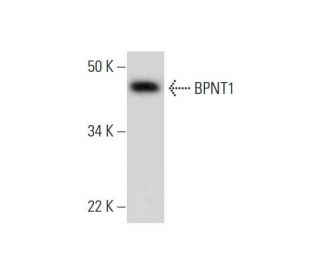


human liver extract: sc-363766
- 500 µg protein in 200 µl SDS-PAGE Western blotting buffer
- Positivkontrolle für den Western Blot
- recommended use is 50 µg (20 µl) per lane
- extracts should be stored at -20°C and repeated freezing and thawing should be minimized
- sample vial should be placed at 95° C for up to 5 minutes, once prior to use
- Not available in Germany.

Direktverknüpfungen
Siehe auch...
Menschlicher Leberextrakt, der aus menschlichem Lebergewebe gewonnen wird, dient als grundlegendes Instrument in der biomedizinischen Forschung, insbesondere bei Studien zur Leberphysiologie, zum Leberstoffwechsel und zu Lebererkrankungen. Die Leber spielt eine zentrale Rolle bei verschiedenen physiologischen Prozessen, einschließlich Stoffwechsel, Entgiftung und Immunmodulation. Humane Leberextrakte enthalten eine Vielzahl von Proteinen, Enzymen und Metaboliten, die die komplexen Funktionen der Mikroumgebung der Leber widerspiegeln. Forscher nutzen diese Extrakte, um die molekularen Mechanismen zu untersuchen, die Lebererkrankungen wie Hepatitis, Zirrhose und Leberkrebs zugrunde liegen. Durch die Analyse der Zusammensetzung und Aktivität spezifischer Enzyme und Proteine im Lebergewebe können die Forscher Biomarker für die Diagnose, den Verlauf und die Prognose von Krankheiten ermitteln. Darüber hinaus sind menschliche Leberextrakte von unschätzbarem Wert für die Untersuchung des Arzneimittelstoffwechsels und der Toxizität, da die Leber das wichtigste Organ für den Arzneimittelstoffwechsel und die Entgiftung ist. Darüber hinaus werden diese Extrakte bei der Entwicklung von In-vitro-Modellen von Lebergewebe verwendet, um die Leberbiologie und die Pathogenese von Krankheiten zu untersuchen, was Einblicke in potenzielle Interventionen bei Lebererkrankungen ermöglicht. Insgesamt spielen menschliche Leberextrakte eine entscheidende Rolle bei der Verbesserung unseres Verständnisses der Leberphysiologie und -pathologie und tragen zur Entwicklung neuer diagnostischer Ansätze für Lebererkrankungen bei.
human liver extract Literaturhinweise:
- Hemmung der Protein- und Nukleinsäuresynthese von tierischen Zellen in vitro durch hochmolekulare Inhibitoren in menschlichem Leberextrakt. | Nilsson, G. 1976. Biochim Biophys Acta. 418: 376-96. PMID: 1247551
- Canalin-Carbamoyltransferase in der menschlichen Leber als Teil eines Stoffwechselzyklus, in dem Guanidino-Verbindungen gebildet werden. | Natelson, S., et al. 1977. Clin Chem. 23: 960-6. PMID: 15744
- Die Galbeta1,4GlcNAc-alpha2,6-Sialyltransferase in der Leber wird bei Alkoholikern herunterreguliert: eine mögliche Ursache für das Auftreten von Asialokonjugaten. | Gong, M., et al. 2007. Metabolism. 56: 1241-7. PMID: 17697868
- Reinigung von menschlicher Leber-Guanase und Charakterisierung von Antikörpern gegen sie durch Immunoblotting. | Ito, S., et al. 1990. Clin Biochem. 23: 113-20. PMID: 2372926
- Charakterisierung von Antikörpern gegen menschliche Leber-Guanase durch Immunoblotting und immunhistochemische Färbung von menschlicher Leber-Guanase durch eine direkte Markierungsmethode für Antikörper und Enzyme. | Ito, S., et al. 1989. J Histochem Cytochem. 37: 611-5. PMID: 2649557
- Herstellung und Eigenschaften eines spezifischen Antiserums gegen menschliche Leber. | Mihas, AA. and Spenney, JG. 1977. Int Arch Allergy Appl Immunol. 54: 255-61. PMID: 406206
- Hydrolyse von Tay-Sachs-Gangliosid durch Beta-Hexosaminidase A aus menschlicher Leber und Urin. | Li, YT., et al. 1973. J Biol Chem. 248: 7512-5. PMID: 4745777
- Phenylalanin-Hydroxylase der menschlichen Leber: Test und einige Eigenschaften. | Kaufman, S. 1969. Arch Biochem Biophys. 134: 249-52. PMID: 5345589
- Thymidin- und Uridin-Stoffwechsel bei der Hemmung des Zellwachstums von HeLa-Zellen durch menschlichen Leberextrakt. | Nilsson, G. 1970. Exp Cell Res. 59: 207-16. PMID: 5413543
- Oxidation von 7-Methylguanin durch menschliche Xanthinoxidase. | Skupp, S. and Ayvazian, JH. 1969. J Lab Clin Med. 73: 909-16. PMID: 5815015
- Entfernung von O6-Methylguanin aus der DNA durch menschliche Leberfraktionen. | Pegg, AE., et al. 1982. Proc Natl Acad Sci U S A. 79: 5162-5. PMID: 6957855
- Regulierung der Funktion menschlicher Lymphozyten durch einen löslichen Extrakt aus normaler menschlicher Leber. | Chisari, FV. 1978. J Immunol. 121: 1279-86. PMID: 701796
- 2-Aminoadipat-2-oxoglutarat-Aminotransferase-Isoenzyme in der menschlichen Leber: eine plausible physiologische Rolle im Lysin- und Tryptophan-Stoffwechsel. | Okuno, E., et al. 1993. Enzyme Protein. 47: 136-48. PMID: 8087205
Bestellinformation
| Produkt | Katalog # | EINHEIT | Preis | ANZAHL | Favoriten | |
human liver extract | sc-363766 | 500 µg/200 µl | $120.00 |