
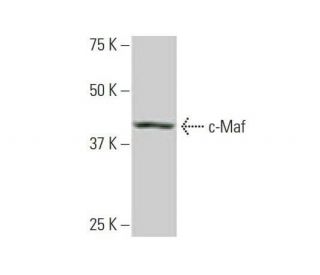



c-Maf 항체(6B8)는 Maf 가족의 중요한 구성원인 bZIP 전사 인자의 c-Maf를 검출하도록 설계된 쥐 단일 클론 IgG2b kappa 경쇄 항체입니다. c-Maf 단일 클론 항체(6B8)는 아미노산을 표적으로 합니다. 304-403번의 인간 c-Maf 단백질을 표적으로 삼아, 마우스, 쥐, 인간 종에 걸쳐 c-Maf를 정확하게 인식할 수 있도록 하며, 웨스턴 블랏팅(WB), 면역침전법(IP), 효소결합 면역흡착 분석법(ELISA) 등의 응용과 호환됩니다. V-maf musculoaponeurotic fibrosarcoma oncogene homolog로도 알려진 c-Maf는 조혈, 배아 수정체 섬유 세포 발달, T세포 아폽토시스, 연골세포 말단 분화 등 필수적인 생물학적 과정에서 유전자 발현을 조절하는 데 중요한 역할을 합니다. c-Maf는 상호작용하는 파트너와 프로모터 컨텍스트에 따라 양성 및 음성 방향으로 전사를 조절함으로써 광범위한 발달 및 생리 기능에 영향을 미칩니다. c-Maf는 c-Myb 및 Ets-1과 같은 주요 단백질과 상호 작용하여 초기 골수성 세포 분화를 촉진하고 T-MARE 부위에 결합하여 표적 유전자를 조절합니다. 항-c-Maf 항체(6B8)는 비접합 형태로 제공되어 다양한 실험적 요구에 유연하게 대처할 수 있습니다. c-Maf(6B8) 항체는 세포 분화, 종양 발생, 전사 조절에서 c-Maf의 다각적인 역할을 연구하는 연구자들에게 없어서는 안 될 도구입니다. 조혈계 분화 기작을 연구하든, 수정체 발달을 연구하든, c-Maf 단일클론항체(6B8)는 여러 실험 플랫폼에서 이 원발암유전자를 신뢰할 수 있고 정확하게 검출할 수 있습니다.
Alexa Fluor®는 미국 오리건주 Molecular Probes Inc.의 상표입니다.
LI-COR®와 Odyssey®는 LI-COR Biosciences의 등록 상표입니다.
c-Maf 항체 (6B8) 참고문헌:
- Maf 유전자에 의한 마우스 수정체 섬유 세포 발달 및 분화 조절. | Ring, BZ., et al. 2000. Development. 127: 307-17. PMID: 10603348
- MafA는 강력한 세포 변형 능력을 가지고 있지만 약한 전사인자입니다. | Nishizawa, M., et al. 2003. Oncogene. 22: 7882-90. PMID: 12970735
- 쥐 배아 발달 중 피부에서 c-maf 및 mafB 유전자의 발현. | Ogata, A., et al. 2004. Acta Histochem. 106: 65-7. PMID: 15032330
- 신장에서 c-maf의 발달 기여: 정상 마우스 신장에서 c-maf mRNA의 분포 및 발달 연구와 c-maf 녹아웃 마우스 신장과 간의 조직학적 연구. | Imaki, J., et al. 2004. Biochem Biophys Res Commun. 320: 1323-7. PMID: 15249232
- c-MAF 의존 조절 T 세포는 장내 병원균에 대한 면역학적 내성을 매개합니다. | Xu, M., et al. 2018. Nature. 554: 373-377. PMID: 29414937
- 장내 미생물 군집 특이적 Th17 세포는 조절 특성을 가지고 있으며 c-MAF와 IL-10을 통해 이펙터 T 세포를 억제합니다. | Brockmann, L., et al. 2023. Immunity. 56: 2719-2735.e7. PMID: 38039966
- 랩 GDP 해리 억제제: 랩 GTPase를 올바른 위치에 배치합니다. | Pfeffer, SR., et al. 1995. J Biol Chem. 270: 17057-9. PMID: 7615494
- 유비쿼터스 전사 인자 MafK의 조건부 발현은 적혈구 백혈병 세포 분화를 유도합니다. | Igarashi, K., et al. 1995. Proc Natl Acad Sci U S A. 92: 7445-9. PMID: 7638211
- 작은 Maf 단백질은 Fos와 이합체화되며 NF-E2 전사인자의 경쟁적 억제제로 작용할 수 있습니다. | Kataoka, K., et al. 1995. Mol Cell Biol. 15: 2180-90. PMID: 7891713
- 작은 Maf 단백질은 인간 전사인자 TCF11/Nrf1/LCR-F1과 상호 작용합니다. | Johnsen, O., et al. 1996. Nucleic Acids Res. 24: 4289-97. PMID: 8932385
- c-Maf는 c-Myb와 상호작용하여 분화 중 초기 골수성 유전자의 전사를 조절합니다. | Hedge, SP., et al. 1998. Mol Cell Biol. 18: 2729-37. PMID: 9566892
- 쥐 Maf 관련 인자: DNA 결합 및 헤테로다이머 형성의 특이성. | Matsushima-Hibiya, Y., et al. 1998. Biochem Biophys Res Commun. 245: 412-8. PMID: 9571165
주문정보
| 제품명 | 카탈로그 번호 | 단위 | 가격 | 수량 | 관심품목 | |
c-Maf 항체 (6B8) | sc-293420 | 100 µg/ml | $322.00 |