
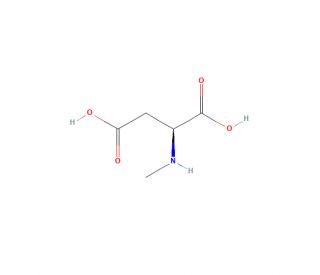

N-Methyl-L-aspartic acid (CAS 4226-18-0)
See product citations (1)
QUICK LINKS
N-Methyl-L-aspartic acid, referred to as NMLA, is a derivative of the amino acid, distinguished by the addition of a methyl group to the nitrogen atom of the carboxyl group. This compound is incorporated in scientific research, particularly in the field of neuroscience, as it is a part of several neurotransmitter receptors and contributes significantly to the control of numerous physiological processes. N-Methyl-L-aspartic acid is an essential element of various neurotransmitter receptors, including the N-methyl-D-aspartate (NMDA) receptor and the metabotropic glutamate receptor, which makes it a widely used agent in scientific investigations. Additionally, it′s instrumental in research concerning neuronal plasticity, learning and memory, and synaptic plasticity. As an agonist of the NMDA receptor—a glutamate receptor that significantly influences neuronal excitability and synaptic plasticity—N-Methyl-L-aspartic acid binds to and activates the NMDA receptor. This activation prompts a surge of calcium ions into the cell, which subsequently increases the activity of several enzymes, including protein kinases and phosphatases. These enzymes then induce alterations in the expression of genes related to neuronal plasticity.
N-Methyl-L-aspartic acid (CAS 4226-18-0) References
- Occurrence of D-aspartic acid and N-methyl-D-aspartic acid in rat neuroendocrine tissues and their role in the modulation of luteinizing hormone and growth hormone release. | D'Aniello, A., et al. 2000. FASEB J. 14: 699-714. PMID: 10744627
- A specific enzymatic high-performance liquid chromatography method to determine N-methyl-D-aspartic acid in biological tissues. | D'Aniello, A., et al. 2002. Anal Biochem. 308: 42-51. PMID: 12234462
- Acidic amino acids with strong excitatory actions on mammalian neurones. | CURTIS, DR. and WATKINS, JC. 1963. J Physiol. 166: 1-14. PMID: 14024354
- THE SYNTHESIS OF SOME ACIDIC AMINO ACIDS POSSESSING NEUROPHARMACOLOGICAL ACTIVITY. | WATKINS, JC. 1962. J Med Pharm Chem. 91: 1187-99. PMID: 14056452
- Occurrence and neuroendocrine role of D-aspartic acid and N-methyl-D-aspartic acid in Ciona intestinalis. | D'Aniello, A., et al. 2003. FEBS Lett. 552: 193-8. PMID: 14527686
- Third-order neuronal responses contribute to shaping the negative electroretinogram in sodium iodate-treated rats. | Tanaka, M., et al. 2005. Curr Eye Res. 30: 443-53. PMID: 16020277
- Methods for syntheses of N-methyl-DL-aspartic acid derivatives. | Boros, M., et al. 2007. Amino Acids. 33: 709-17. PMID: 17334906
- Enzymatically catalyzed DNA synthesis using L-Asp-dGMP, L-Asp-dCMP, and L-Asp-dTMP. | Terrazas, M., et al. 2008. Chem Biodivers. 5: 31-9. PMID: 18205125
- Neurovascular protective effect of FeTPPs in N-methyl-D-aspartate model: similarities to diabetes. | Al-Gayyar, MM., et al. 2010. Am J Pathol. 177: 1187-97. PMID: 20651233
- Chiral separation of N-methyl-DL-aspartic acid in rat brain tissue as N-ethoxycarbonylated (S)-(+)-2-octyl ester derivatives by GC-MS. | Nguyen, DT., et al. 2012. Biomed Chromatogr. 26: 1353-6. PMID: 22290726
- Displaceable binding of [3H]l-glutamic acid to non-receptor materials. | Ito, M., et al. 1986. Life Sci. 38: 1089-96. PMID: 2870406
- The occurrence of N-methyl-D-aspartic acid in muscle extracts of the blood shell, Scapharca broughtonii. | Sato, M., et al. 1987. Biochem J. 241: 309-11. PMID: 3551926
- Effects of compounds related to beta-hydroxyglutamic acid (BHGA) on identifiable giant neurones of an African giant snail (Achatina fulica Férussac). | Novales-Li, P., et al. 1987. Eur J Pharmacol. 143: 415-23. PMID: 3691664
- Destomycin A. The acid hydrolysis and the partial structure. | Kondo, S., et al. 1965. J Antibiot (Tokyo). 18: 192-4. PMID: 5898337
- Effects of excitatory amino acids on locomotor activity after bilateral microinjection into the rat nucleus accumbens: possible dependence on dopaminergic mechanisms. | Donzanti, BA. and Uretsky, NJ. 1983. Neuropharmacology. 22: 971-81. PMID: 6137783
Ordering Information
| Product Name | Catalog # | UNIT | Price | Qty | FAVORITES | |
N-Methyl-L-aspartic acid, 10 mg | sc-212234 | 10 mg | $19.00 | |||
N-Methyl-L-aspartic acid, 50 mg | sc-212234A | 50 mg | $52.00 |