
Subscrever / Inscrever-se Conta
Corrinho de compra (0)
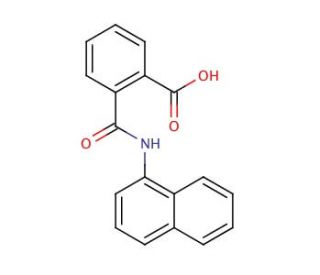

Estrutura molecular do N-1-Naphthylphthalamidic acid, Número CAS: 132-66-1
N-1-Naphthylphthalamidic acid (CAS 132-66-1)
Veja citações de produtos (1)
Nomes alternativos:
Naptalam; N-(1-Naphthyl)phthalamidic acid
Aplicacao:
N-1-Naphthylphthalamidic acid é um inibidor do transporte de IAA
Numero VAT:
132-66-1
Privada:
≥98%
Peso Molecular:
291.30
Separar por Funcao:
C18H13NO3
Para uso em exclusivo em pesquisa. Não se destina a uso em diagnostico e tratamento.
* Refere-se a Certificado de Análise para data especifica de lotes (incluindo-se o conteúdo de agua).
LINKS RÁPIDOS
Informacoes sobre ordens
Citacoes dos Produtos
Descricao
Informações Técnicas
Informações de Segurança
SDS & Certificado de Análise
O ácido N-1-naftilftalamídico, também conhecido como Naptalam, é um derivado do aminoácido triptofano, que é um precursor da serotonina. Ele também foi pesquisado por seu potencial para aliviar o desconforto crônico e melhorar a qualidade do sono. O mecanismo exato pelo qual o ácido N-1-naftilftalamídico funciona não é totalmente conhecido, mas há a hipótese de que ele possa funcionar como um agonista do receptor de serotonina. Isso significa que ele possivelmente se liga e ativa os receptores de serotonina no cérebro, um processo que pode estar por trás de seus efeitos de melhora do humor e redução da ansiedade.
N-1-Naphthylphthalamidic acid (CAS 132-66-1) Referencias
- A auxina derivada de plantas desempenha um papel acessório no desenvolvimento de sintomas após a infeção por Rhodococcus fascians. | Stes, E., et al. 2012. Plant J. 70: 513-27. PMID: 22181713
- O silenciamento de genes em Arabidopsis propaga-se da raiz para o rebento, através de uma barreira de gating, por movimento célula-a-célula, não vascular e dependente do modelo. | Liang, D., et al. 2012. Plant Physiol. 159: 984-1000. PMID: 22582134
- Plasticidade nos Padrões de Divisão Celular e Dependência do Transporte de Auxina durante a Embriogénese in Vitro em Brassica napus. | Soriano, M., et al. 2014. Plant Cell. 26: 2568-2581. PMID: 24951481
- Os marcadores precoces estão presentes em ambas as vias de embriogénese a partir de micrósporos e embriões zigóticos imaturos em sobreiro, Quercus suber L. | Rodríguez-Sanz, H., et al. 2014. BMC Plant Biol. 14: 224. PMID: 25162300
- Repórteres para a medição sensível e quantitativa da resposta à auxina. | Liao, CY., et al. 2015. Nat Methods. 12: 207-10, 2 p following 210. PMID: 25643149
- O catecol, um dos principais componentes do fumo, influencia o crescimento da raiz primária e o alongamento dos pêlos radiculares através da sinalização redox mediada por espécies reactivas de oxigénio. | Wang, M., et al. 2017. New Phytol. 213: 1755-1770. PMID: 27878986
- Remodelação das folhas das plantas de renda: os antioxidantes e os ERO são reguladores-chave da morte celular programada. | Dauphinee, AN., et al. 2017. Planta. 246: 133-147. PMID: 28389868
- A resposta bifásica do crescimento da raiz ao ácido abscísico em Arabidopsis envolve a interação com as vias de sinalização do etileno e da auxina. | Li, X., et al. 2017. Front Plant Sci. 8: 1493. PMID: 28890725
- A sinalização sistémica através da proteína tumoral controlada por tradução controla a formação de raízes laterais em Arabidopsis. | Branco, R. and Masle, J. 2019. J Exp Bot. 70: 3927-3940. PMID: 31037291
- A sinalização da auxina envolvida no LBD29 reprime os reguladores principais do NAC e a biossíntese da parede da fibra. | Lee, KH., et al. 2019. Plant Physiol. 181: 595-608. PMID: 31377726
- A variação críptica na metilação do ADN dirigida por ARN controla o desenvolvimento da raiz lateral quando a sinalização da auxina é perturbada. | Shahzad, Z., et al. 2020. Nat Commun. 11: 218. PMID: 31924796
- Mecanismo e função da circunvolução da raiz. | Taylor, I., et al. 2021. Proc Natl Acad Sci U S A. 118: PMID: 33608460
- ROOT PENETRATION INDEX 3, um importante locus de características quantitativas associado à penetrabilidade do sistema radicular em Arabidopsis. | Bello Bello, E., et al. 2022. J Exp Bot. 73: 4716-4732. PMID: 35512438
Informacoes sobre ordens
| Nome do Produto | Numero de Catalogo | UNID | Preco | Qde | FAVORITOS | |
N-1-Naphthylphthalamidic acid, 100 mg | sc-257826 | 100 mg | $77.00 | |||
N-1-Naphthylphthalamidic acid, 1 g | sc-257826A | 1 g | $168.00 |