
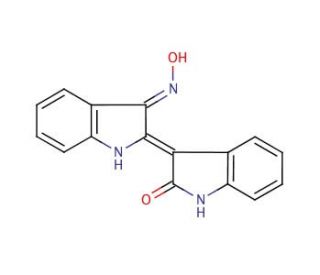

Indirubin-3′-monoxime (CAS 160807-49-8)
See product citations (1)
QUICK LINKS
Indirubin-3′-monoxime, a chemical compound derived from the naturally occurring indirubin, has become a valuable tool in scientific research, particularly in the field of cell biology and signal transduction. Its mechanism of action involves inhibiting cyclin-dependent kinases (CDKs), specifically CDK1 and CDK5, by competing with ATP binding at the catalytic site. This inhibition results in cell cycle arrest and modulation of various cellular processes regulated by CDK activity, such as proliferation, differentiation, and apoptosis. Additionally, indirubin-3′-monoxime has been shown to exhibit anti-inflammatory properties by suppressing the activity of glycogen synthase kinase-3β (GSK-3β) and the nuclear factor kappa-light-chain-enhancer of activated B cells (NF-κB) signaling pathway. In research settings, indirubin-3′-monoxime has been extensively used to investigate the functions of CDKs and their involvement in cellular processes, including neurogenesis, neuronal differentiation, and synaptic plasticity. Moreover, its ability to modulate CDK activity has led to its exploration as an agent in neurological disorders, such as Alzheimer′s disease and Parkinson′s disease, as well as in cancer research. Overall, indirubin-3′-monoxime serves as a versatile tool for unraveling the complexities of cell signaling pathways and holds promise for the development of novel interventions targeting CDKs and associated pathways in various pathological conditions.
Indirubin-3′-monoxime (CAS 160807-49-8) References
- Indirubins inhibit glycogen synthase kinase-3 beta and CDK5/p25, two protein kinases involved in abnormal tau phosphorylation in Alzheimer's disease. A property common to most cyclin-dependent kinase inhibitors? | Leclerc, S., et al. 2001. J Biol Chem. 276: 251-60. PMID: 11013232
- Inhibition of cyclin-dependent kinase 1 (CDK1) by indirubin derivatives in human tumour cells. | Marko, D., et al. 2001. Br J Cancer. 84: 283-9. PMID: 11161389
- Application of a homogenous membrane potential assay to assess mitochondrial function. | Sakamuru, S., et al. 2012. Physiol Genomics. 44: 495-503. PMID: 22433785
- Human protein kinase inhibitor screening by capillary electrophoresis using transverse diffusion of laminar flow profiles for reactant mixing. | Nehmé, H., et al. 2013. J Chromatogr A. 1314: 298-305. PMID: 24075461
- Kinase inhibitor profile for human nek1, nek6, and nek7 and analysis of the structural basis for inhibitor specificity. | Moraes, EC., et al. 2015. Molecules. 20: 1176-91. PMID: 25591119
- The Small Molecule Indirubin-3'-Oxime Inhibits Protein Kinase R: Antiapoptotic and Antioxidant Effect in Rat Cardiac Myocytes. | Udumula, MP., et al. 2016. Pharmacology. 97: 25-30. PMID: 26571010
- High-throughput screening and bioinformatic analysis to ascertain compounds that prevent saturated fatty acid-induced β-cell apoptosis. | Lee, SH., et al. 2017. Biochem Pharmacol. 138: 140-149. PMID: 28522407
- Oncosis-like cell death is induced by berberine through ERK1/2-mediated impairment of mitochondrial aerobic respiration in gliomas. | Sun, Y., et al. 2018. Biomed Pharmacother. 102: 699-710. PMID: 29604589
- Inhibitory effects of indirubin-3'-monoxime against human osteosarcoma. | Zhang, Y., et al. 2019. IUBMB Life. 71: 1465-1474. PMID: 31050877
- Identification of Two Kinase Inhibitors with Synergistic Toxicity with Low-Dose Hydrogen Peroxide in Colorectal Cancer Cells in vitro. | Freund, E., et al. 2020. Cancers (Basel). 12: PMID: 31906582
Ordering Information
| Product Name | Catalog # | UNIT | Price | Qty | FAVORITES | |
Indirubin-3′-monoxime, 1 mg | sc-202660 | 1 mg | $79.00 | |||
Indirubin-3′-monoxime, 5 mg | sc-202660A | 5 mg | $321.00 | |||
Indirubin-3′-monoxime, 50 mg | sc-202660B | 50 mg | $671.00 |