
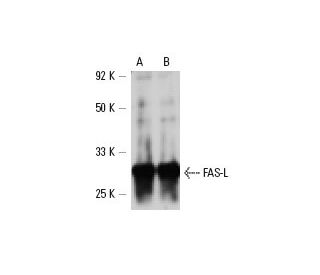


FAS-L Antibody (4H9): sc-18897
- FAS-L Antibody (4H9) is a Armenian hamster monoclonal IgG provided at 200 µg/ml
- raised against recombinant human FAS ligand
- recommended for detection of FAS-L of human origin by WB, IP, IF and FCM
- available conjugated to either phycoerythrin or FITC for IF, IHC(P) and FCM
- At present, we have not yet completed the identification of the preferred secondary detection reagent(s) for FAS-L Antibody (4H9). This work is in progress.

QUICK LINKS
SEE ALSO...
FAS-L Antibody (4H9) is a hamster monoclonal IgG antibody designed to detect FAS protein, an essential cell surface glycoprotein involved in regulating cell death through apoptosis. FAS protein maintains immune homeostasis and is primarily located on lymphoid cell surfaces, where FAS protein interacts with FAS-L to initiate apoptotic signaling pathways. FAS protein′s presence on cell membranes enables rapid and efficient communication between immune cells, particularly during immune responses against virus-infected or transformed cells. FAS protein facilitates interaction between cytotoxic T lymphocytes and target cells, contributing to immuno-surveillance. FAS-L Antibody (4H9) demonstrates reactivity with human species, making FAS-L (4H9) antibody suitable for western blotting, immunohistochemistry, immunofluorescence, and immunoprecipitation. Anti-FAS-L monoclonal antibody (4H9) serves as an invaluable tool for researchers studying apoptosis, immune regulation, and mechanisms underlying cytotoxic T lymphocyte-mediated cytotoxicity.
Alexa Fluor® is a trademark of Molecular Probes Inc., OR., USA
LI-COR® and Odyssey® are registered trademarks of LI-COR Biosciences
FAS-L Antibody (4H9) References:
- Role of Fas/Fas-L in vascular cell apoptosis. | Stoneman, VE. and Bennett, MR. 2009. J Cardiovasc Pharmacol. 53: 100-8. PMID: 19188840
- Is the Fas/Fas-L pathway a promising target for treating inflammatory heart disease? | Henriques-Pons, A. and de Oliveira, GM. 2009. J Cardiovasc Pharmacol. 53: 94-9. PMID: 19188841
- Role of the Fas/Fas-L pathway-mediated apoptosis in inflammatory heart diseases and vasculature diseases. | Binah, O. 2009. J Cardiovasc Pharmacol. 53: 91-3. PMID: 19188842
- Effects of the Fas/Fas-L pathway on fluoride-induced apoptosis in SH-SY5Y cells. | Xu, B., et al. 2011. Environ Toxicol. 26: 86-92. PMID: 19852076
- FAS/FAS-L dependent killing of activated human monocytes and macrophages by CD4+CD25- responder T cells, but not CD4+CD25+ regulatory T cells. | Jagger, AL., et al. 2012. J Autoimmun. 38: 29-38. PMID: 22197557
- Expression levels of Fas/Fas-L mRNA in human brain glioma stem cells. | Tao, J., et al. 2012. Mol Med Rep. 5: 1202-6. PMID: 22344564
- Mitochondrial- and Fas-L-mediated pathways involved in quinestrol induced spermatogenic apoptosis in adult rat testes. | Li, J., et al. 2014. Toxicol Mech Methods. 24: 609-15. PMID: 25258304
- Expression of FAS-L Differs from Primary to Relapsed Low-grade Gliomas and Predicts Progression-free Survival. | Werner, JM., et al. 2017. Anticancer Res. 37: 6639-6648. PMID: 29187439
- Fas-L promotes the stem cell potency of adipose-derived mesenchymal cells. | Solodeev, I., et al. 2018. Cell Death Dis. 9: 695. PMID: 29891848
- FAS/FAS-L-mediated apoptosis and autophagy of SPC-A-1 cells induced by water-soluble polysaccharide from Polygala tenuifolia. | Yu, S., et al. 2020. Int J Biol Macromol. 150: 449-458. PMID: 32027895
Ordering Information
| Product Name | Catalog # | UNIT | Price | Qty | FAVORITES | |
FAS-L Antibody (4H9) | sc-18897 | 200 µg/ml | $322.00 | |||
FAS-L Antibody (4H9) FITC | sc-18897 FITC | 200 µg/ml | $336.00 | |||
FAS-L Antibody (4H9) PE | sc-18897 PE | 200 µg/ml | $349.00 |