
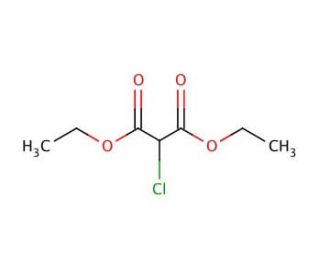

Molecular structure of Diethyl chloromalonate, CAS Number: 14064-10-9
Diethyl chloromalonate (CAS 14064-10-9)
CAS Number:
14064-10-9
Molecular Weight:
194.61
Molecular Formula:
C7H11ClO4
Supplemental Information:
This is classified as a Dangerous Good for transport and may be subject to additional shipping charges.
For Research Use Only. Not Intended for Diagnostic or Therapeutic Use.
* Refer to Certificate of Analysis for lot specific data.
QUICK LINKS
Ordering Information
Description
Technical Information
Safety Information
SDS & Certificate of Analysis
Diethyl chloromalonate (DECM) is a versatile organic compound characterized by the presence of both a carboxylic acid and a chloro group. Within the realm of scientific research, Diethyl chloromalonate has been extensively employed as a reagent for synthesizing a broad spectrum of organic compounds. During reactions with other molecules, the carboxylic acid becomes protonated, while the chloro group activates. This synergistic effect facilitates the formation of new chemical bonds, enabling the synthesis of diverse organic compounds.
Diethyl chloromalonate (CAS 14064-10-9) References
- Kinetic separation methodology for the stereoselective synthesis of (E)- and (Z)-alpha-fluoro-alpha,beta-unsaturated esters via the palladium-catalyzed carboalkoxylation of 1-bromo-1-fluoroalkenes. | Xu, J. and Burton, DJ. 2002. Org Lett. 4: 831-3. PMID: 11869139
- The identification and optimization of a N-hydroxy urea series of flap endonuclease 1 inhibitors. | Tumey, LN., et al. 2005. Bioorg Med Chem Lett. 15: 277-81. PMID: 15603939
- Ring expansion reactions of 4-amino-1,1-dioxo-[1,2,3,5]-thiatriazoles. | Duggan, PJ., et al. 2007. Org Biomol Chem. 5: 472-7. PMID: 17252129
- Synthesis and anti-tuberculosis activity of the marine natural product caulerpin and its analogues. | Canché Chay, CI., et al. 2014. Mar Drugs. 12: 1757-72. PMID: 24681629
- The development of catalytic nucleophilic substitution reactions: challenges, progress and future directions. | An, J., et al. 2014. Org Biomol Chem. 12: 2993-3003. PMID: 24699913
- Diverse display of non-covalent interacting elements using pyrimidine-embedded polyheterocycles. | Choi, Y., et al. 2015. Chem Commun (Camb). 51: 13040-3. PMID: 26185802
- Catalytic Access to Alkyl Bromides, Chlorides and Iodides via Visible Light-Promoted Decarboxylative Halogenation. | Candish, L., et al. 2016. Chemistry. 22: 9971-4. PMID: 27191347
- Optimization of a novel series of potent and orally bioavailable GPR119 agonists. | Koshizawa, T., et al. 2017. Bioorg Med Chem Lett. 27: 3249-3253. PMID: 28648463
- Synthesis of 2-Monochloropanol Fatty Acid Esters and Their Acute Oral Toxicities in Swiss Mice. | Zhang, Z., et al. 2019. J Agric Food Chem. 67: 3789-3795. PMID: 30874433
- Organocatalytic Chlorination of Alcohols by P(III)/P(V) Redox Cycling. | Longwitz, L., et al. 2019. J Org Chem. 84: 7863-7870. PMID: 31135155
- Driving Recursive Dehydration by PIII/PV Catalysis: Annulation of Amines and Carboxylic Acids by Sequential C-N and C-C Bond Formation. | Lecomte, M., et al. 2019. J Am Chem Soc. 141: 12507-12512. PMID: 31345031
- Shedding light on the nature of the catalytically active species in photocatalytic reactions using Bi2O3 semiconductor. | Riente, P., et al. 2021. Nat Commun. 12: 625. PMID: 33504763
- A Giese reaction for electron-rich alkenes. | Huang, Q., et al. 2020. Chem Sci. 12: 2225-2230. PMID: 34163988
- Correction: Synthetic routes for a variety of halogenated (chiral) acetic acids from diethyl malonate. | Mazenauer, MR., et al. 2018. RSC Adv. 8: 2872. PMID: 35543877
- Preparation of 2-amino-4(3H)-oxopyrimido[5,4-b] [1,4]thiazines (5-thiapterins) and their evaluation as cofactors for phenylalanine hydroxylase. | Henrie, RN., et al. 1983. J Med Chem. 26: 559-63. PMID: 6834389
Ordering Information
| Product Name | Catalog # | UNIT | Price | Qty | FAVORITES | |
Diethyl chloromalonate, 5 ml | sc-227841 | 5 ml | $77.00 |