
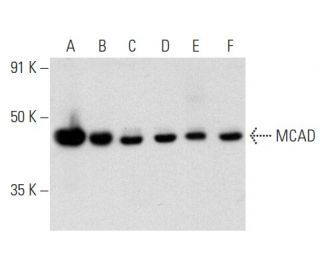
Anticorpo MCAD (G-4): sc-365109
- MCAD Antibody G-4 è un monoclonale di topo IgG1 κ, citato in 6 pubblicazioni, fornito in 200 µg/ml
- specifico per un epitopo mappato tra gli amminoacidi 141-163 nella regione interna a MCAD di origine human
- raccomandato per il rilevamento di MCAD di origine mouse, rat e human in WB, IP, IF e ELISA; anche reattivo con ulteriori specie, incluse e bovine and porcine
- m-IgG Fc BP-HRP e m-IgG1 BP-HRP sono i reagenti secondari preferiti per l'anticorpo MCAD (G-4) for WB applications. Questi reagenti sono ora offerti in bundle con l'anticorpo MCAD (G-4)(vedere le informazioni per l'ordine sotto).

LINK RAPIDI
VEDI ANCHE...
Le acil-CoA deidrogenasi sono una famiglia di enzimi che si localizzano nel mitocondrio e mirano a catene aciliche di lunghezza compresa tra 4 e 16, utilizzando la via di b-ossidazione mitocondriale degli acidi grassi. Nei tessuti dei mammiferi, molte acil-CoA deidrogenasi a catena diritta possiedono diverse specificità di substrato. In rari casi, le irregolarità dell'acil-CoA deidrogenasi a catena media possono causare ipoglicemia a digiuno, disfunzione epatica ed encefalopatia, spesso con conseguente morte in età infantile. L'MCAD, designato anche acil-CoA deidrogenasi a catena media (ACADM) e MCADH, è un omotetramero. Il gene MCAD codifica una proteina di 421 aminoacidi con caratteristiche di peptidi di transito proteico mitocondriale. La proteina mostra un'identità di sequenza dell'88% con MCAD di origine suina. L'acil-CoA deidrogenasi a catena media catalizza la reazione iniziale nella b-ossidazione degli acil-CoA a catena dritta da C4 a C12.
Alexa Fluor® è un marchio registrato di Molecular Probes Inc., OR., USA
LI-COR® e Odyssey® sono marchi registrati di LI-COR Biosciences
Anticorpo MCAD (G-4) Riferimenti:
- Una strategia di successo per la diagnosi preimpianto del deficit di acil-CoA deidrogenasi a catena media (MCAD). | Ioulianos, A., et al. 2000. Prenat Diagn. 20: 593-8. PMID: 10913960
- Caratterizzazione molecolare e funzionale di un deficit lieve di MCAD. | Zschocke, J., et al. 2001. Hum Genet. 108: 404-8. PMID: 11409868
- Il legame della 'flavoproteina a trasferimento di elettroni' (ETF) umana con l'acil-CoA deidrogenasi a catena media (MCAD) coinvolge un residuo di arginina e istidina. | Parker, AR. 2003. J Enzyme Inhib Med Chem. 18: 453-62. PMID: 14692513
- Diagnosi specifica del deficit di acil-CoA deidrogenasi a catena media (MCAD) in campioni di sangue essiccato mediante un test di reazione a catena della polimerasi (PCR) che rileva una mutazione puntiforme (G985) nel gene MCAD. | Gregersen, N., et al. 1991. Clin Chim Acta. 203: 23-34. PMID: 1769118
- Rilevazione dell'esanoilglicina urinaria nella diagnosi di deficit di MCAD da screening neonatale. | Downing, M., et al. 2008. J Inherit Metab Dis. 31: 550. PMID: 18649007
- Screening delle mutazioni dei geni dell'acil-CoA deidrogenasi a catena media (MCAD) e dell'ornitina transcarbamilasi (OTC) mediante amplificazione PCR multiplex e sequenziamento. | Horn, MP., et al. 2009. Clin Chem Lab Med. 47: 56-9. PMID: 19055470
- Vie facili e ristrette per la dissociazione dell'ottenoil-CoA dal complesso charge-transfer acil-CoA deidrogenasi a catena grassa media (MCAD)-FADH2-ottenoil-CoA: energia e meccanismo di soppressione dell'attività ossidativa dell'enzima. | Kumar, NR. and Srivastava, DK. 1995. Biochemistry. 34: 9434-43. PMID: 7626613
- Ripiegamento e assemblaggio intramitocondriale dell'acil-CoA deidrogenasi a catena media (MCAD). Dimostrazione dell'alterato trasferimento della variante K304E di MCAD dal suo complesso con hsp60 al tetramero nativo. | Saijo, T., et al. 1994. J Biol Chem. 269: 4401-8. PMID: 7905878
- Caratterizzazione dell'acil-CoA deidrogenasi a catena media (MCAD) umana wild-type e di enzimi mutanti presenti in pazienti MCAD-deficienti mediante elettroforesi su gel bidimensionale: evidenza di una modificazione post-traslazionale dell'enzima. | Bross, P., et al. 1994. Biochem Med Metab Biol. 52: 36-44. PMID: 7917465
- La coespressione di chaperonine GroESL batteriche supera in parte il ripiegamento non produttivo e l'assemblaggio del tetramero dell'acil-CoA deidrogenasi umana a catena media (MCAD) espressa in E. coli e portatrice della mutazione K304E che causa la malattia. | Bross, P., et al. 1993. Biochim Biophys Acta. 1182: 264-74. PMID: 8104486
Informazioni ordini
| Nome del prodotto | Codice del prodotto | UNITÀ | Prezzo | Quantità | Preferiti | |
MCAD Anticorpo (G-4) | sc-365109 | 200 µg/ml | $322.00 | |||
MCAD (G-4): m-IgG Fc BP-HRP Bundle | sc-540313 | 200 µg Ab; 10 µg BP | $361.00 | |||
MCAD (G-4): m-IgG1 BP-HRP Bundle | sc-542034 | 200 µg Ab; 20 µg BP | $361.00 | |||
MCAD (G-4) peptide neutralizzante | sc-365109 P | 100 µg/0.5 ml | $69.00 |