
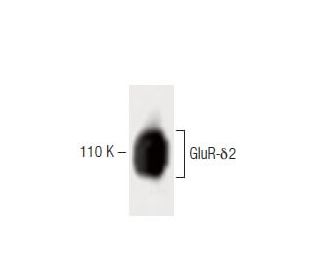


Anticorpo GluR-δ2 (48): sc-135927
- GluR- delta 2 Antibody 48 è un monoclonale di topo IgG1 fornito in 50 µg/500 µl
- generato contro gli amminoacidi 665-786 di GluR-δ2 di origine mouse
- raccomandato per il rilevamento di GluR-δ2 di origine mouse e rat in WB, IP e IF
- Al momento non abbiamo ancora completato l'identificazione dei reagenti secondari di rilevazione preferiti per GluR-δ2 l'anticorpo (48). Questo lavoro è in corso.

I recettori del glutammato mediano la maggior parte della neurotrasmissione eccitatoria nel cervello e svolgono un ruolo importante nella plasticità neurale, nello sviluppo neurale e nella neurodegenerazione. I recettori ionotropici del glutammato sono classificati in recettori NMDA e recettori kainati/AMPA, entrambi contenenti canali ionici glutammato-gettati, specifici per i cationi. I recettori kainato/AMPA si co-localizzano con i recettori NMDA in molte sinapsi e sono costituiti da sette subunità strutturalmente correlate, denominate da GluR-1 a -7 e GluR-δ2. I recettori kainati/AMPA sono i principali responsabili della neurotrasmissione eccitatoria veloce da parte del glutammato, mentre i recettori NMDA sono funzionalmente caratterizzati da una cinetica lenta e da un'elevata permeabilità agli ioni Ca2+. I recettori NMDA sono costituiti da cinque subunità: epsilion 1, 2, 3, 4 e una subunità zeta. La subunità zeta è espressa in tutto il tronco encefalico, mentre le quattro subunità epsilon hanno una distribuzione limitata. Nei topi, mutazioni nel gene che codifica il GluR-δ2 (GRID2) causano il fenotipo Lurcher. Il gene che codifica il GluR-δ2 umano mappa sul cromosoma 4q22.
Alexa Fluor® è un marchio registrato di Molecular Probes Inc., OR., USA
LI-COR® e Odyssey® sono marchi registrati di LI-COR Biosciences
Anticorpo GluR-δ2 (48) Riferimenti:
- Interazione diretta di GluRdelta2 con le proteine Shank nelle cellule del Purkinje cerebellare. | Uemura, T., et al. 2004. Mol Cell Neurosci. 26: 330-41. PMID: 15207857
- Aumento della trasmissione sinaptica inibitoria nello strato molecolare cerebellare del topo GluRdelta2 knock-out. | Ohtsuki, G., et al. 2004. J Neurosci. 24: 10900-7. PMID: 15574740
- Il CRF e l'urocortina modulano in modo differenziato l'espressione e la distribuzione di GluRdelta2 nelle sinapsi delle fibre parallele e delle cellule del neurocinema. | Gounko, NV., et al. 2005. Mol Cell Neurosci. 30: 513-22. PMID: 16198122
- Meccanismi di regolazione cerebellare appresi dagli studi su GluRdelta2. | Hirano, T. 2006. Mol Neurobiol. 33: 1-16. PMID: 16388107
- L'estremo C-terminale di GluRdelta2 è essenziale per l'induzione della depressione a lungo termine nelle fette cerebellari. | Kohda, K., et al. 2007. Eur J Neurosci. 25: 1357-62. PMID: 17425562
- La molecola GluRδ2, simile al recettore del glutammato, è coinvolta nella formazione di sinapsi nelle sinapsi tra fibre parallele e neuroni di neurocircolo. | Hirano, T. 2012. Cerebellum. 11: 71-7. PMID: 20387025
- L'interazione trans-sinaptica di GluRdelta2 e Neurexin attraverso Cbln1 media la formazione di sinapsi nel cervelletto. | Uemura, T., et al. 2010. Cell. 141: 1068-79. PMID: 20537373
- Sviluppo di una tecnica anatomica per visualizzare la modalità di innervazione delle fibre rampicanti nelle cellule del Purkinje e sua applicazione a topi mutanti privi di GluRδ2 e Ca(v)2.1. | Miyazaki, T. and Watanabe, M. 2011. Anat Sci Int. 86: 10-8. PMID: 21153457
- GluRδ2 assembla quattro neurexine nella triade trans-sinaptica per innescare la formazione delle sinapsi. | Lee, SJ., et al. 2012. J Neurosci. 32: 4688-701. PMID: 22457515
- Disturbo dell'organizzazione microzonale cerebellare nel topo knockout per GluD2 (GluRδ2). | Hashizume, M., et al. 2013. Front Neural Circuits. 7: 130. PMID: 23970854
Informazioni ordini
| Nome del prodotto | Codice del prodotto | UNITÀ | Prezzo | Quantità | Preferiti | |
GluR-δ2 Anticorpo (48) | sc-135927 | 50 µg/500 µl | $322.00 |