
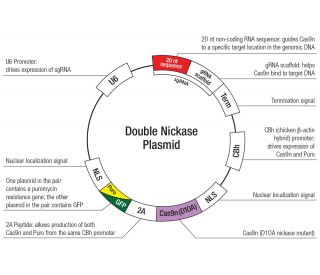


The Double Nickase Plasmid features a U6 promoter for sgRNA expression, a 20 nt targeting sequence, and a gRNA scaffold to guide Cas9n. It includes a CBh promoter for Cas9n (D10A) and puromycin resistance, GFP for transfection verification, and nuclear localization signals (NLS). The 2A peptide allows co-expression of Cas9n and Puro from a single promoter, enabling precise genome editing with reduced off-target effects.
cathepsin G双切口酶质粒(h): sc-402663-NIC
- 针对种属:human
- 20 µg 纯化的即用型的质粒DNA,最多可供20次转染
- cathepsin G 双切口酶质粒(h)含有一对质粒,分别编码D10A突变的Cas9核酸酶,和目标特异的 20 nt 向导RNA (gRNA),与其相应的/%base_sku_name%/ CRISPR/Cas9敲除质粒相比,它在基因敲除方面具有更好的特异性
- 成对的向导RNA序列与目标基因中约20个碱基对互补,从而使Cas9可以模仿DNA双链断裂(DSB),介导特异的基因组DNA双切割
- 质粒对中的一个包含供筛选使用的嘌呤霉素抗性基因;另一个包含供观察转染使用的绿色荧光蛋白标记
- cathepsin G双切酶质粒(h)和cathepsin G双切酶质粒(h2)编码针对CTSG的不同配对gRNA设计。其中一种或两种设计可能均有提供

订购信息
| 产品名称 | 产品编号 | 规格 | 价格 | 数量 | 收藏夹 | |
cathepsin G双切口酶质粒(h) | sc-402663-NIC | 20 µg | $410.00 | |||
cathepsin G双切口酶质粒(h2) | sc-402663-NIC-2 | 20 µg | $410.00 |
CTSG 编码组织蛋白酶 G(cathepsin G),这是一种由中性粒细胞和肥大细胞产生的丝氨酸蛋白酶,储存在嗜天青颗粒中,并在脱颗粒及 NET(中性粒细胞胞外诱捕网)形成过程中释放。组织蛋白酶 G 通过对微生物及宿主底物进行蛋白水解加工、调节趋化因子和细胞因子,以及参与细胞外基质重塑,从而促进先天免疫防御。借助其在炎症信号传导与蛋白酶级联反应中的作用,CTSG 影响白细胞募集、血管与组织通透性以及抗微生物反应。组织蛋白酶 G 活性失调与慢性炎症性疾病、组织损伤及肿瘤相关炎症有关,因此 CTSG 是研究免疫驱动病理机制的有用靶点。
cathepsin G 双切酶质粒(h)由一对匹配的质粒组成,专为在 human 细胞系中对 CTSG 位点进行高特异性编辑而设计。每个质粒分别表达Cas9 D10A切口酶和针对CTSG内不同DNA链的独特sgRNA。当这两种切口酶被引导至相邻但位于DNA链相反侧的位点时,会产生错位的单链切口,从而共同形成错位双链断裂,这需要两个引导RNA在靶位点上协同发挥作用。由此产生的DNA断裂通过内源性细胞修复途径(最常见的是非同源末端连接(NHEJ))得到修复,从而导致插入或缺失,进而破坏CTSG的功能。通过要求双sgRNA在靶位点结合,双切口方法提高了编辑特异性,并为需要对靶向精度进行额外控制的应用提供了互补的CRISPR策略。
为高效识别编辑后的细胞,其中一个质粒编码GFP以实现转染细胞群的荧光可视化,而配套质粒则携带嘌呤霉素抗性基因用于抗生素筛选。这些特性共同支持共转染细胞群的高效富集,并简化了CTSG基因失活克隆的验证流程。
仅供研究使用。不用于诊断或治疗。