
C1orf173 Plasmídeo de ativação de CRISPR (h): sc-409362-ACT
- alvos específicos: human
- 20 µg de plasmídeo de DNA pronto para transfecção; Suficiente para até 20 transfecções
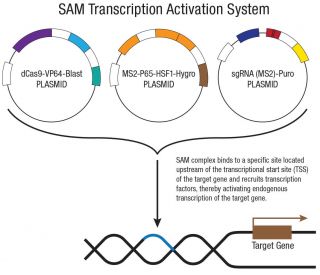
- C1orf173O plasmídeo de ativação de CRISPR (h)e um mediador da ativação sinergética (SAM) dentro do sistema de ativada da transcrição, criado para a especificamente fazer a regulação genética crescente
- C1orf173 Plasmídeo de ativação CRISPR (h) consiste em 3 pares de plasmídeos com a razão de massa de 1:1:1: um plasmídeo contento o código para Cas9 desativada
- O complexo SAM resultante se liga a uma região especifica a qual contem aproximadamente 200-250 nt na região upstream da região de inicio da transcrição e fornece um recrutamento robusto de fatores de transcrição para uma eficiente ativação genética.
- Os gRNAs codificados pelo Plasmídeo de Ativação CRISPR C1orf173 (h) e pelo Plasmídeo de Ativação CRISPR C1orf173 (h2) têm como alvo regiões reguladoras distintas a montante do local de início da transcrição de ERICH3. Um ou ambos os desenhos podem estar disponíveis

Informacoes sobre ordens
| Nome do Produto | Numero de Catalogo | UNID | Preco | Qde | FAVORITOS | |
C1orf173 Plasmídeo de ativação de CRISPR (h) | sc-409362-ACT | 20 µg | $397.00 | |||
C1orf173 Plasmídeo de ativação de CRISPR (h2) | sc-409362-ACT-2 | 20 µg | $397.00 |
ERICH3 (também denominado C1orf173) codifica uma proteína rica em glutamato com anotação funcional limitada, o que o torna um alvo útil para estudos mecanísticos de genes humanos pouco caracterizados. Evidências disponíveis provenientes de perfis de expressão e de estudos de associação genética sugerem que o ERICH3 pode influenciar programas regulatórios celulares ligados à biologia neuronal e à transcrição responsiva ao estresse, potencialmente cruzando-se com vias que controlam a homeostase da expressão gênica e a proteostase. Como um quadro de leitura aberto em grande parte não caracterizado, o ERICH3 é frequentemente investigado para conectar genótipo a fenótipo em análises em nível de sistemas. Padrões de expressão desregulados foram relatados em conjuntos de dados relevantes para doenças, sustentando seu uso em pesquisa exploratória sobre correlatos moleculares de características complexas.
C1orf173 O Plasmídeo de Ativação CRISPR (h) oferece uma abordagem direcionada e não destrutiva para regular positivamente a expressão endógena de ERICH3 sem alterar a sequência de ADN subjacente.
C1orf173 O Plasmídeo de Ativação CRISPR (h) é um sistema mediador de ativação sinérgica (SAM) de três plasmídeos, concebido para a regulação positiva transcricional altamente eficiente e específica do locus ERICH3 em linhas celulares humanas. O sistema é construído em torno de uma Cas9 cataliticamente inativa (dCas9) portadora de duas mutações inativadoras (D10A e N863A) que eliminam a atividade nuclease, preservando simultaneamente a ligação ao ADN. Esta dCas9 é fundida com VP64, um potente ativador transcricional, e é coexpressa com um gene de resistência à blasticidina para seleção. O segundo plasmídeo codifica a proteína de fusão MS2-p65-HSF1, um complexo ativador secundário que atua em conjunto com o dCas9-VP64, juntamente com um gene de resistência à higromicina. O terceiro plasmídeo codifica um sgRNA de 20 nt específico para o alvo, fundido a dois aptâmeros de RNA MS2 que recrutam o complexo MS2-p65-HSF1 para o local de ativação, acompanhado por um gene de resistência à puromicina. Os três plasmídeos são administrados numa proporção de massa de 1:1:1 para uma expressão equilibrada de todos os componentes do sistema.
Uma vez montado no locus alvo, o complexo SAM liga-se a cerca de 200 pb a montante do local de início da transcrição ERICH3, onde VP64, p65 e HSF1 atuam em conjunto para recrutar a maquinaria transcricional e impulsionar a regulação positiva da expressão endógena de C1orf173. Ao contrário da Cas9 com atividade nuclease, o dCas9 não introduz quebras de cadeia dupla nem modifica a sequência genómica, preservando o locus ERICH3 nativo e permitindo o estudo de respostas transcricionais dependentes de C1orf173 no locus endógeno, tornando-o uma ferramenta valiosa para estudos funcionais, identificação de genes-alvo e modelagem da restauração da via C1orf173 em células tumorais com expressão de ERICH3 silenciada ou reduzida.
Apenas para uso em investigação. Não se destina a uso diagnóstico ou terapêutico.