
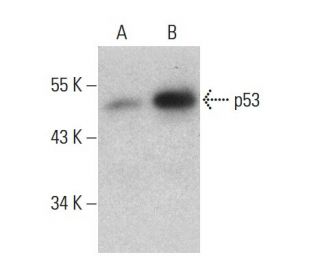
p53 Anticuerpo (pAb 122): sc-56182
- p53 Anticuerpo pAb 122 es un monoclonal de ratón IgG2b, ver las 12 publicaciones, proporcionado como 200 µg/ml
- producido contra los amino ácidos 370-378 de p53 de origen mouse
- p53 Anticuerpo (pAb 122) es recomendado para detectar a conserved, denaturation-resistant determinant of the p53 protein de mouse, rat y human origen, mediante WB, IP, IF y FCM
- p53 Anticuerpo (pAb 122) es disponible conjugado a agarosa para IP; HRP para WB, IHC(P) y ELISA; y tanto a phycoerythrin como a FITC para IF, IHC(P) y FCM
- también disponible conjugado a Alexa Fluor® 488, Alexa Fluor® 546, Alexa Fluor® 594 o Alexa Fluor® 647 para WB (RGB), IF, IHC (P) y FCM
- también disponible conjugado a Alexa Fluor® 680 o Alexa Fluor® 790 para WB (NIR), IF y FCM
- m-IgG Fc BP-HRP es el reactivo de detección secundario preferido para p53 Anticuerpo (pAb 122) para aplicaciones WB. Este reactivo se ofrece ahora en un paquete con p53 Anticuerpo (pAb 122)(ver información de pedido más abajo).

ENLACES RÁPIDOS
VER TAMBIÉN ....
L'anticorps anti-p53 (pAb 122) est un anticorps monoclonal de souris IgG2b kappa qui se lie spécifiquement à la protéine p53 humaine au niveau de l'épitope englobant les acides aminés 370-378, qui fait partie d'un déterminant conservé et résistant à la dénaturation au sein du domaine de tétramérisation de p53. Cette spécificité permet à l'anticorps anti-p53 (pAb 122) de détecter les formes sauvages et mutantes de p53 provenant de l'homme, de la souris et du rat par western blotting, immunoprécipitation, immunofluorescence et cytométrie de flux. L'anticorps monoclonal p53 (pAb 122) est disponible sous forme non conjuguée et sous diverses formes conjuguées, notamment agarose, peroxydase de raifort (HRP), phycoérythrine (PE), isothiocyanate de fluorescéine (FITC) et plusieurs conjugués Alexa Fluor®, ce qui offre une grande souplesse pour diverses applications expérimentales. La protéine p53 est une protéine suppresseur de tumeur essentielle qui contient des domaines de liaison à l'ADN, d'oligomérisation et d'activation de la transcription, fonctionnant pour réguler à la hausse les gènes liés à l'arrêt de la croissance et à l'apoptose en réponse à des signaux de stress cellulaire. p53 influence la mort cellulaire programmée, la différenciation cellulaire et les mécanismes de contrôle du cycle cellulaire. Bien que principalement localisée dans le noyau, p53 peut être transportée dans le cytoplasme par son régulateur négatif MDM2, une E3 ubiquitine ligase qui cible p53 pour la dégradation protéasomique par polyubiquitination. L'activité de p53 est finement régulée par des modifications post-traductionnelles telles que la phosphorylation et l'acétylation, qui modulent son affinité de liaison à l'ADN et son activité transcriptionnelle. Les mutations dans le domaine de liaison à l'ADN (acides aminés 110-286) altèrent souvent la capacité de p53 à se lier à l'ADN et sont associées à de nombreux cancers humains. La capacité de l'anticorps monoclonal de souris p53 (pAb 122) à reconnaître un épitope résistant à la dénaturation en fait un outil précieux pour la détection de p53 dans diverses conditions expérimentales, y compris celles impliquant des protéines dénaturées.
Alexa Fluor® es una marca registrada de Molecular Probes Inc., OR., USA
REIVEW LI-COR® y Odyssey® son marcas registradas de LI-COR Biosciences.
p53 Anticuerpo (pAb 122) Referencias:
- Funciones de la oncoproteína MDM2. | Freedman, DA., et al. 1999. Cell Mol Life Sci. 55: 96-107. PMID: 10065155
- Biología estructural del supresor tumoral p53 y de los mutantes asociados al cáncer. | Joerger, AC. and Fersht, AR. 2007. Adv Cancer Res. 97: 1-23. PMID: 17419939
- Un dominio de unión al ADN está contenido en el C-terminal de la proteína p53 de tipo salvaje. | Foord, OS., et al. 1991. Nucleic Acids Res. 19: 5191-8. PMID: 1923804
- La proteína p53 mutante, reguladora maestra de las neoplasias malignas humanas: informe del V Taller sobre la proteína p53 mutante. | Blandino, G., et al. 2012. Cell Death Differ. 19: 180-3. PMID: 22095277
- Enfoque terapéutico del cáncer basado en la estabilización conformacional de la proteína p53 mutante mediante pequeños péptidos. | Tal, P., et al. 2016. Oncotarget. 7: 11817-37. PMID: 26943582
- Inmunosensor amperométrico desechable para la determinación de la proteína p53 humana en lisados celulares utilizando microportadores magnéticos. | Pedrero, M., et al. 2016. Biosensors (Basel). 6: PMID: 27879639
- Aumento de la semivida de la proteína p53 en queratinocitos de ratón tras la irradiación UV-B. | Liu, M., et al. 1994. Carcinogenesis. 15: 1089-92. PMID: 8020138
- Translocación citoplasmática dependiente de la síntesis proteica de la proteína p53 tras la estimulación con suero de células MCF-7 de crecimiento detenido. | Takahashi, K., et al. 1993. Mol Carcinog. 8: 58-66. PMID: 8352892
- La p53 humana se une al ADN como un homodímero proteico, pero las variantes monoméricas conservan toda la actividad de transactivación de la transcripción. | Tarunina, M. and Jenkins, JR. 1993. Oncogene. 8: 3165-73. PMID: 8414520
- La oncoproteína MDM2 se sobreexpresa en las líneas celulares de rabdomiosarcoma y estabiliza la proteína p53 de tipo salvaje. | Keleti, J., et al. 1996. Am J Pathol. 149: 143-51. PMID: 8686737
Información sobre pedidos
| Nombre del producto | Número de catálogo | UNIDAD | Precio | CANTIDAD | Favoritos | |
p53 Anticuerpo (pAb 122) | sc-56182 | 200 µg/ml | $322.00 | |||
Paquete de p53 (pAb 122): m-IgG Fc BP-HRP | sc-552866 | 200 µg Ab; 10 µg BP | $361.00 | |||
p53 Anticuerpo (pAb 122) AC | sc-56182 AC | 500 µg/ml, 25% agarose | $424.00 | |||
p53 Anticuerpo (pAb 122) HRP | sc-56182 HRP | 200 µg/ml | $322.00 | |||
p53 Anticuerpo (pAb 122) FITC | sc-56182 FITC | 200 µg/ml | $336.00 | |||
p53 Anticuerpo (pAb 122) PE | sc-56182 PE | 200 µg/ml | $349.00 | |||
p53 Anticuerpo (pAb 122) Alexa Fluor® 488 | sc-56182 AF488 | 200 µg/ml | $364.00 | |||
p53 Anticuerpo (pAb 122) Alexa Fluor® 546 | sc-56182 AF546 | 200 µg/ml | $364.00 | |||
p53 Anticuerpo (pAb 122) Alexa Fluor® 594 | sc-56182 AF594 | 200 µg/ml | $364.00 | |||
p53 Anticuerpo (pAb 122) Alexa Fluor® 647 | sc-56182 AF647 | 200 µg/ml | $364.00 | |||
p53 Anticuerpo (pAb 122) Alexa Fluor® 680 | sc-56182 AF680 | 200 µg/ml | $364.00 | |||
p53 Anticuerpo (pAb 122) Alexa Fluor® 790 | sc-56182 AF790 | 200 µg/ml | $364.00 |