


Plásmido Doble Nickase (h) SAP 49: sc-407057-NIC
- Especies Diana: human
- 20 µg de plásmido de ADN purificado listo para la trasfección; suficiente para 20 transfecciones máximo
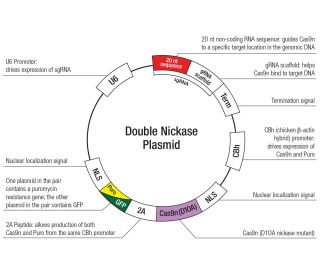
- El Plásmido Double Nickase (h)SAP 49 consisten en un par de plásmidos cada uno codificando una nucleasa Cas9 mutada D10A y una guia de ARN de 20 nucleótidos (gRNA) diseñados para una mayor especificidad que el homologo CRISPR/Cas9 KO
- Las secuencias de gRNA tienen una diferencia de unas 20 pb para permitir un corte doble mediado por Cas9 en el ADN que imita el doble corte
- Uno de los plásmidos contiene el gen de resistencia a puromicina para la selección y el otro el marcado GFP para confirmar visualmente la transfección
- El plásmido de doble nickasa SAP 49 (h) y el plásmido de doble nickasa SAP 49 (h2) codifican diseños distintos de pares de gRNA dirigidos a SF3B4. Puede que esté disponible uno o ambos diseños
- Tras la transfección, la eficacia del knockout puede comprobarse mediante WB, IF ó IHC utilzando el anticuerpo: SAP 49 Anticuerpo (G-12): sc-365570

Información sobre pedidos
| Nombre del producto | Número de catálogo | UNIDAD | Precio | CANTIDAD | Favoritos | |
Plásmido Doble Nickase (h) SAP 49 | sc-407057-NIC | 20 µg | $410.00 | |||
Plásmido Doble Nickase (h2) SAP 49 | sc-407057-NIC-2 | 20 µg | $410.00 |
SF3B4 codifica SAP 49, un componente central del subcomplejo SF3b dentro de la ribonucleoproteína nuclear pequeña U2 que ayuda a reconocer las secuencias del punto de ramificación durante el empalme del pre-ARNm. Al favorecer el ensamblaje del espliceosoma y la selección de sitios de empalme, SAP 49 contribuye a la integridad del transcriptoma y a la regulación posterior del procesamiento del ARN, los programas del ciclo celular y las respuestas al estrés. La alteración del empalme dependiente de SF3B4 se asocia con cambios en la expresión de isoformas y con modificaciones amplias de las redes de regulación génica observadas en múltiples contextos de enfermedad, incluidos cánceres y trastornos del desarrollo. Como factor del espliceosoma, SAP 49 se estudia con frecuencia en los mecanismos de fidelidad del empalme, el control del empalme alternativo y las relaciones entre genotipo e isoforma.
SAP 49 El plásmido de doble nicasa (h) consiste en un par de plásmidos emparejados diseñados para la edición de alta especificidad del locus SF3B4 en líneas celulares human. Cada plásmido expresa una nicasa Cas9 D10A y un ARN guía específico (sgRNA) dirigido a cadenas de ADN opuestas dentro de SF3B4. Cuando se dirigen a sitios adyacentes en cadenas de ADN opuestas, las dos nicasas generan cortes en cadena simple desplazados que, juntos, producen una rotura de doble cadena escalonada, lo que requiere una actividad coordinada sobre el objetivo por parte de ambas guías. La rotura de ADN resultante se resuelve mediante vías de reparación celular endógenas, más comúnmente a través de la unión de extremos no homólogos (NHEJ), lo que da lugar a inserciones o deleciones que alteran la función de SF3B4. Al requerir la participación de dos ARN guía en el locus diana, el enfoque de doble corte mejora la especificidad de la edición y proporciona una estrategia CRISPR complementaria para aplicaciones en las que se desea un control adicional sobre la precisión de la orientación.
Para facilitar la identificación eficiente de las células editadas, un plásmido codifica GFP para la visualización fluorescente de las poblaciones transfectadas, mientras que el plásmido complementario lleva un gen de resistencia a la puromicina para la selección con antibióticos. En conjunto, estas características facilitan el enriquecimiento eficiente de las poblaciones cotransfectadas y simplifican la validación de los clones con SF3B4 alterado.
Sólo para uso en investigación. No destinado a uso diagnóstico o terapéutico.