
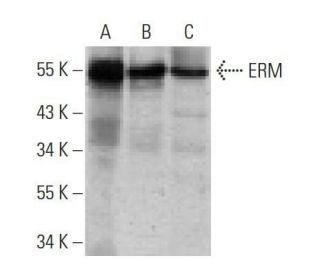

ERM 항체(3H3): sc-293164. Jurkat(A), NIH/3T3(B) 및 MCF-7(C) 전체 세포 용해물에서 ERM 발현의 웨스턴 블롯 분석.
ERM 항체 (3H3): sc-293164
- ERM 항체 3H3 는 마우스 monoclonal IgG1 이며 100 µg/ml으로 제공합니다.
- human의 ERM에 해당하는 재조합 단백질 단편에 대해 제기됨
- WB, IP와 ELISA으로 mouse, rat와 human origin의 ERM을 검출할것을 권장합니다.
- 현재 ERM 항체(3H3)에 대해 선호하는 2차 검출 시약의 식별을 아직 완료하지 못했습니다. 이 작업은 진행 중입니다.

빠른 링크
보조 제품
설명
Gene 정보
데이터 시트 및 프로토콜
연구 정보
더보기
ERM 항체(3H3)는 웨스턴 블랏팅(WB), 면역침전(IP), 효소결합면역흡착분석(ELISA) 등의 방법을 통해 생쥐, 쥐, 인간 표본에서 ERM을 검출하는 생쥐 단일클론 IgG1 항체입니다. ERM, 즉 에즈린-라딕신-모에신(Ezrin-Radixin-Moesin)은 세포막과 세포골격의 연결에 중요한 역할을 담당함으로써 세포의 모양, 운동성, 신호 전달 경로에 영향을 미칩니다. 항-ERM 항체(3H3)는 세포막에 주로 존재하는 단백질을 표적으로 삼는데, 이 단백질은 세포 부착 및 이동과 같은 과정에 필수적인 미세 융모와 막 주름의 형성에 필수적입니다. ERM의 적절한 국소화는 세포 구조를 유지하고 세포 외 환경과 세포 내부 사이의 소통을 촉진하는 데 매우 중요합니다. ERM 단일클론항체(3H3)는 세포 성장과 분화 조절을 포함한 다양한 세포 기능에 관여하는 단백질을 검출할 수 있게 해 줌으로써, 정상적인 생리학 및 암 전이와 같은 질병 상태 모두에서 중요한 역할을 합니다. ERM(3H3) 항체는 ERM의 신뢰할 수 있는 검출과 정량화를 가능하게 해 줌으로써, 연구자들이 세포 역학과 병리학에서 ERM의 다양한 역할을 탐구할 수 있게 해 줍니다.
연구용으로만 사용가능합니다. 진단이나 치료용으로 사용불가합니다.
Alexa Fluor®는 미국 오리건주 Molecular Probes Inc.의 상표입니다.
LI-COR®와 Odyssey®는 LI-COR Biosciences의 등록 상표입니다.
ERM 항체 (3H3) 참고문헌:
- 세포 부착 및 막 역학에 있는 ERM 단백질. | Mangeat, P., et al. 1999. Trends Cell Biol. 9: 187-92. PMID: 10322453
- 혈장막 조직과 기능에 있어서의 ERM-Merlin과 EBP50 단백질 군. | Bretscher, A., et al. 2000. Annu Rev Cell Dev Biol. 16: 113-43. PMID: 11031232
- 상피 세포 조직과 기능에 있어서의 ERM 단백질. | Fiévet, B., et al. 2007. Biochim Biophys Acta. 1773: 653-60. PMID: 16904765
- 머린과 ERM 단백질--세포 피질에서 수용체 분포와 신호 전달을 조절하는 조절자. | McClatchey, AI. and Fehon, RG. 2009. Trends Cell Biol. 19: 198-206. PMID: 19345106
- 세포 부착 및 이동에 있어서 ERM 단백질의 새로운 역할. | Arpin, M., et al. 2011. Cell Adh Migr. 5: 199-206. PMID: 21343695
- 암에서 약물 내성의 요인으로 작용하는 유출 수송체의 막 발현을 지원하는 ERM 단백질과 전사 조절 인자의 생리적 역할. | Ogihara, T., et al. 2020. Cancers (Basel). 12: PMID: 33198344
- 이펙터 매개 ERM 활성화는 RhoA 활성을 국소적으로 억제하여 정단 세포 도메인을 형성합니다. | Zaman, R., et al. 2021. J Cell Biol. 220: PMID: 33836044
- ERM 단백질 moesin은 생체 내 자연 살해 세포의 항상성을 조절합니다. | Satooka, H., et al. 2022. Cell Immunol. 371: 104456. PMID: 34798556
- 히드로마이신-A와 함께 작용하는 마크로라이드가 Erm 매개 저항성을 극복하는 메커니즘에 대한 구조적 통찰. | Chen, CW., et al. 2023. Nat Commun. 14: 4196. PMID: 37452045
- 흑색종에서 MCAM/CD146 및 ERM 계열 단백질의 협력적 분극화. | Miller, SG., et al. 2024. Mol Biol Cell. 35: ar31. PMID: 38117590
주문정보
| 제품명 | 카탈로그 번호 | 단위 | 가격 | 수량 | 관심품목 | |
ERM 항체 (3H3) | sc-293164 | 100 µg/ml | $322.00 |