
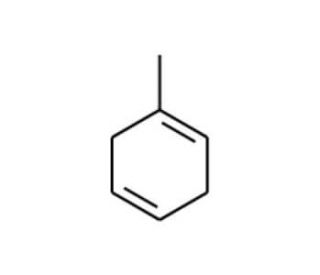

1-Methyl-1,4-cyclohexadiene (CAS 4313-57-9)
QUICK LINKS
1-Methyl-1,4-cyclohexadiene (MCHD) is a member of the larger cyclohexadienes family, characterized by its cyclic hydrocarbon structure. This substance appears as a colorless liquid with a sharp smell. 1-Methyl-1,4-cyclohexadiene is utilized in various ways, such as in the creation of fragrances, other organic compounds, and in the manufacturing process of polymers. Additionally, it′s a key player in the synthesis of polycyclic aromatic hydrocarbons (PAHs). 1-Methyl-1,4-cyclohexadiene is noted for its diverse applications in scientific research, which include studying its environmental impact, its role in polymer production, and its potential as a catalyst in chemical reactions. It′s also used to understand the structure and properties of PAHs and to delve into the effects of PAHs on human health. While the exact mechanism of action of 1-Methyl-1,4-cyclohexadiene is yet to be fully comprehended, it′s presumed to act as a catalyst in various chemical reactions. Additionally, it′s hypothesized to interact with specific enzymes and proteins, which could potentially explain its catalytic role in certain reactions.
1-Methyl-1,4-cyclohexadiene (CAS 4313-57-9) References
- Hypoxylon sp., an endophyte of Persea indica, producing 1,8-cineole and other bioactive volatiles with fuel potential. | Tomsheck, AR., et al. 2010. Microb Ecol. 60: 903-14. PMID: 20953951
- Modulation of volatile organic compound formation in the Mycodiesel-producing endophyte Hypoxylon sp. CI-4. | Ul-Hassan, SR., et al. 2012. Microbiology (Reading). 158: 465-473. PMID: 22096148
- Ultraviolet-Visible (UV-Vis) Microspectroscopic System Designed for the In Situ Characterization of the Dehydrogenation Reaction Over Platinum Supported Catalytic Microchannel Reactor. | Suarnaba, EG., et al. 2016. Appl Spectrosc. 70: 1806-1812. PMID: 27697823
- Mimicking Class I b Mn2 -Ribonucleotide Reductase: A MnII2 Complex and Its Reaction with Superoxide. | Magherusan, AM., et al. 2018. Angew Chem Int Ed Engl. 57: 918-922. PMID: 29165865
- 1-Methyl-1,4-cyclohexadiene as a Traceless Reducing Agent for the Synthesis of Catechols and Hydroquinones. | Baschieri, A., et al. 2019. J Org Chem. 84: 13655-13664. PMID: 31536337
- Extraction of essential oil from Citrus reticulate Blanco peel and its antibacterial activity against Cutibacterium acnes (formerly Propionibacterium acnes). | Hou, HS., et al. 2019. Heliyon. 5: e02947. PMID: 31872120
- Novel Amphiphilic Block Copolymers for the Formation of Stimuli-Responsive Non-Lamellar Lipid Nanoparticles. | Zhai, J., et al. 2021. Molecules. 26: PMID: 34203820
- Mechanisms of Action of Microbial Biocontrol Agents against Botrytis cinerea. | Roca-Couso, R., et al. 2021. J Fungi (Basel). 7: PMID: 34947027
- Dataset from analytical pyrolysis assays for converting waste tires into valuable chemicals in the presence of noble-metal catalysts. | Azócar, BS., et al. 2022. Data Brief. 40: 107745. PMID: 35005140
- Arene Ru(II) Complexes with Difluorinated Ligands Act as Potential Inducers of S-Phase Arrest via the Stabilization of c-myc G-Quadruplex DNA. | Zeng, L., et al. 2022. Molecules. 27: PMID: 35335261
- Arene Variation of Highly Cytotoxic Tridentate Naphthoquinone-Based Ruthenium(II) Complexes and In-Depth In Vitro Studies. | Cseh, K., et al. 2022. Pharmaceutics. 14: PMID: 36432656
- Delving into Agri-Food Waste Composition for Antibacterial Phytochemicals. | Pereira, JAM., et al. 2023. Metabolites. 13: PMID: 37233675
- Enantioselective Synthesis of Triarylmethanes via Intermolecular C-H Functionalization of Cyclohexadienes with Diaryldiazomethanes. | Lee, M. and Davies, HML. 2023. Org Lett. 25: 4000-4004. PMID: 37249358
Ordering Information
| Product Name | Catalog # | UNIT | Price | Qty | FAVORITES | |
1-Methyl-1,4-cyclohexadiene, 5 g | sc-273368 | 5 g | $139.00 |