
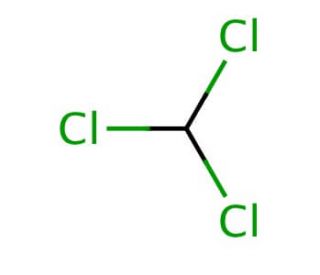

Chloroform (CAS 67-66-3)
See product citations (1)
QUICK LINKS
Chloroform, with the chemical formula CHCl3, is a trichloromethane derivative, a dense, colorless, volatile liquid known for its distinctive sweet smell. Historically significant as an anesthetic, chloroform′s use today is predominantly in industrial and research settings due to its potency and risks associated with exposure. In scientific research, chloroform serves primarily as a solvent due to its ability to dissolve many organic compounds that are otherwise insoluble in water, making it invaluable in the extraction and purification of biochemicals like alkaloids, fats, oils, and some resins. Its non-polar nature allows it to participate in phase separation techniques, particularly in liquid-liquid extraction processes. When mixed with water, chloroform undergoes phase separation, enabling the selective dissolution of compounds based on their solubility in the chloroform phase versus the aqueous phase. This characteristic is extensively utilized in the purification of large biomolecules and in the preparation of samples for analysis in fields such as environmental science, where it is used to extract pollutants from water samples before analysis. Additionally, in organic synthesis, chloroform acts as a source of the dichlorocarbene (:CCl2) group when treated with strong base. This reactive intermediate is employed in the synthesis of various organic compounds through reactions such as the formation of dichlorocyclopropanes from alkenes, illustrating its pivotal role in facilitating complex chemical transformations.
Chloroform (CAS 67-66-3) References
- Role of ryanodine receptors in chloroform-induced contraction in Swine tracheal smooth muscle. | Lin, YR., et al. 2002. Toxicol Appl Pharmacol. 183: 146-51. PMID: 12387754
- Immunotoxicological profile of chloroform in female B6C3F1 mice when administered in drinking water. | Auttachoat, W., et al. 2009. Drug Chem Toxicol. 32: 77-87. PMID: 19514942
- Chloroform exposure in air and water in Swedish indoor swimming pools-urine as a biomarker of occupational exposure. | Ragnebro, O., et al. 2023. Ann Work Expo Health. 67: 876-885. PMID: 37339253
- Toluene-driven anaerobic biodegradation of chloroform in a continuous-flow bioelectrochemical reactor. | Tucci, M., et al. 2023. Chemosphere. 338: 139467. PMID: 37437617
- Efficient and Reversible Separation of Chloroform from Chlorinated Hydrocarbons and Water Utilizing a Two-Dimensional Coordination Network. | Li, GB., et al. 2023. ACS Appl Mater Interfaces. 15: 37602-37608. PMID: 37504065
- Cytotoxicity and genotoxicity evaluation of chloroform using Vicia faba roots. | Li, X., et al. 2023. Toxicol Ind Health. 39: 603-612. PMID: 37518894
- Anthropogenic Chloroform Emissions from China Drive Changes in Global Emissions. | An, M., et al. 2023. Environ Sci Technol. 57: 13925-13936. PMID: 37656597
- Chloroform in food samples from 2014 Canadian total diet study: occurrence and dietary exposure. | Cao, XL., et al. 2024. Food Addit Contam Part A Chem Anal Control Expo Risk Assess. 41: 143-150. PMID: 38193981
- Chloroform associated with bone mineral density and bone mineral content in adults: A population-based cross-sectional research. | Li, L., et al. 2024. PLoS One. 19: e0290132. PMID: 38427675
Ordering Information
| Product Name | Catalog # | UNIT | Price | Qty | FAVORITES | |
Chloroform, 1 L | sc-239527A | 1 L | $112.00 | |||
Chloroform, 4 L | sc-239527 | 4 L | $204.00 |