
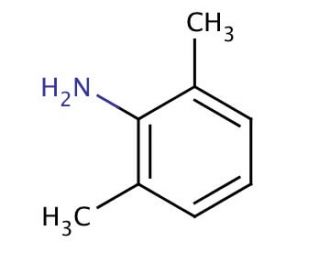

2,6-Dimethylaniline (CAS 87-62-7)
QUICK LINKS
2,6-Dimethylaniline is a chemical compound that functions as a reagent in various organic synthesis reactions. It acts as a nucleophilic aromatic substitution reagent, participating in reactions to introduce alkyl or acyl groups onto aromatic rings. 2,6-Dimethylaniline′s mechanism of action involves its ability to donate a lone pair of electrons to an electrophilic aromatic system, leading to the formation of new carbon-carbon bonds. In experimental applications, 2,6-Dimethylaniline is utilized as a building block for the synthesis of agrochemicals, and dyes. Its molecular structure allows it to participate in a range of synthetic transformations, making it useful for the construction of complex organic molecules. 2,6-Dimethylaniline′s role in its capacity to facilitate the creation of novel chemical entities through its involvement in diverse synthetic pathways.
2,6-Dimethylaniline (CAS 87-62-7) References
- Oxidation of 2,6-dimethylaniline by recombinant human cytochrome P450s and human liver microsomes. | Gan, J., et al. 2001. Chem Res Toxicol. 14: 672-7. PMID: 11409937
- Analysis of the lidocaine metabolite 2,6-dimethylaniline in bovine and human milk. | Puente, NW. and Josephy, PD. 2001. J Anal Toxicol. 25: 711-5. PMID: 11765029
- The effect of deuterium and fluorine substitution upon the mutagenicity of N-hydroxy-2,6-dimethylaniline. | Matilde Marques, M., et al. 2002. Mutat Res. 506-507: 41-8. PMID: 12351143
- NTP Toxicology and Carcinogenesis Studies of 2,6-Xylidine (2,6-Dimethylaniline) (CAS No. 87-62-7) in Charles River CD Rats (Feed Studies). | ,. 1990. Natl Toxicol Program Tech Rep Ser. 278: 1-138. PMID: 12748701
- Chemical oxidation of 2,6-dimethylaniline by electrochemically generated Fenton's reagent. | Masomboon, N., et al. 2010. J Hazard Mater. 176: 92-8. PMID: 19963316
- Chemical oxidation of 2,6-dimethylaniline in the fenton process. | Masomboon, N., et al. 2009. Environ Sci Technol. 43: 8629-34. PMID: 20028063
- Effect of carrier composition on 2,6-dimethylaniline degradation in aqueous solution by fluidized-bed Fenton process. | Ratanatamskul, C., et al. 2011. Environ Technol. 32: 1233-7. PMID: 21970165
- Elevated 4-aminobiphenyl and 2,6-dimethylaniline hemoglobin adducts and increased risk of bladder cancer among lifelong nonsmokers--The Shanghai Bladder Cancer Study. | Tao, L., et al. 2013. Cancer Epidemiol Biomarkers Prev. 22: 937-45. PMID: 23539508
- Covalent binding of [14C]-2,6-dimethylaniline to DNA of rat liver and ethmoid turbinate. | Short, CR., et al. 1989. J Toxicol Environ Health. 27: 85-94. PMID: 2724370
- The in vivo oxidative metabolism of 2,4- and 2,6-dimethylaniline in the dog and rat. | Short, CR., et al. 1989. Toxicology. 57: 45-58. PMID: 2749743
- Muscle-Type Nicotinic Receptor Modulation by 2,6-Dimethylaniline, a Molecule Resembling the Hydrophobic Moiety of Lidocaine. | Alberola-Die, A., et al. 2016. Front Mol Neurosci. 9: 127. PMID: 27932949
- Measurement of lidocaine and 2,6-dimethylaniline in minipig plasma, skin, and dermal tapes using UHPLC with electrospray MS/MS. | Li, Q., et al. 2018. J Chromatogr B Analyt Technol Biomed Life Sci. 1087-1088: 158-172. PMID: 29747144
- Effect of 2,6-xylidine (DMA) on secretion of biomarkers for inflammation and neurodevelopment by the placenta. | Arita, Y., et al. 2022. J Reprod Immunol. 149: 103458. PMID: 34952372
- Forward and reverse dosimetry for aniline and 2,6-dimethylaniline in humans extrapolated from humanized-liver mouse data using simplified physiologically based pharmacokinetic models. | Miura, T., et al. 2022. J Toxicol Sci. 47: 531-538. PMID: 36450497
- 2,6-Dimethylaniline (2,6-xylidine). | . 1993. IARC Monogr Eval Carcinog Risks Hum. 57: 323-35. PMID: 8207863
Ordering Information
| Product Name | Catalog # | UNIT | Price | Qty | FAVORITES | |
2,6-Dimethylaniline, 5 g | sc-238422 | 5 g | $27.00 | |||
2,6-Dimethylaniline, 100 g | sc-238422A | 100 g | $32.00 |