
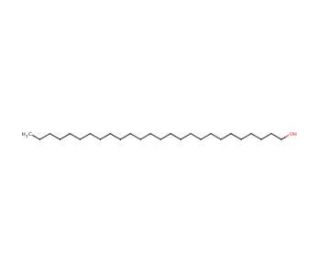

1-Hexacosanol (CAS 506-52-5)
QUICK LINKS
1-Hexacosanol is a long-chain fatty alcohol that is studied for its applications in materials science and surface chemistry. In the field of lubrication, it is of interest due to its ability to form protective monolayers on surfaces, which can reduce friction and wear on mechanical parts. Researchers also examine 1-Hexacosanol for its potential use as a phase change material in thermal energy storage systems, where its melting and solidification properties can be harnessed to regulate temperature. In addition, this compound is investigated for its role in the synthesis of surfactants and emulsifiers, as its hydrophobic tail and hydrophilic head group allow it to stabilize mixtures of oil and water. The study of 1-Hexacosanol also extends to the field of biochemistry, where its effects on lipid bilayers and cell membrane dynamics are considered. Moreover, it serves as an aliphatic compound in the production of various organic derivatives through reactions such as oxidation and esterification.
1-Hexacosanol (CAS 506-52-5) References
- Trace determination of 1-octacosanol in rat plasma by solid-phase extraction with Tenax GC and capillary gas chromatography. | Marrero Delange, D. and González Bravo, L. 2001. J Chromatogr B Biomed Sci Appl. 762: 43-9. PMID: 11589457
- Studies on the immunological effects of fatty alcohols--I. Effects of n-hexacosanol on murine macrophages in culture. | Moosbrugger, I., et al. 1992. Int J Immunopharmacol. 14: 293-302. PMID: 1624228
- N-hexacosanol ameliorates streptozotocin-induced diabetic rat nephropathy. | Saito, M., et al. 2006. Eur J Pharmacol. 544: 132-7. PMID: 16859672
- N-hexacosanol reverses diabetic induced muscarinic hypercontractility of ileum in the rat. | Shinbori, C., et al. 2006. Eur J Pharmacol. 545: 177-84. PMID: 16872599
- Preventive effects of cyclohexenonic long-chain fatty alcohol on diabetic cystopathy in the rat. | Suzuki, H., et al. 2006. Can J Physiol Pharmacol. 84: 195-201. PMID: 16900945
- Treatment with cyclohexenonic long-chain fatty alcohol reverses diabetes-induced tracheal dysfunction in the rat. | Hanada, T., et al. 2006. Pharmacology. 78: 51-60. PMID: 16912516
- Cyclohexenonic long-chain fatty alcohol has therapeutic effects on diabetes-induced angiopathy in the rat aorta. | Shinbori, C., et al. 2007. Eur J Pharmacol. 567: 139-44. PMID: 17499713
- N-hexacosanol prevents diabetes-induced rat ileal dysfunction without qualitative alteration of the muscarinic receptor system. | Narimatsu, N., et al. 2007. Biomed Res. 28: 267-73. PMID: 18000340
- Effects of N-hexacosanol on nitric oxide synthase system in diabetic rat nephropathy. | Okada, S., et al. 2008. Mol Cell Biochem. 315: 169-77. PMID: 18528636
- A diet low in animal fat and rich in N-hexacosanol and fisetin is effective in reducing symptoms of Parkinson's disease. | Renoudet, VV., et al. 2012. J Med Food. 15: 758-61. PMID: 22846082
- Acetylcholinesterase inhibitory activity of stigmasterol & hexacosanol is responsible for larvicidal and repellent properties of Chromolaena odorata. | Gade, S., et al. 2017. Biochim Biophys Acta Gen Subj. 1861: 541-550. PMID: 27916676
- Biologically-guided isolation of leishmanicidal secondary metabolites from Euphorbia peplus L. | Amin, E., et al. 2017. Saudi Pharm J. 25: 236-240. PMID: 28344474
- Hexacosanol reduces plasma and hepatic cholesterol by activation of AMP-activated protein kinase and suppression of sterol regulatory element-binding protein-2 in HepG2 and C57BL/6J mice. | Lee, JH., et al. 2017. Nutr Res. 43: 89-99. PMID: 28676202
- Chemical footprints mediate habitat selection in co-occurring aphids. | Porras, MF., et al. 2022. Behav Ecol. 33: 1107-1114. PMID: 36518632
- Effect of n-hexacosanol on insulin secretion in the rat. | Damgé, C., et al. 1995. Eur J Pharmacol. 274: 133-9. PMID: 7768265
Ordering Information
| Product Name | Catalog # | UNIT | Price | Qty | FAVORITES | |
1-Hexacosanol, 25 mg | sc-213332 | 25 mg | $61.00 | |||
1-Hexacosanol, 100 mg | sc-213332A | 100 mg | $306.00 |