
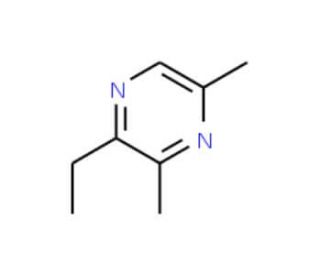

3,5-Dimethyl-2-ethylpyrazine (CAS 13925-07-0)
QUICK LINKS
3,5-Dimethyl-2-ethylpyrazine is a compound that is studied within the realms of food chemistry and olfactory science due to its distinctive aromatic properties. In sensory research, 3,5-Dimethyl-2-ethylpyrazine is utilized to understand the mechanisms of odor perception and flavor identification, as well as to examine its impact on the overall sensory experience. In analytical chemistry, this compound is often used as a standard for the calibration of instruments and for the development of methods aimed at detecting and quantifying trace aroma compounds in complex mixtures. Additionally, its synthesis and the modifications of its functional groups are explored in synthetic chemistry to create new derivatives with potential applications in flavor and fragrance formulations. Researchers also investigate the stability and reactions of 3,5-Dimethyl-2-ethylpyrazine under different environmental conditions to understand how these factors influence its sensory attributes.
3,5-Dimethyl-2-ethylpyrazine (CAS 13925-07-0) References
- Characterization of pyrazines in some Chinese liquors and their approximate concentrations. | Fan, W., et al. 2007. J Agric Food Chem. 55: 9956-62. PMID: 17970591
- Volatiles and water- and fat-soluble precursors of Saanen goat and cross Suffolk lamb flavour. | Madruga, M., et al. 2013. Molecules. 18: 2150-65. PMID: 23434868
- Characterization of the key odorants in pan-fried white mushrooms (Agaricus bisporus L.) by means of molecular sensory science: comparison with the raw mushroom tissue. | Grosshauser, S. and Schieberle, P. 2013. J Agric Food Chem. 61: 3804-13. PMID: 23581517
- Evaluation of process parameters governing the aroma generation in three hazelnut cultivars (Corylus avellana L.) by correlating quantitative key odorant profiling with sensory evaluation. | Kiefl, J. and Schieberle, P. 2013. J Agric Food Chem. 61: 5236-44. PMID: 23663154
- Key aroma compounds in roasted in-shell peanuts. | Kaneko, S., et al. 2013. Biosci Biotechnol Biochem. 77: 1467-73. PMID: 23832337
- Characterisation of the aroma profiles of different honeys and corresponding flowers using solid-phase microextraction and gas chromatography-mass spectrometry/olfactometry. | Seisonen, S., et al. 2015. Food Chem. 169: 34-40. PMID: 25236195
- Comparing the effects of conventional and microwave roasting methods for bioactive composition and the sensory quality of cold-pressed orange seed oil. | Aydeniz Güneşer, B. and Yilmaz, E. 2019. J Food Sci Technol. 56: 634-642. PMID: 30906021
- An Alkylpyrazine Synthesis Mechanism Involving l-Threonine-3-Dehydrogenase Describes the Production of 2,5-Dimethylpyrazine and 2,3,5-Trimethylpyrazine by Bacillus subtilis. | Zhang, L., et al. 2019. Appl Environ Microbiol. 85: PMID: 31585995
- Influence of Different Frying Processes on the Flavor Characteristics and Sensory Profile of Garlic Oil. | Sun, J., et al. 2019. Molecules. 24: PMID: 31817376
- Effects of thermal processing on the flavor molecules of goat by-product hydrolysates. | de Araújo Cordeiro, ARR., et al. 2020. Food Res Int. 138: 109758. PMID: 33288160
- Characterisation of the chocolate aroma in roast jackfruit seeds. | Spada, FP., et al. 2021. Food Chem. 354: 129537. PMID: 33756328
- Characterization of Key Aroma-Active Compounds in Rough and Moderate Fire Rougui Wuyi Rock Tea (Camellia sinensis) by Sensory-Directed Flavor Analysis and Elucidation of the Influences of Roasting on Aroma. | Yang, P., et al. 2022. J Agric Food Chem. 70: 267-278. PMID: 34962402
- Sensory lexicon and aroma volatiles analysis of brewing malt. | Su, X., et al. 2022. NPJ Sci Food. 6: 20. PMID: 35411041
- A Comprehensive Investigation of Macro-Composition and Volatile Compounds in Spring-Picked and Autumn-Picked White Tea. | Zhang, C., et al. 2022. Foods. 11: PMID: 36429222
- Volatilomics Analysis of Jasmine Tea during Multiple Rounds of Scenting Processes. | Zhang, C., et al. 2023. Foods. 12: PMID: 36832885
Ordering Information
| Product Name | Catalog # | UNIT | Price | Qty | FAVORITES | |
3,5-Dimethyl-2-ethylpyrazine, 5 g | sc-206711 | 5 g | $143.00 | |||
3,5-Dimethyl-2-ethylpyrazine, 50 g | sc-206711A | 50 g | $194.00 |