
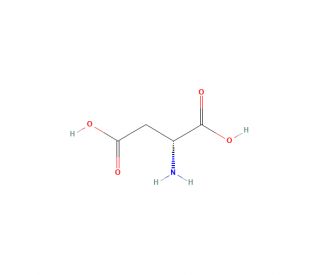

D-Aspartic acid (CAS 1783-96-6)
QUICK LINKS
D-Aspartic acid is an endogenous NMDA receptor agonist with similar activity to the L-isomer. It is also a non-metabolizable substrate for EAA uptake systems. It modulates melatonin synthesis in the pineal gland. D-Aspartic acid (D-Asp) is a naturally occurring amino acid present in the human body, as well as in other mammals, plants, and certain bacteria. Classified as a non-essential amino acid, it isn′t necessary to obtain it from the diet since the body can synthesize it from other amino acids. Within the realm of biology, D-Aspartic acid holds a role in various processes, including protein synthesis, metabolism, and neurotransmission. Moreover, it plays a part in regulating hormones, such as testosterone and growth hormone. Despite the ongoing research, the precise mechanism of action of D-Aspartic acid remains partially understood. However, it is believed to act as a neuromodulator, influencing the activity of neurotransmitters and hormones in intricate ways. Additionally, D-Aspartic acid is thought to interact with the NMDA receptor, a specific type of glutamate receptor that has implications in learning and memory, among other physiological processes.
D-Aspartic acid (CAS 1783-96-6) References
- Blood-brain barrier produces significant efflux of L-aspartic acid but not D-aspartic acid: in vivo evidence using the brain efflux index method. | Hosoya, K., et al. 1999. J Neurochem. 73: 1206-11. PMID: 10461913
- The role of D-aspartic acid and N-methyl-D-aspartic acid in the regulation of prolactin release. | D'Aniello, G., et al. 2000. Endocrinology. 141: 3862-70. PMID: 11014243
- Determination of free D-aspartic acid, D-serine and D-alanine in the brain of mutant mice lacking D-amino acid oxidase activity. | Morikawa, A., et al. 2001. J Chromatogr B Biomed Sci Appl. 757: 119-25. PMID: 11419736
- D-aspartic acid in the nervous system of Aplysia limacina: possible role in neurotransmission. | Spinelli, P., et al. 2006. J Cell Physiol. 206: 672-81. PMID: 16222705
- The role and molecular mechanism of D-aspartic acid in the release and synthesis of LH and testosterone in humans and rats. | Topo, E., et al. 2009. Reprod Biol Endocrinol. 7: 120. PMID: 19860889
- Simultaneous determination of D-aspartic acid and D-glutamic acid in rat tissues and physiological fluids using a multi-loop two-dimensional HPLC procedure. | Han, H., et al. 2011. J Chromatogr B Analyt Technol Biomed Life Sci. 879: 3196-202. PMID: 21371949
- Developmental changes in free D-aspartic acid in the chicken embryo and in the neonatal rat. | Neidle, A. and Dunlop, DS. 1990. Life Sci. 46: 1517-22. PMID: 2355797
- Improvement of post-thawed sperm quality and fertility of Arian rooster by oral administration of d-aspartic acid. | Ansari, M., et al. 2017. Theriogenology. 92: 69-74. PMID: 28237346
- D-Aspartic Acid in Vertebrate Reproduction: Animal Models and Experimental Designs‡. | Di Fiore, MM., et al. 2019. Biomolecules. 9: PMID: 31484465
- The presence of free D-aspartic acid in rodents and man. | Dunlop, DS., et al. 1986. Biochem Biophys Res Commun. 141: 27-32. PMID: 3801000
- Involvement of D-aspartic acid in the synthesis of testosterone in rat testes. | D'Aniello, A., et al. 1996. Life Sci. 59: 97-104. PMID: 8699926
- D-aspartic acid localization during postnatal development of rat adrenal gland. | Sakai, K., et al. 1997. Biochem Biophys Res Commun. 235: 433-6. PMID: 9199212
- Free D-aspartate and D-serine in the mammalian brain and periphery. | Hashimoto, A. and Oka, T. 1997. Prog Neurobiol. 52: 325-53. PMID: 9247969
- D-aspartate modulates melatonin synthesis in rat pinealocytes. | Ishio, S., et al. 1998. Neurosci Lett. 249: 143-6. PMID: 9682837
- Structure/activity relations of N-methyl-d-aspartate receptor ligands as studied by their inhibition of [3H]d2-amino-5-phosphonopentanoic acid binding in rat brain membranes | , et al. 1988. Neuroscience. 26: 17-31.
Ordering Information
| Product Name | Catalog # | UNIT | Price | Qty | FAVORITES | |
D-Aspartic acid, 1 g | sc-202562 | 1 g | $31.00 |