
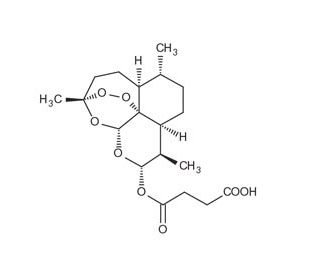

Artesunate (CAS 88495-63-0)
See product citations (5)
QUICK LINKS
Artesunate is a semi-synthetic derivative of artemisinin, a natural compound extracted from the plant Artemisia annua. It is widely studied for its potent antimalarial properties and its mechanisms of action, which involve multiple pathways. The primary mechanism of action of artesunate involves the cleavage of its endoperoxide bridge by heme or ferrous iron within the parasite, leading to the generation of reactive oxygen species (ROS). These ROS cause extensive damage to parasitic proteins, lipids, and DNA, ultimately resulting in the death of the parasite. In research, artesunate is extensively used to study its effects on Plasmodium species, the causative agents of malaria. Researchers employ artesunate to investigate the molecular mechanisms of its action, including the specific targets within the parasite and the pathways leading to cell death. It is also used in studies aimed at understanding resistance mechanisms, as some malaria parasites have developed resistance to artemisinin-based compounds. These studies focus on genetic mutations and alterations in the parasite that confer resistance and explore strategies to overcome this resistance. Furthermore, artesunate has been utilized in research beyond malaria, including its potential effects on other parasites and its antiproliferative activities in various cell lines. The compound′s ability to induce ROS and cause cellular damage makes it a valuable tool for studying oxidative stress and cell death pathways in different biological systems. Overall, artesunate′s applications in research significantly contribute to advancing our understanding of parasitic biology, resistance mechanisms, and the development of novel antimalarial strategies.
Artesunate (CAS 88495-63-0) References
- Artemisinin drugs: novel antimalarial agents. | Price, RN. 2000. Expert Opin Investig Drugs. 9: 1815-27. PMID: 11060779
- The anti-malarial artesunate is also active against cancer. | Efferth, T., et al. 2001. Int J Oncol. 18: 767-73. PMID: 11251172
- Molecular modes of action of artesunate in tumor cell lines. | Efferth, T., et al. 2003. Mol Pharmacol. 64: 382-94. PMID: 12869643
- Artesunate alleviates liver fibrosis by regulating ferroptosis signaling pathway. | Kong, Z., et al. 2019. Biomed Pharmacother. 109: 2043-2053. PMID: 30551460
- Artesunate inhibits osteoclastogenesis through the miR-503/RANK axis. | Huang, MZ., et al. 2020. Biosci Rep. 40: PMID: 32542308
- Artesunate and Dihydroartemisinin Inhibit Rabies Virus Replication. | Luo, J., et al. 2021. Virol Sin. 36: 721-729. PMID: 33661488
- Artesunate suppresses Th17 response via inhibiting IRF4-mediated glycolysis and ameliorates Sjog̈ren's syndrome. | Xiao, F., et al. 2022. Signal Transduct Target Ther. 7: 274. PMID: 36031634
- Single-cell RNA sequencing deciphers the mechanism of sepsis-induced liver injury and the therapeutic effects of artesunate. | He, XL., et al. 2023. Acta Pharmacol Sin. 44: 1801-1814. PMID: 37041228
- Artesunate protects against ocular fibrosis by suppressing fibroblast activation and inducing mitochondria-dependent ferroptosis. | Liu, J., et al. 2023. FASEB J. 37: e22954. PMID: 37159329
- Artesunate Sensitizes human hepatocellular carcinoma to sorafenib via exacerbating AFAP1L2-SRC-FUNDC1 axis-dependent mitophagy. | Ma, Z., et al. 2024. Autophagy. 20: 541-556. PMID: 37733919
Ordering Information
| Product Name | Catalog # | UNIT | Price | Qty | FAVORITES | |
Artesunate, 10 mg | sc-201329 | 10 mg | $62.00 | |||
Artesunate, 50 mg | sc-201329A | 50 mg | $288.00 |