
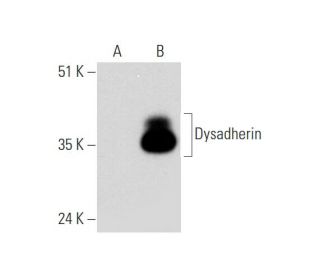

Dysadherin Antibody (A-4): sc-515271
- Dysadherin Antibody (A-4) is a mouse monoclonal IgG3 κ provided at 200 µg/ml
- specific for an epitope mapping between amino acids 30-53 within an N-terminal extracellular domain of Dysadherin of human origin
- recommended for detection of Dysadherin isoform 1 of human origin by WB, IP, IF and ELISA
- m-IgG3 BP-HRP is the preferred secondary detection reagent for Dysadherin Antibody (A-4) for WB applications. This reagent is now offered in a bundle with Dysadherin Antibody (A-4) (see ordering information below).

QUICK LINKS
SEE ALSO...
Dysadherin Antibody (A-4) is a mouse monoclonal IgG3 antibody that detects Dysadherin in human samples through applications such as western blotting (WB), immunoprecipitation (IP), immunofluorescence (IF), and enzyme-linked immunosorbent assay (ELISA). Dysadherin, also known as FXYD domain-containing ion transport regulator 5, plays a critical role in cancer biology as a cell membrane glycoprotein associated with tumor progression. Anti-Dysadherin antibody (A-4) down-regulates E-cadherin expression, which is essential for maintaining cell-cell adhesion in epithelial tissues. This down-regulation reduces intercellular adhesiveness, facilitating cancer cell metastasis to distant sites in the body. Dysadherin is predominantly located in tissues such as the spleen, lung, skeletal muscle, and testis, and maps to human chromosome 19q13.2. Dysadherin′s ability to modulate E-cadherin levels highlights its importance as a potential therapeutic target in cancer treatment, making Dysadherin (A-4) monoclonal antibody an invaluable tool for researchers studying cancer metastasis mechanisms and cell adhesion in tumor progression.
Alexa Fluor® is a trademark of Molecular Probes Inc., OR., USA
LI-COR® and Odyssey® are registered trademarks of LI-COR Biosciences
Dysadherin Antibody (A-4) References:
- Clinicopathologic significance of dysadherin expression in cutaneous malignant melanoma: immunohistochemical analysis of 115 patients. | Nishizawa, A., et al. 2005. Cancer. 103: 1693-700. PMID: 15751018
- Expression of dysadherin and E-cadherin in trophoblastic tissue in normal and abnormal pregnancies. | Batistatou, A., et al. 2007. Placenta. 28: 590-2. PMID: 17084448
- Significance of dysadherin and E-cadherin expression in differentiated-type gastric carcinoma with submucosal invasion. | Maehata, Y., et al. 2011. Hum Pathol. 42: 558-67. PMID: 21239043
- FXYD5 (dysadherin) regulates the paracellular permeability in cultured kidney collecting duct cells. | Lubarski, I., et al. 2011. Am J Physiol Renal Physiol. 301: F1270-80. PMID: 21900457
- Let-7a down-regulation plays a role in thyroid neoplasias of follicular histotype affecting cell adhesion and migration through its ability to target the FXYD5 (Dysadherin) gene. | Colamaio, M., et al. 2012. J Clin Endocrinol Metab. 97: E2168-78. PMID: 22965940
- Alterations in dysadherin expression and F-actin reorganization: a possible mechanism of hypericin-mediated photodynamic therapy in colon adenocarcinoma cells. | Kılıç Süloğlu, A., et al. 2015. Cytotechnology. 67: 311-30. PMID: 24510318
- FXYD5 (dysadherin) may mediate metastatic progression through regulation of the β-Na+-K+-ATPase subunit in the 4T1 mouse breast cancer model. | Lubarski-Gotliv, I., et al. 2017. Am J Physiol Cell Physiol. 313: C108-C117. PMID: 28515087
- A strategy for generating cancer-specific monoclonal antibodies to aberrant O-glycoproteins: identification of a novel dysadherin-Tn antibody. | Steentoft, C., et al. 2019. Glycobiology. 29: 307-319. PMID: 30726901
- FXYD5/Dysadherin, a Biomarker of Endometrial Cancer Myometrial Invasion and Aggressiveness: Its Relationship With TGF-β1 and NF-κB Pathways. | Besso, MJ., et al. 2019. Front Oncol. 9: 1306. PMID: 31867269
- Evaluation of the Effect of Foeniculum vulgare on the Expression of E-Cadherin, Dysadherin and Ki-67 in BALB/C Mice with 4T1 Model of Breast Cancer. | Mehralikhani, A., et al. 2021. Nutr Cancer. 73: 318-328. PMID: 32266842
Ordering Information
| Product Name | Catalog # | UNIT | Price | Qty | FAVORITES | |
Dysadherin Antibody (A-4) | sc-515271 | 200 µg/ml | $322.00 | |||
Dysadherin Antibody (A-4): m-IgG3 BP-HRP Bundle | sc-550531 | 200 µg Ab; 40 µg BP | $361.00 | |||
Dysadherin (A-4) Neutralizing Peptide | sc-515271 P | 100 µg/0.5 ml | $69.00 |