
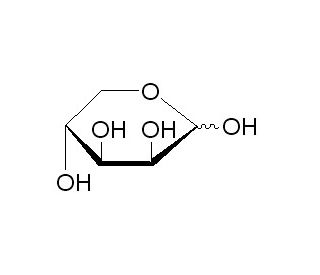

D-(-)-Lyxose (CAS 1114-34-7)
Direktverknüpfungen
D-(-)-Lyxose ist ein seltener Desoxyzucker, der in der Natur in geringen Mengen in verschiedenen Organismen vorkommt. Er gehört zur Familie der Ketopentose, einer Gruppe von Monosacchariden, die fünf Kohlenstoffatome und eine Ketongruppe enthalten. Die einzigartige Struktur dieses Zuckers, dem im Vergleich zu den Pentosezuckern ein Sauerstoffatom fehlt, macht ihn zu einem interessanten Thema für die biochemische und synthetische Forschung. In wissenschaftlichen Studien wird D-(-)-Lyxose verwendet, um die Rolle und die Stoffwechselwege von seltenen Zuckern in Organismen zu untersuchen und Einblicke in ihre biologische Bedeutung und evolutionäre Aspekte zu gewinnen. In der Forschung wird D-(-)-Lyxose bei der Synthese komplexer Kohlenhydrate und Glykokonjugate eingesetzt, da sie eine strukturelle Vielfalt in diese Moleküle einbringen kann. Dies hat Auswirkungen auf das Verständnis kohlenhydratvermittelter biologischer Erkennungs- und Signalprozesse. Darüber hinaus wird D-(-)-Lyxose im Zusammenhang mit enzymatischen Reaktionen untersucht, an denen seltene Zucker beteiligt sind, was zur Entdeckung und Entwicklung von Enzymen mit neuartigen Funktionalitäten oder Spezifitäten beiträgt. Diese Studien tragen zu einem umfassenderen Verständnis der Kohlenhydratchemie und der Enzymkatalyse bei, wobei der Schwerpunkt auf der Erforschung biochemischer Wege und molekularer Wechselwirkungen liegt, die die zellulären Funktionen und die biochemische Vielfalt bestimmen.
D-(-)-Lyxose (CAS 1114-34-7) Literaturhinweise
- Bewertung von Analytschutzmitteln zur Verbesserung der gaschromatographischen Analyse von Pestiziden. | Anastassiades, M., et al. 2003. J Chromatogr A. 1015: 163-84. PMID: 14570329
- Analyse von Zuckern in Umweltproben mittels Gaschromatographie-Massenspektrometrie. | Medeiros, PM. and Simoneit, BR. 2007. J Chromatogr A. 1141: 271-8. PMID: 17207493
- Metabolischer Fußabdruck von Lactobacillus buchneri Stamm LA1147 während des anaeroben Verderbs von fermentierten Gurken. | Johanningsmeier, SD. and McFeeters, RF. 2015. Int J Food Microbiol. 215: 40-8. PMID: 26325599
- Erkundung des chemischen Raums für Gefriertrocknungshilfsstoffe. | Meng-Lund, H., et al. 2019. Int J Pharm. 566: 254-263. PMID: 31145963
- Umwandlung von Alkoholen in Methylenacetale durch Reaktion mit Dimethylsulfoxid-Brom | Munavu, R. M. 1980. The Journal of Organic Chemistry. 45(16): 3341-3343.
- Überschussenthalpien von wässrigen Lösungen von Monosacchariden bei 298,15 K: Pentosen und 2-Desoxyzucker | Barone, G., Castronuovo, G., Doucas, D., Elia, V., & Mattia, C. A. 1983. The Journal of Physical Chemistry. 87(11): 1931-1937.
- Selektive Bindung von Zucker an β-Cyclodextrin: Ein Prototyp für Zucker-Zucker-Wechselwirkungen in Wasser | Aoyama, Y., Nagai, Y., Otsuki, J. I., Kobayashi, K., & Toi, H. 1992. Angewandte Chemie International Edition in English. 31(6): 745-747.
- Qualitative und quantitative Analyse von charakteristischen Zuckern in dreifarbigen Quinoas auf der Grundlage von ungezielter und gezielter Metabolomik | Song, J., & Peng, J. 2024. Journal of Food Composition and Analysis. 126: 105880.
- Charakterisierung der wichtigsten Aromastoffe in einem neuen Qingke-Baijiu aus Tibet mittels GC-MS, GC× GC-MS und GC-O-MS | Zhao, Y., Liao, P., Chen, L., Zhang, Y., Wang, X., Kang, Q.,.. & Sun, J. 2024. Food Chemistry Advances. 4: 100589.
Bestellinformation
| Produkt | Katalog # | EINHEIT | Preis | ANZAHL | Favoriten | |
D-(-)-Lyxose, 5 g | sc-221457 | 5 g | $65.00 |