
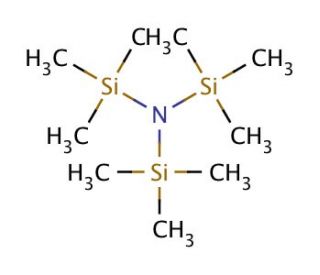

Tris(trimethylsilyl)amine (CAS 1586-73-8)
LINK RAPIDI
La Tris(trimetilsilil)ammina è una base forte, non nucleofila, utilizzata come reagente nella sintesi organica. Funziona come base di Lewis, donando prontamente la sua coppia di elettroni solitari a vari elettrofili. In questa veste, viene impiegata nella deprotonazione di composti acidi, come alcoli, fenoli e acidi carbossilici, per formare i corrispondenti alcossidi o fenossidi. Può essere utilizzato nella sintesi di composti organosiliconici, dove agisce come nucleofilo nella formazione di legami carbonio-silicio. La modalità d'azione della tris(trimetilsililil)ammina prevede la sua interazione con i protoni acidi, che porta alla formazione di intermedi stabili e carichi negativamente. Questa reattività la rende utile nella preparazione di un'ampia gamma di composti organici e organosiliconici, contribuendo all'avanzamento delle metodologie in ambito chimico e di sviluppo.
Tris(trimethylsilyl)amine (CAS 1586-73-8) Referenze
- gem-Difluoroolefinazione di chetoni diarilici e aldeidi enolizzabili con difluorometil 2-piridil solfone: nuove conoscenze sulla reazione di Julia-Kocienski. | Gao, B., et al. 2014. Chemistry. 20: 7803-10. PMID: 24807811
- Sililazione catalitica del dinitrogeno con un complesso di dicobalto. | Siedschlag, RB., et al. 2015. J Am Chem Soc. 137: 4638-41. PMID: 25799204
- Sililazione catalitica del dinitrogeno da parte di una famiglia di complessi triironici. | Ferreira, RB., et al. 2018. ACS Catal. 8: 7208-7212. PMID: 30574427
- Conversione di dinitrogeno in tris(trimetilsilil)ammina catalizzata da complessi di titanio triamido-ammina. | Ghana, P., et al. 2019. Chem Commun (Camb). 55: 3231-3234. PMID: 30806394
- Accoppiamento deprotonativo di piridine con aldeidi catalizzato da una base amidica HMDS generata in situ. | Shigeno, M., et al. 2019. Chem Pharm Bull (Tokyo). 67: 1179-1182. PMID: 31685747
- Riduzione catalitica del dinitrogeno a tris(trimetilsilil)ammina utilizzando complessi di rodio con un ligando a pinza di tipo PNP a base di pirrolo. | Kawakami, R., et al. 2019. Chem Commun (Camb). 55: 14886-14889. PMID: 31720597
- Valutazione dell'identità dello ione metallico sulla sililazione catalitica del dinitrogeno mediante una serie di complessi trimetallici. | Eaton, MC., et al. 2020. Eur J Inorg Chem. 2020: 1519-1524. PMID: 33071629
- Formazione di ammoniaca catalizzata da un complesso di dinitrogeno-bridged Dirhenium con ligandi PNP-Pincer in condizioni di reazione blande*. | Meng, F., et al. 2021. Angew Chem Int Ed Engl. 60: 13906-13912. PMID: 33835664
Informazioni ordini
| Nome del prodotto | Codice del prodotto | UNITÀ | Prezzo | Quantità | Preferiti | |
Tris(trimethylsilyl)amine, 5 g | sc-229652 | 5 g | $51.00 |