
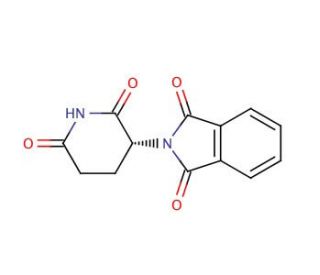

(R)-(+)-Thalidomide (CAS 2614-06-4)
Direktverknüpfungen
(R)-(+)-Thalidomid ist eines der Enantiomere von Thalidomid, einer Verbindung, die aufgrund ihrer interessanten chemischen und biologischen Eigenschaften umfassend untersucht wurde. Das (R)-Enantiomer von Thalidomid war Gegenstand umfangreicher Forschungen auf dem Gebiet der Chiralität und ihrer Auswirkungen auf die biologische Aktivität. R)-(+)-Thalidomid wurde auf seine Fähigkeit untersucht, das Immunsystem zu modulieren und die Produktion verschiedener Zytokine und Wachstumsfaktoren zu beeinflussen. Es wurde festgestellt, dass diese Verbindung selektiv die Produktion des Tumornekrosefaktors alpha (TNF-α) hemmt, eines kritischen Zytokins, das an systemischen Entzündungen beteiligt ist und ein wichtiges Ziel bei der Erforschung von Entzündungskrankheiten darstellt. Die Forscher untersuchen, wie diese Modulation erfolgt, indem sie die Bindung von (R)-(+)-Thalidomid an den Cereblon-Komplex, einen Teil des Ubiquitin-Ligase-Komplexes, untersuchen, der den Abbau bestimmter Transkriptionsfaktoren beeinflusst. Über die Immunmodulation hinaus wurde (R)-(+)-Thalidomid in der Forschung eingesetzt, um seine Auswirkungen auf zelluläre Mechanismen wie die Angiogenese zu verstehen. Die Fähigkeit des Wirkstoffs, die Bildung neuer Blutgefäße unter bestimmten Bedingungen zu hemmen, ist mit seiner Wirkung auf den vaskulären endothelialen Wachstumsfaktor (VEGF) und den basischen Fibroblasten-Wachstumsfaktor (bFGF) verbunden. (R)-(+)-Thalidomid ist auch ein wertvolles Instrument in der chiralchemischen Forschung, insbesondere bei der Untersuchung der Mechanismen hinter den unterschiedlichen biologischen Aktivitäten der Enantiomere. Es hilft zu verstehen, wie die Stereochemie eines Moleküls seine Interaktion mit verschiedenen biologischen Zielen beeinflusst.
(R)-(+)-Thalidomide (CAS 2614-06-4) Literaturhinweise
- Untersuchung der In-vitro-Biotransformation von R-(+)-Thalidomid mittels HPLC, Nano-HPLC, CEC und HPLC-APCI-MS. | Meyring, M., et al. 1999. J Chromatogr B Biomed Sci Appl. 723: 255-64. PMID: 10080653
- Modifiziertes DNA-Aptamer, das das (R)-Isomer eines Thalidomid-Derivats mit hoher Enantioselektivität bindet. | Shoji, A., et al. 2007. J Am Chem Soc. 129: 1456-64. PMID: 17263432
- Neueste Fortschritte bei der analytischen Bestimmung von Thalidomid und seinen Metaboliten. | Bosch, ME., et al. 2008. J Pharm Biomed Anal. 46: 9-17. PMID: 18023317
- Teratogene Wirkungen von Thalidomid: molekulare Mechanismen. | Ito, T., et al. 2011. Cell Mol Life Sci. 68: 1569-79. PMID: 21207098
- Enantiomerisierungsmechanismus von Thalidomid und die Rolle von Wasser und Hydroxidionen. | Tian, C., et al. 2012. Chemistry. 18: 14305-13. PMID: 23065668
- Ein Mini-Review über Thalidomid: Chemie, Wirkmechanismen, therapeutisches Potenzial und antiangiogene Eigenschaften bei Multiplem Myelom. | Mercurio, A., et al. 2017. Curr Med Chem. 24: 2736-2744. PMID: 28571559
- Ein Vergleich der teratogenen Aktivität von Thalidomid bei Kaninchen und Ratten. | Schumacher, H., et al. 1968. J Pharmacol Exp Ther. 160: 189-200. PMID: 5639104
- Thalidomid ist ein Hemmstoff der Angiogenese. | D'Amato, RJ., et al. 1994. Proc Natl Acad Sci U S A. 91: 4082-5. PMID: 7513432
- Thalidomid hemmt die Replikation des menschlichen Immunschwächevirus Typ 1. | Makonkawkeyoon, S., et al. 1993. Proc Natl Acad Sci U S A. 90: 5974-8. PMID: 8327469
Bestellinformation
| Produkt | Katalog # | EINHEIT | Preis | ANZAHL | Favoriten | |
(R)-(+)-Thalidomide, 10 mg | sc-208224 | 10 mg | $183.00 |